

…..Allocations Spark Questions
Over Roads, Schools, Hospitals
….Citizens Urged To Demand Accountability For Public Funds, Completed Projects
Daud Olatunji
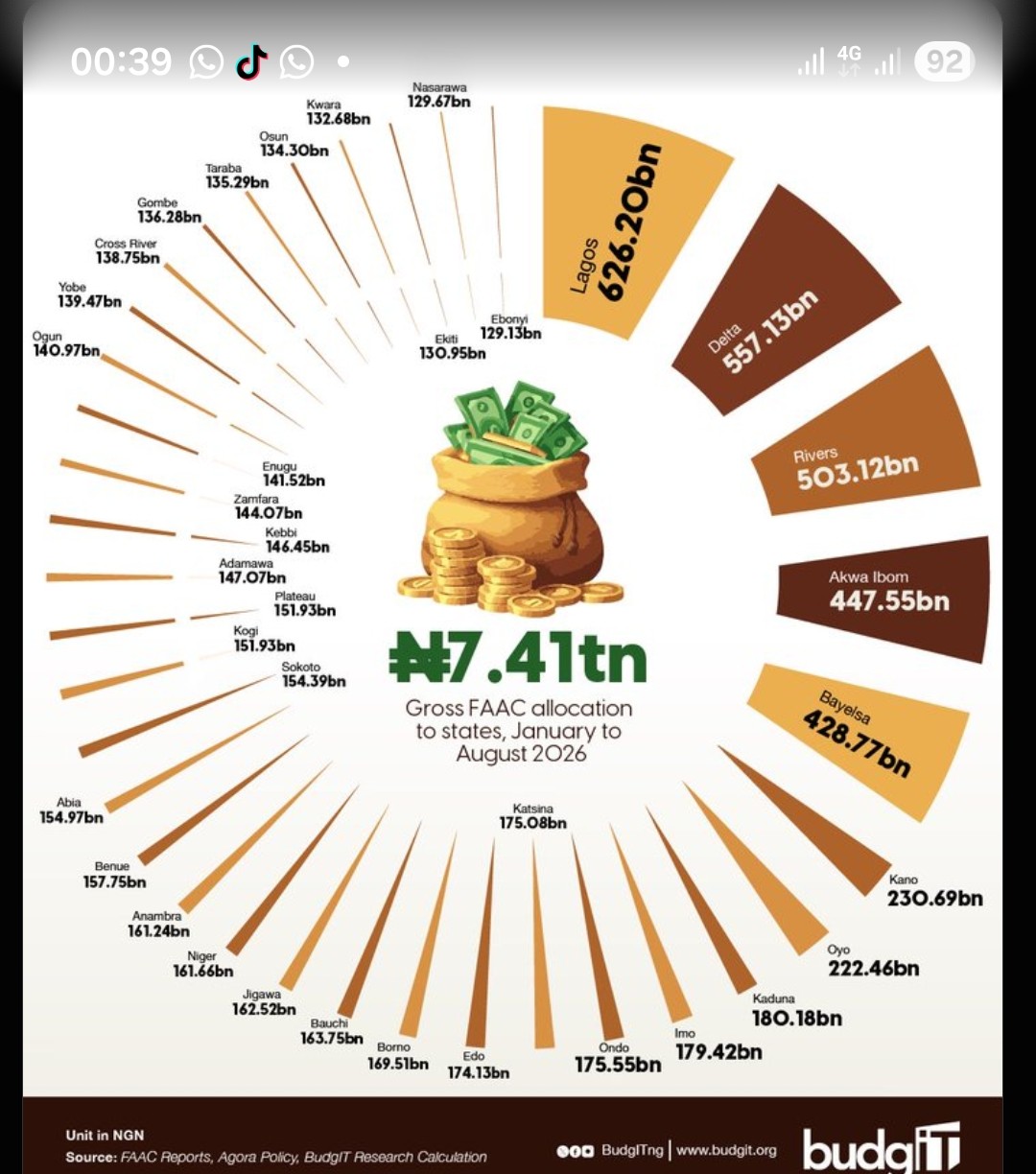
Nigeria’s 36 state governments received a combined ₦7.41tn in gross allocations from the Federation Account Allocation Committee (FAAC) between January and August 2026, with Lagos State accounting for the largest share of the reported allocations, according to data published by BudgIT.
The figures, which highlight the enormous financial resources flowing to state governments, have renewed calls for greater transparency and accountability in the management of public funds, particularly regarding infrastructure, education and healthcare delivery.
The data showed that Lagos received ₦626.20bn during the eight-month period, followed by Delta State with ₦557.13bn and Rivers State with ₦503.12bn.
Akwa Ibom received ₦447.55bn, while Bayelsa State collected ₦428.77bn, placing the five states among the largest recipients of the reported allocations.
At the other end of the table, Ebonyi State received ₦129.13bn, while Nasarawa and Kwara received ₦129.67bn and ₦132.68bn, respectively.
The figures have drawn attention to the responsibility of state governments to demonstrate how allocations from the federation account translate into tangible improvements in the lives of residents.
Where the money went
According to the BudgIT graphic, several other states received substantial allocations during the period.
Kano State received ₦230.69bn, while Oyo collected ₦222.46bn. Kaduna received ₦180.18bn, Imo ₦179.42bn and Ondo ₦175.55bn.
Edo State received ₦174.13bn, Borno ₦169.51bn, Bauchi ₦163.75bn and Jigawa ₦162.52bn.
Niger State received ₦161.66bn, Anambra ₦161.24bn and Benue ₦157.75bn, while Abia collected ₦154.97bn.
Sokoto received ₦154.39bn, Kogi ₦151.93bn, Plateau ₦151.93bn and Adamawa ₦147.07bn.
Kebbi State received ₦146.45bn, Zamfara ₦144.07bn, Enugu ₦141.52bn and Ogun ₦140.97bn.
Yobe received ₦139.47bn, Cross River ₦138.75bn, Gombe ₦136.28bn and Taraba ₦135.29bn.
Osun collected ₦134.30bn, Ekiti ₦130.95bn, while Ebonyi received ₦129.13bn.
The graphic listed Katsina State’s allocation at ₦175.08bn.
The figures represent gross allocations as presented in the BudgIT graphic and should not, without further breakdown, be interpreted as the total amount available for discretionary spending by each state government.
..Allocations raise accountability questions
Although monthly FAAC allocations provide a significant source of revenue for state governments, the amount received by a state does not, by itself, establish how much was spent on public services or whether the expenditure produced measurable results.
State governments are responsible for managing their budgets and implementing projects within their respective jurisdictions, while state houses of assembly exercise legislative oversight, including scrutiny of budgets and public expenditure.
The size of the allocations therefore raises important questions about the relationship between public revenue and the quality of essential services available to residents.
For instance, residents can reasonably demand explanations about the condition of roads, the availability of equipment and medicines in public hospitals, the state of public schools, and the provision of water and other basic amenities.
However, determining whether a government has managed its revenue effectively requires more than examining its FAAC receipts. A proper assessment would also consider internally generated revenue, statutory obligations, debt servicing, personnel costs, capital expenditure and the projects completed during the period.
Revenue figures are not proof of performance
The allocations also highlight the need to distinguish between the amount of money received by a state and the results achieved with that money.
A state receiving a larger allocation does not automatically mean it has performed better or worse than another state. Differences in population, revenue entitlements, derivation, expenditure commitments and other fiscal factors can affect the resources available to each government.
Similarly, a state’s receipt of a smaller allocation does not, on its own, establish that its government has failed to deliver public services.
To determine whether public funds are producing results, residents and accountability organisations need access to detailed budget implementation reports, audited financial statements, procurement records and information on completed projects.
Such information would make it easier to compare what governments promised in their budgets with what they actually delivered.
Citizens urged to demand value for money
The BudgIT figures underscore the importance of extending public scrutiny beyond the Federal Government to state administrations, where many essential services and infrastructure projects directly affect residents.
PLATFORM TIMES reports that while federal spending and national revenue distribution often dominate public debate, state-level financial accountability remains crucial to understanding how public resources are translated into development.
 '
 '
Do you want to share a story with us? Do you want to advertise with us? Do you need publicity for a product, service, or event? Contact us on WhatsApp +2348183319097 Email: platformtimes@gmail.com
We are committed to impactful investigative journalism for human interest and social justice. Your donation will help us tell more stories. Kindly donate any amount HERE
 '
