

…Paediatricians Urge Funding Boost
…Preventable Diseases Driving Deaths
…Vaccines, Malnutrition Worsen Crisis
Daud Olatunji
The Paediatric Association of Nigeria (PAN) has raised fresh concerns over Nigeria’s worsening child health indicators, warning that vaccine-preventable diseases, malnutrition and rising newborn deaths continue to claim thousands of young lives daily.
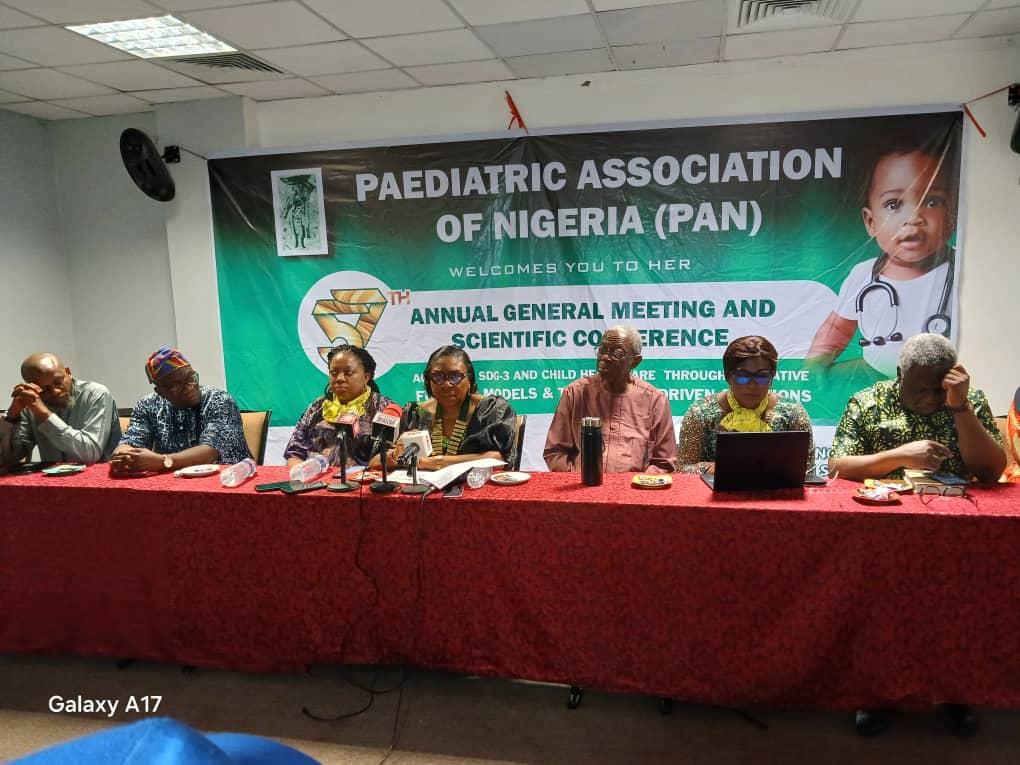
Speaking at a press conference in Abeokuta, Ogun State, ahead of the 57th Annual General Meeting and Scientific Conference of the association, PAN President, Dr Ekanem Ekure, disclosed that more than 800 Nigerian families lose a newborn every day, despite the fact that most of the deaths are preventable.
Ekure said Nigeria remained off track in achieving Sustainable Development Goal 3 (SDG-3), particularly in the areas of neonatal and under-five survival, describing the situation as a national emergency requiring urgent political, financial and technological intervention.
“Our most recent national surveys show that neonatal mortality has not declined; instead, it has steadily increased. Children who survive the newborn period are still dying from malaria, pneumonia and diarrhoea — diseases the world already knows how to prevent and treat,” she said.
According to her, about 50 per cent of child deaths in Nigeria are worsened by malnutrition, noting that poorly nourished children are far more likely to die from infections than healthy ones.
Ekure blamed vaccine hesitancy, misinformation, poverty, insecurity and weak health financing for Nigeria’s high burden of preventable child deaths, warning that the resurgence of diseases such as measles in some parts of the country mirrored global trends where immunisation rates have fallen.
“Vaccines save lives. They have saved millions of lives globally and continue to do so. In my hospital, for over 10 years, none of my students has seen a case of measles on the wards. Yet in other parts of Nigeria, we still record outbreaks.
The difference is immunisation,” she said.
She acknowledged that vaccines, like other medicines, may have mild side effects such as fever or pain at injection sites, but stressed that Nigeria had strong surveillance systems to track adverse events, including a reporting platform provided by NAFDAC.
“Public health decisions are based on overwhelming benefits against negligible risks. We cannot abandon life-saving vaccines because of misinformation,” Ekure added.
The PAN president also urged the media to play a more active role in combating false narratives about immunisation, describing journalists as critical partners in safeguarding children’s lives.
Addressing malnutrition and food insecurity, Ekure advised parents to prioritise exclusive breastfeeding for the first six months of life and embrace locally sourced foods rather than relying on expensive processed alternatives.
“Breastfeeding is the foundation of child nutrition. Babies need nothing else for the first six months. We also have rich local foods across Nigeria. Let us cook what we grow. Home gardening can make a real difference,” she said.
She further called for increased investment in local vaccine production, warning that Nigeria’s dependence on donor-supported vaccines through agencies such as Gavi was unsustainable in the long term.
“There is a timeline when these partners will pull out. How prepared are we? Local vaccine production will reduce costs, create jobs, strengthen our economy and secure our children’s future,” she said.
Ekure said these challenges formed the core focus of PAN’s 57th Annual General Meeting and Scientific Conference, tagged PANConf Gateway 2026, scheduled to hold in Abeokuta from January 21 to 23, 2026.
The conference theme, “Achieving SDG-3 and Child Health Care through Innovative Funding Models and Technology-Driven Solutions,” will bring together paediatricians, policymakers, researchers, development partners, media professionals and technology innovators to develop practical solutions to Nigeria’s child health crisis.
Sub-themes include sustainable child health financing, artificial intelligence and digital health solutions, emerging and re-emerging infectious diseases, local vaccine manufacturing and the role of the media in advancing child survival.
Ekure said PAN had, over the last two years, strengthened governance structures, expanded partnerships and intensified advocacy, including training immunisation champions across the country to counter vaccine misinformation and boost coverage.
However, she warned that professional excellence alone was insufficient without strong political commitment and sustainable financing.
“The future of Nigeria is inseparable from the health of its children. This conference is not just another meeting; it is a call for accelerated action, smarter financing and innovative solutions to ensure that no Nigerian child is left behind,” she said.
She urged governments at all levels to prioritise child-focused programmes, called on the private sector and development partners to invest in accountable child health initiatives, and tasked the media with sustaining evidence-based reporting on child survival and wellbeing.
The conference is expected to attract leading experts in child health, public policy and development from across Nigeria and beyond.
 '
' '
'Do you want to share a story with us? Do you want to advertise with us? Do you need publicity for a product, service, or event? Contact us on WhatsApp +2348183319097 Email: platformtimes@gmail.com
We are committed to impactful investigative journalism for human interest and social justice. Your donation will help us tell more stories. Kindly donate any amount HERE
