

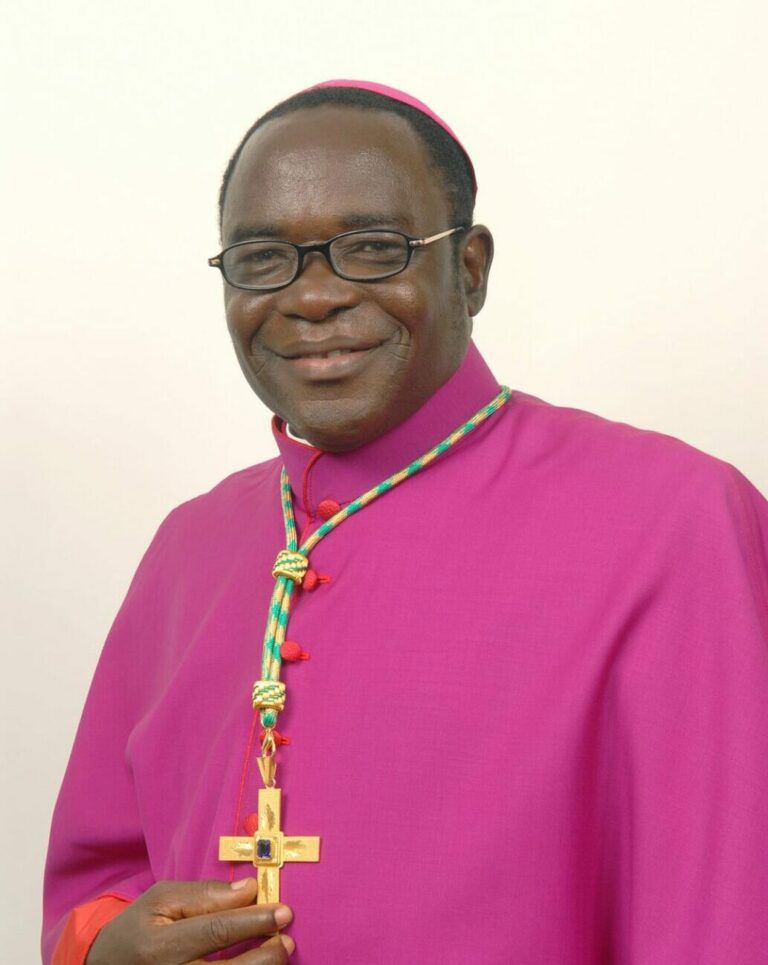
The Catholic Bishop of Sokoto Diocese, Most Rev. Matthew Hassan Kukah, has warned that Nigeria is sinking deeper into a cycle of violence, denial and systemic hypocrisy, describing the country’s worsening insecurity as a “theatre of lies” sustained by broken trust between citizens and the state.
Speaking during an interview on Frontline, a current affairs programme on Eagle 102.5 FM, Ilese-Ijebu, on Friday, the cleric said Nigeria’s crisis was not rooted in religion but in governance failure, moral collapse and elite compromise, which have normalised what he called the nation’s “collective humiliation”.
Kukah said, “Religion comes before politics. The pulpit comes before the political podium.
“The problem is not religion interfering in politics, but politicians disobeying what they hear in churches and mosques.
“Wherever you see conflict, it is a conflict between obedience and disobedience.”
The bishop recalled that his doctoral research, later published as Religion, Politics and Power in Northern Nigeria, had long warned about the dangerous intersection of faith and governance, stressing that places of worship were meant to serve as “filling stations” for moral values rather than tools for political manipulation.
Reacting to reports of the abduction of over 170 worshippers in Kaduna State , initially denied by security agencies before later confirmation, Kukah said the episode exposed a collapsing crisis management system and a deep credibility deficit in government.
“Something happened. People were abducted in a church. Government preferred denial. The church insisted it happened. That triangle of lies and truth explains why Nigeria is where it is,” he said.
He criticised security agencies for suppressing bad news in the name of image management, warning that denial only deepens public distrust.
“You cannot be embarrassed about the injury or death of Nigerian citizens. Covering wounds does not heal them. It only shows in the way you walk,” he added.
The cleric dismissed official claims of “kinetic and non-kinetic strategies” as empty jargon, noting that kidnappings and mass abductions had continued unchecked.
“How do you move 170 adults in Nigeria today and say you are looking for them? In the Arizona desert, a rat cannot move without being detected,” Kukah said, describing Nigeria’s situation as globally disgraceful.
He lamented that mass abductions had become routine, with communities celebrating rescued victims today only to brace for the next tragedy tomorrow.
“This theatre would have been amusing if it weren’t about life and death. It is shameful, disgraceful and embarrassing. No Nigerian, whether in office or out of office, can excuse this collective humiliation,” he said.
Kukah also faulted reports that the Katsina State Government approved the release of suspected bandits as part of a peace initiative, warning that Nigeria had developed a dangerous culture of rewarding criminality.
“This is a country that has become used to rewarding malfeasance. It shows in appointments, elections and now in security,” he said.
He criticised what he described as fragmented and incoherent security responses across states, insisting that there was no unified national architecture.
“Rivers cannot be doing one thing and Yobe another. Whatever states are doing must fit into a national framework. That is not happening,” he said.
The bishop also questioned Nigeria’s deradicalisation programmes, noting that many repentant fighters were returned to communities that rejected them, thereby fuelling further instability.
“You cannot pour new wine into old wineskins,” he said, warning that violence had become a pathway to wealth.
“Boys of yesterday are now multi-billionaires. The message is clear: if you fight long enough, you will be rewarded.”
On claims of Christian genocide, Kukah rejected the fixation on labels, insisting that the debate over terminology distracted from the real tragedy.
“I am not interested in definitions. Whether you call it genocide, persecution or mass atrocities, Nigerians are dying. That is what must stop,” he said.
He aligned with the position of the Vatican and the Catholic Bishops’ Conference of Nigeria that security must be framed as a national, not religious, issue.
“I do not want Christians to stop dying while others are dying. Nobody should die because of their religion,” he said.
Kukah warned that deepening Christian–Muslim binaries could trap Nigeria in an irreversible identity crisis.
“We are not the only country with Christians and Muslims. Why is it only Nigeria that functions like this?” he asked.
Referencing Rwanda’s post-genocide recovery, Kukah highlighted President Paul Kagame’s abolition of ethnic labels as a key lesson for Nigeria.
“Kagame said: no more Hutu, no more Tutsi. We are all Rwandans,” he said, accusing Nigeria’s elites of weaponising identity whenever it suited their interests.
“When they are stealing money in Abuja, they are not Christians or Muslims. They are just thieves,” he added.
The bishop said Nigeria must abandon expectations of external salvation.
“I am not interested in America rescuing Christians. I am interested in restoring peace in Nigeria,” he said.
Airstrikes, compromise and northern Nigeria
Kukah also rejected unverified narratives surrounding disputed airstrikes in Sokoto State, warning that emotionally driven reporting could further inflame tensions.
“I am not saying something happened or didn’t happen. But have we seen the strike? Have we seen the bodies?” he asked, stressing that journalism must be grounded in evidence.
According to him, Nigeria’s greatest security challenge was not lack of firepower or intelligence but systemic compromise involving political elites, security agencies, traditional institutions and even religious leaders.
“Our problem is not lack of capacity. Our problem is serious compromise. Some of these people are wearing uniforms. Some are sitting in high places. They are sponsoring this evil, and they can be fished out, no matter the position they hold,” he said.
The cleric described Northern Nigeria as the epicentre of the country’s security crisis, urging residents to confront uncomfortable truths.
“We must accept that the north is the crime scene. These are our children. They have fathers, mothers, uncles. They are among us,” Kukah said.
“Nigeria has become a slaughterhouse, and we are deceiving ourselves if we think this is happening everywhere else.”
Insecurity not about religion
Kukah dismissed attempts to frame banditry and kidnapping solely in religious terms, arguing that insecurity was driven by poverty, illiteracy, governance failure and elite manipulation.
“Religion can no longer be the basis for building a nation that is collapsing before our eyes. No kingdom will survive in this world based on religion or ethnicity,” he said.
He warned that privileging one religion or region created fertile ground for extremism.
“That is how Boko Haram was fuelled — not by sermons, but by power imbalance,” he said.
Muslim–Muslim ticket, governance failures
On Muslim-Muslim presidential ticket, Kukah said symbolic balance alone could not rescue the country, insisting that competence and character must trump identity.
“Balance of what? We are balancing corruption. What we need is balance of justice, fairness and equity,” he said.
While acknowledging concerns raised by Christians, he noted that religious identity had not prevented engagement under the current administration.
“Christians did not take to the streets. And in fairness, hands of friendship have been extended,” he said.
On governance, Kukah said democracy was being weakened by poor communication and lack of measurable impact, particularly after the removal of fuel subsidy.
“People were told the journey would be hard, but nobody explained the road map. There was food in the market, but no money in people’s pockets,” he said.
“The basket is full, but the people are not eating. Water, water everywhere, but not a drop to drink.”
Rule of law, not sermons
The bishop defended the presence of politicians in churches but rejected the use of pulpits as campaign platforms, noting that the Catholic Church prohibited political endorsements from the altar.
“Once you enter the house of God, you enter as a sinner looking for mercy. God does not have governors or presidents,” he said.
On rebuilding trust, Kukah said Nigeria relied too heavily on moral preaching instead of law enforcement.
“We substitute moral exhortation for law. The church cannot do the work of the police or the judiciary,” he said.
According to him, Nigeria’s crisis persisted because laws were rarely enforced.
“Here, you can break the law and nothing happens. We live under the rule of men, not the rule of law. In societies governed by law, you don’t break the law — the law breaks you,” he said.
‘Foreign powers won’t save Nigeria’
Kukah also dismissed expectations that foreign powers, particularly the United States, would resolve Nigeria’s internal problems.
“America has no agenda to save Nigeria. They have their own interests. No country comes into your house and leaves without kicking something,” he said.
He warned against what he called a “crusader mentality” that imagines foreign intervention as a solution to Nigeria’s security crisis.
“Christians will not live on another planet. This is our country, and we must fix it,” he said.
Urging Nigerians not to surrender to despair, Kukah called for sustained civic engagement and accountability.
“Justice is not given. Justice is fought for. No Nigerian is too small to seek justice. Don’t give up, no matter how toxic the environment,” he said.
 '
' '
'Do you want to share a story with us? Do you want to advertise with us? Do you need publicity for a product, service, or event? Contact us on WhatsApp +2348183319097 Email: platformtimes@gmail.com
We are committed to impactful investigative journalism for human interest and social justice. Your donation will help us tell more stories. Kindly donate any amount HERE
