

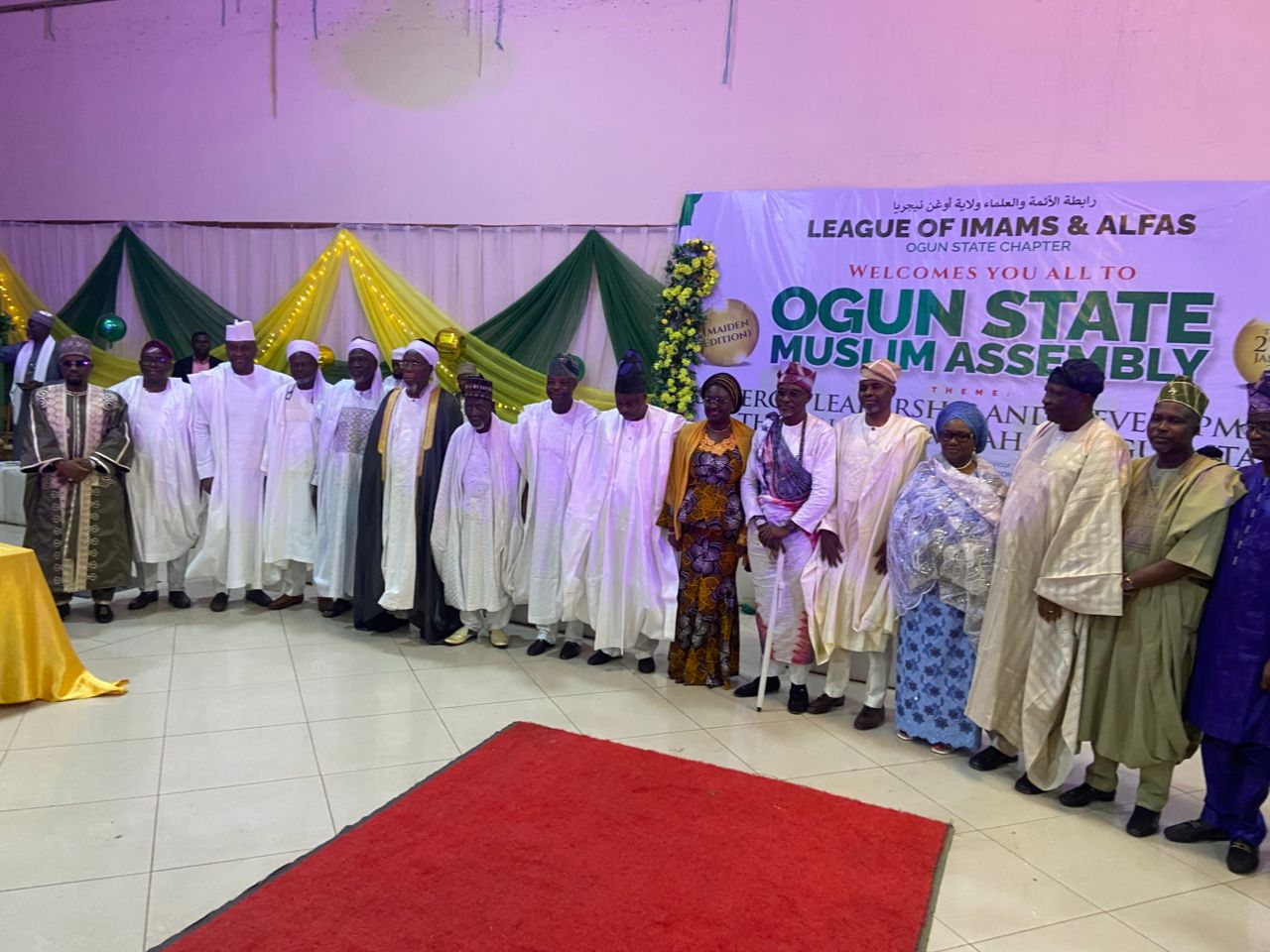
Ogun State Muslims on Tuesday convened their first-ever General Assembly in Abeokuta, marking a major push to heal divisions within the Ummah and reposition Islamic institutions for unity, social relevance and sustainable development.
The high-level gathering, organised by the League of Imams and Alfas, Ogun State, and powered by the Council of Muslim Titled Chiefs (COMTIC), drew over 500 clerics, scholars, traditional rulers, politicians and community leaders under the theme, “Synergy, Leadership and Development in the Muslim Ummah of Ogun State.”
Speaking through his representative, former Dean, Faculty of Arts, University of Ibadan, Prof. Abdulafeez Oladosu, the Registrar of the Joint Admissions and Matriculation Board (JAMB), Prof. Ishaq Oloyede, decried persistent disunity among Imams in the state, warning that internal fragmentation had weakened the collective impact of Muslims.
“Why are Imams in Ogun State not united?” Oladosu asked rhetorically, urging Islamic leaders to embrace renewed cohesion and praying that the assembly would herald a new era of greatness for the Ummah.
The event served as a platform for deep introspection on challenges confronting Muslims in Ogun, including weak institutions, economic marginalisation, declining social influence and leadership gaps.
Declaring the assembly open, Deputy Governor of Ogun State, Engr. Noimot Salako-Oyedele, called for inclusive leadership and stronger community ownership, stressing that spiritual authority alone could not deliver development without structured organisation and collective participation.
“You may have a brilliant business idea, but without customers, that business will not grow. Likewise, a political party may have strong ideas, but without followers, it cannot win elections,” she said, extending the analogy to religious leadership.
She cited century-old religious organisations in Nigeria that combined scholarship with strong lay participation to build schools, universities, pilgrimage boards, zakat foundations and welfare institutions.
“When engagement is limited to Friday prayers and ceremonial occasions, when leaders speak to people rather than with them, a dangerous gap develops,” Salako-Oyedele warned.
She recalled attending the foundation-laying ceremony of the League of Imams’ secretariat five years ago, lamenting that the project had stalled due to weak community ownership, which she contrasted with the rapid development of Covenant University driven by inclusive mobilisation.
“This is not about competition between the Ulama and the lay members of the community. Each of us has a role to play,” she said, adding that governments respond more to organised constituencies than isolated voices.
“What we need is true synergy, leadership that speaks for the Ummah, not just to government; leadership that builds institutions, not personal influence,” she said.
Former Ogun State Governor, Senator Ibikunle Amosun, who served as Father of the Day, described the assembly as timely, saying divisions within Islam had weakened collective influence and distorted public perception of the Ummah.
“Over time, the practice and propagation of Islam have faced challenges, including differences among Islamic organisations and variations in Qur’anic interpretation arising from sectarian divisions,” Amosun said.
“These differences have sometimes led to disunity and conflicting teachings, portraying the Muslim Ummah as fragmented rather than united.”
He urged Muslims to prioritise their faith over affiliations and to anchor their actions in Qur’anic wisdom and shared understanding.
“When the Muslim Ummah works in synergy , united in teachings and collective purpose ,we are better positioned to raise leaders who will uphold Islamic values and promote peaceful coexistence, social harmony and socio-economic development,” he said.
Earlier, the Secretary General of the League of Imams and Alfas (Rabita), Ogun State, Sheikh Imam Tajudeen Adewunmi, said the assembly was convened in response to harsh realities facing Muslims, including challenges in education, healthcare, economic empowerment, social justice and socio-political integration.
“This Assembly is a deliberate effort to provide a structured platform for reflection on our collective journey, honest engagement on our challenges, and thoughtful consideration of pathways for unity, leadership renewal and sustainable development,” Adewunmi said.
He noted that the diversity of participants — clerics, academics, politicians and community leaders — underscored the belief that meaningful progress could only emerge from broad consultation and shared responsibility.
Adewunmi commended Governor Dapo Abiodun’s administration for sustaining engagement with religious bodies and promoting peaceful coexistence, while also praising the Federal Government for resolving long-standing disputes with the Academic Staff Union of Universities (ASUU), which he said reaffirmed the centrality of education to national development.
He also lauded COMTIC for conceiving and sponsoring the assembly, praying for divine reward for its members.
“This Assembly belongs to all of us. Its success will not be measured only by the quality of today’s discussions, but by the understanding, cooperation and purposeful actions that follow,” he said.
Also corroborating, the Baba Adeen of Yorubaland and former Nigerian High Commissioner to the UK, Ambassador Sarafa Isola, urged religious groups particularly Muslim to be more in harmony, adding that it will enable them to tolerate and be unity among people.
“The more united the people are, the better for society. That is one of the objectives here. We will pray together, the essence of the gathering here is unity among the Muslims.
In his keynote address, Emeritus Prof. Kamaldeen Balogun, Chief Imam of Gbagura-land and Mufti of Egba-land, delivered a sweeping diagnosis of the Muslim Ummah’s challenges in Ogun State, tracing them to internal negligence, fragmentation, education and welfare gaps, economic marginalisation, justice disengagement and leadership deficits marked by intergenerational disconnects.
Quoting novelist Chinua Achebe on the power of togetherness, Balogun contextualised Ogun’s diversity — Egba, Ijebu, Yewa/Awori and Remo — and Islam’s historical integration into the region through trade, scholarship and communal living.
He cited Qur’anic verses such as 13:11 on self-change, 3:105 against division and 4:135 on justice, stressing that renewal must begin from within.
“The problems we face are neither inevitable nor insoluble,” Balogun said. “But they require us to move from reaction to structured planning.”
He proposed institutionalising synergy through a standing consultative platform; developing a time-bound Muslim Development Blueprint; strengthening education through zakat and waqf; mobilising economic cooperatives; promoting inclusive leadership with youth and women participation; engaging government strategically; and embedding accountability in Muslim institutions.
He positioned the League of Imams and COMTIC as natural conveners and harmonisers for collective work and advocacy.
Prof. Oladosu, representing Prof. Oloyede, reinforced the urgency of unity by questioning why Ogun Imams remained divided and why society increasingly gravitated toward what God forbids, praying that the assembly would inaugurate a new era of greatness for the Ummah.
Senator Shuaib Salis also spoke in support of unity and collective action, aligning with the assembly’s central message.
Other dignitaries at the event included former UK Ambassador and Baba Adinni of Yoruba, Edo and Delta States, Sharafadeen Tunji Ishola; former Deputy Governor and Iya Adinni of Ogun State, Alhaja Salmot Badru; the Olowu of Owu Kingdom, Oba Prof. Saka Matemilola; Alh. Engr. Abdulhakeem Bisiriyu, representing the Commissioner for Education; regional Chief Imams; representatives of the League of Imams and Alfas in Yorubaland; members of the Supreme Council for Islamic Affairs; academics and media practitioners.
PLATFORM TIMES reports that the assembly, the first of its kind in Ogun State is widely seen as a potential turning point for the Muslim community, with leaders expressing optimism that the strong calls for unity, inclusive leadership and institutional rebuilding would translate into concrete actions capable of repositioning the Ummah for greater social relevance and sustainable development.
 '
' '
'Do you want to share a story with us? Do you want to advertise with us? Do you need publicity for a product, service, or event? Contact us on WhatsApp +2348183319097 Email: platformtimes@gmail.com
We are committed to impactful investigative journalism for human interest and social justice. Your donation will help us tell more stories. Kindly donate any amount HERE
