

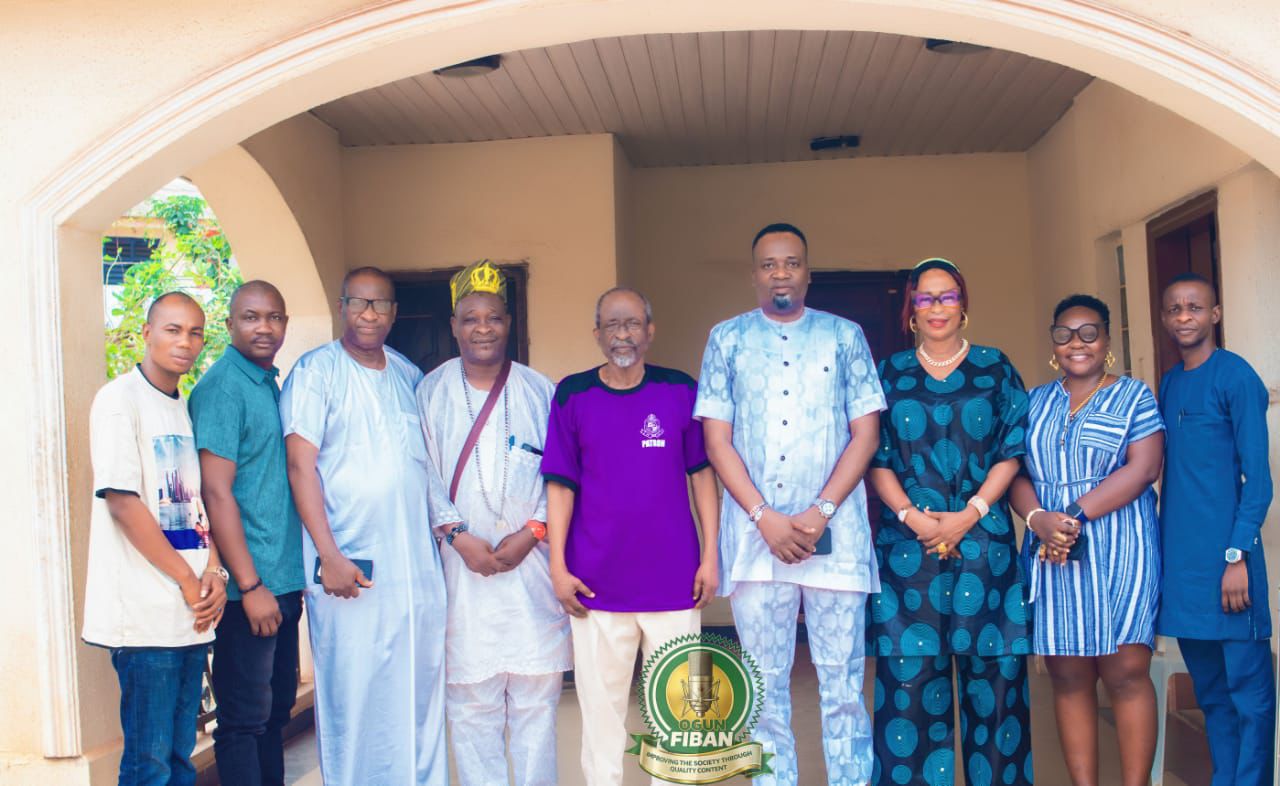
The Apena of Egbaland, Chief Suarau Olayiwola Alani Bankole, has dismissed widespread claims that the Ogboni institution is an occult society, explaining that it is historically a traditional council of elders responsible for governance in the Yoruba traditional administrative system.
Chief Bankole, who is also the Grand Patron of the Ogun State chapter of the Freelance and Independent Broadcasters’ Association of Nigeria, made the clarification on Monday while receiving the newly inaugurated executive committee of Ogun FIBAN at his Onikolobo residence in Abeokuta.
According to him, the misconception surrounding the Ogboni institution stems from years of misinterpretation of the Yoruba word “Ogboni,” which he said originally refers to a respected assembly of elders saddled with advisory and administrative responsibilities within the traditional governance structure.
He noted that long before the advent of British colonial administration, Egba communities had well-structured indigenous systems that effectively governed society, with the Ogboni institution playing a critical role in decision-making and the maintenance of order.
“The Ogboni were simply elders who played advisory and administrative roles in society. Their activities were not secretive and had nothing to do with occult practices,” Bankole said.
The Egba chief traced the origin of the widespread misunderstanding to the return of freed slaves from Sierra Leone, popularly known as the Saros, many of whom returned as Christian converts and sought influence within the traditional administrative system.
He explained that the difficulty they faced integrating into the established governance structure eventually led to the emergence of separate fraternities modeled after the traditional Ogboni framework, which later contributed to the
misconception that the institution was occultic.
Bankole added that Muslims in Egbaland, who had practised Islam in the region long before the arrival of Christianity, initially distanced themselves from the Ogboni council due to the belief that it was associated with occultism.
This development, he said, inadvertently left the administration of many communities largely in the hands of Christian leaders at the time.
Clarifying further, the traditional ruler explained that two different forms of Ogboni now exist across Yorubaland.
According to him, the first is the traditional council of elders drawn from various communities to participate in the administrative council of the land, while the second is a fraternity-based association that operates independently of the traditional governance structure.
He added that both groups could be distinguished through their mode of dressing, particularly the placement of the traditional insignia known as “Saki.”
Members of the traditional Ogboni council, he explained, wear the insignia on the right shoulder, while those belonging to the fraternity place theirs on the left.
Bankole disclosed that Muslims eventually began to participate in the traditional Ogboni council, noting that he personally broke the long-standing barrier when he accepted the position of Oluwo of Iporo following the death of Chief Toye Coker, a prominent Christian leader and Baba Ijo.
“If a Baba Ijo could serve as an Oluwo, there should be nothing preventing a Baba Mosalasi from taking such a position. We all have roles to play in the decision-making structures of our towns and communities,” he said.
The Apena of Egbaland further maintained that none of the Ogboni houses in Egbaland holds secret meetings or engages in occult practices, stressing that the institution remains an integral component of the Yoruba traditional governance system.
He also urged members of FIBAN to combine faith with diligence in their professional pursuits, noting that prayer must be supported by hard work.
Drawing from religious history, he said Prophet Isa (Jesus Christ) worked as a fisherman, while Prophet Muhammad was known to have worked as a herder before his prophetic mission.
Earlier in his remarks, the Chairman of Ogun FIBAN, Chief Olalekan Shoyinka, also known as Ayinla Egba, appreciated Bankole for his consistent fatherly support to the association over the years.
Shoyinka particularly acknowledged the elder statesman’s moral and financial contributions to the growth and stability of the organisation, praying for his continued good health and longevity.
Also speaking, the Secretary of the FIBAN National Transition Committee, Alhaji Gbenga Adebayo-Oladunni, described Bankole as a pillar of support for the association and its members.
Other members of the Ogun FIBAN delegation present during the visit included Alhaji Kola Popoola, Mrs Kikelomo Ogunsina-Obabi, the State General Secretary, Comrade Moses Okunlola; State Treasurer, Comrade Abolanle Oluwatoyin Asakpa; State Publicity Secretary, Comrade Olusoji Emmanuel Akindiya; and Comrade Tolulope Ezekiel Obadare.
 '
' '
'Do you want to share a story with us? Do you want to advertise with us? Do you need publicity for a product, service, or event? Contact us on WhatsApp +2348183319097 Email: platformtimes@gmail.com
We are committed to impactful investigative journalism for human interest and social justice. Your donation will help us tell more stories. Kindly donate any amount HERE
