
President Bola Ahmed Tinubu has urged Nigerian media organisations to intensify scrutiny of state governments and local councils, stressing that subnational authorities now enjoy greater financial autonomy and must be held accountable for how they utilise public funds.
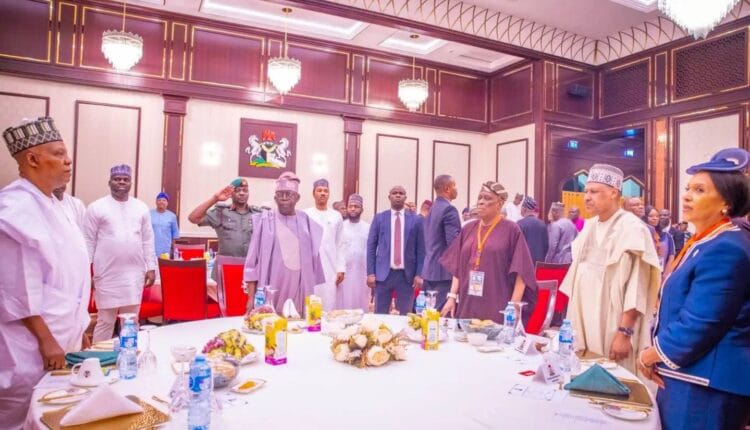
Tinubu made the call on Friday while hosting leaders of the Nigerian media industry at a dinner at the Aso Rock Presidential Villa, Abuja.
The gathering was attended by the leadership of the Nigerian Press Organisation, including the Newspaper Proprietors’ Association of Nigeria, the Broadcasting Organisations of Nigeria, the Nigerian Guild of Editors, and the Nigeria Union of Journalists.
The President said while his administration had continued to face intense scrutiny from the media, similar attention should also be directed at governors and local government officials.
“We’ve opened up the principle of federalism to the extent that local governments are now getting their money,” Tinubu said.
“But how they use it is in your hands, so don’t bombard me alone. Look at the local governments too and equally the sub-national.”
Tinubu noted that reforms introduced by his administration had strengthened the financial position of many states, claiming that none currently relied on borrowing to pay workers’ salaries.
“Today, there is no state that is borrowing to pay the salaries of employees,” he said.
Many states had previously struggled to meet wage obligations, particularly during periods of declining oil revenues, often depending on Federal Government bailouts.
The President attributed improved fiscal conditions to increased revenue allocations, higher crude oil production and enhanced tax collection by the Federal Inland Revenue Service.
He also referenced the Supreme Court of Nigeria judgment delivered in July 2024 which granted financial autonomy to local governments and mandated direct payment of allocations to the councils.
Tinubu further thanked media proprietors for what he described as constructive criticism of his administration, noting that such feedback had challenged him to perform better.
“You didn’t spare me, but you challenged me and provoked that intellectual curiosity of a leader that must perform,” he said.
The President disclosed that reading newspapers daily had become a personal routine.
“There is no morning that I leave my house without going through the newspapers. It’s an addiction. I read all of you, maybe not in full detail, but the headlines,” he added.
Reflecting on the early days of his administration, Tinubu admitted he initially reacted strongly to criticisms from commentators and opinion leaders.
“I was a little stubborn at the beginning of this administration because the hits were coming from the papers and various opinion leaders,” he said.
The President, however, defended some of his administration’s major economic decisions, particularly the removal of petrol subsidy shortly after assuming office in May 2023.
According to him, the move was necessary to prevent the country from sliding into financial collapse.
“At the time, we had to confront the subsidy. Nigeria was on the edge of bankruptcy,” he said, adding that the reforms had helped pull the nation back from economic distress.
He maintained that improvements had since been recorded in foreign exchange management and inflation control.
Speaking on the challenges facing the media industry, Tinubu acknowledged the difficult operating environment confronting news organisations, especially in sourcing funds amid economic pressures.
“I know you are challenged. It is very tough out there. Source and application of funds is almost impossible to acquire in a time of challenges,” he said.
The President also disclosed that issues relating to tariffs affecting the media sector had been discussed earlier and assured stakeholders that the government would review the concerns raised.
Earlier, the President of the Nigerian Press Organisation and publisher of BusinessDay, Mr Frank Aigbogun, urged the Federal Government to protect Nigerian journalism jobs from the growing influence of global technology companies that utilise newsroom content without adequate compensation.
He also appealed for reduced import tariffs on newsprint and broadcasting equipment, warning that rising production costs and competition from digital platforms were threatening the survival of media organisations.
Also speaking, elder statesman and grand patron of NPAN, Olusegun Osoba, commended Tinubu’s economic reforms, expressing optimism that policies such as the Nigeria Revenue Service and the National Single Window initiative would strengthen the country’s revenue base.
Tinubu, however, reiterated that governance and national development required collective responsibility from leaders, institutions and citizens.
“It is all in our hands — you, me and those people we assign responsibilities,” the President said.
 '
' '
'Do you want to share a story with us? Do you want to advertise with us? Do you need publicity for a product, service, or event? Contact us on WhatsApp +2348183319097 Email: platformtimes@gmail.com
We are committed to impactful investigative journalism for human interest and social justice. Your donation will help us tell more stories. Kindly donate any amount HERE
