

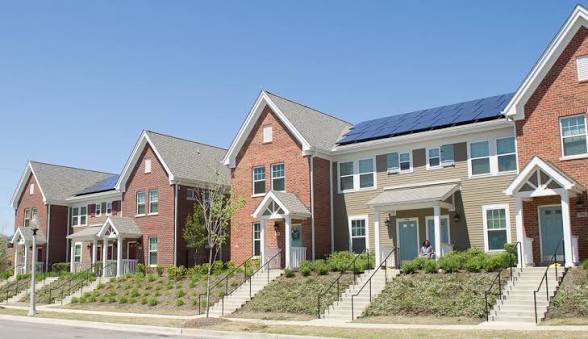
Millions of Nigerians are grappling with a worsening housing crisis as tenants and prospective homebuyers now spend far above the global affordability threshold on rent, with many allocating as much as 60 to 70 per cent of their income to accommodation.
The development, which experts say reflects deepening pressure in the country’s housing market, far exceeds the 30 per cent rent-to-income benchmark recommended by the United Nations for sustainable and affordable housing.
Findings indicate that the sharp rise in rents across major cities including Lagos, Abuja and Port Harcourt over the past two years has significantly overstretched the finances of working-class Nigerians, forcing many to relocate to distant suburbs or cut spending on other basic needs.
The rent-to-income ratio measures the proportion of a tenant’s gross monthly earnings spent on rent and is widely used to determine housing affordability and financial stability.
However, analysts say the ratio in Nigeria has climbed to alarming levels amid surging construction costs, rising urban population and limited housing supply.
A Lagos-based corporate executive, Oluwasegun Olamilekan, narrated his experience, describing the situation as unbearable for average earners.
According to him, he had been paying N450,000 yearly for a two-bedroom apartment in a Lagos suburb until his landlord recently increased the rent to N850,000.
“I chose to live outside the city centre because I knew I couldn’t afford urban rent with my salary. Suddenly the landlord increased the rent to N850,000,” he said.
Olamilekan noted that the new rate was still lower than what some landlords now demand from new tenants in the area.
“Some landlords are asking for as much as N1.2 million from new tenants, excluding agency, agreement and caution fees. When you add everything together, you may end up paying between N1.5 million and N2 million,” he added.
Industry experts say the situation has shattered the affordability threshold for many Nigerians seeking to either rent or own homes.
Co-founder of Alitheia Capital and Chairman of Purple Group, Olajumoke Akinwunmi, warned that the housing market was undergoing a major strain, with renters in Nigeria now spending as much as 70 per cent of their income on accommodation.
“That figure alone should jolt us. Those trying to build or buy today are facing not just barriers, they’re facing cliffs,” she said at a real estate forum in Lagos.
She added that the current realities were forcing both developers and buyers to reconsider their expectations in a volatile market.
According to Akinwunmi, aspiring homeowners who had spent years saving towards equity contributions are discovering that their savings now represent only a fraction of what is required due to rising construction costs.
“Buyers’ dreams have been reset to zero. Developers are also struggling to determine realistic pricing because input costs change frequently,” she said.
Experts attribute the steep increase in rents to Nigeria’s rapidly expanding population, accelerated urbanisation, and the sharp rise in building material costs.
Data from the National Bureau of Statistics show that although inflation declined for the 10th consecutive month as of January 2026, prices of key construction materials have continued to climb.
The price of a 50kg bag of cement, which sold for about N7,500 in late 2025, has risen to between N11,500 and N15,000 in several parts of the country in early 2026.
Professor Timothy Nubi, founding director of the Centre for Housing and Sustainable Development at the University of Lagos, said the rising costs of building materials were directly pushing housing prices and rents upward.
According to him, steel prices have increased by about 20 per cent within the last quarter, while sharp sand has risen by about 25 per cent.
He noted that the surging cost of construction inputs was already translating into higher property prices and rent levels across major Nigerian cities.
Industry stakeholders warn that without deliberate government intervention to boost housing supply and stabilise construction costs, Nigeria’s housing affordability crisis may worsen, pushing more urban residents into financial distress.
 '
' '
'Do you want to share a story with us? Do you want to advertise with us? Do you need publicity for a product, service, or event? Contact us on WhatsApp +2348183319097 Email: platformtimes@gmail.com
We are committed to impactful investigative journalism for human interest and social justice. Your donation will help us tell more stories. Kindly donate any amount HERE
