
…Counterfeit Drinks Linked To Rising Deaths, Illnesses
…40% Of Spirits Market Now Illicit
…Smuggling, Tax Evasion Fueling Booming Back Market
Daud Olatunji
The Spirits and Wines Association of Nigeria has raised fresh concerns over the growing scale of illicit alcohol trade in the country, revealing that Nigeria loses about N428bn annually to the illegal market.
The association disclosed that nearly 40 per cent of spirits and wines consumed nationwide are illicit, warning that the trend is not only eroding government revenue but also endangering public health.
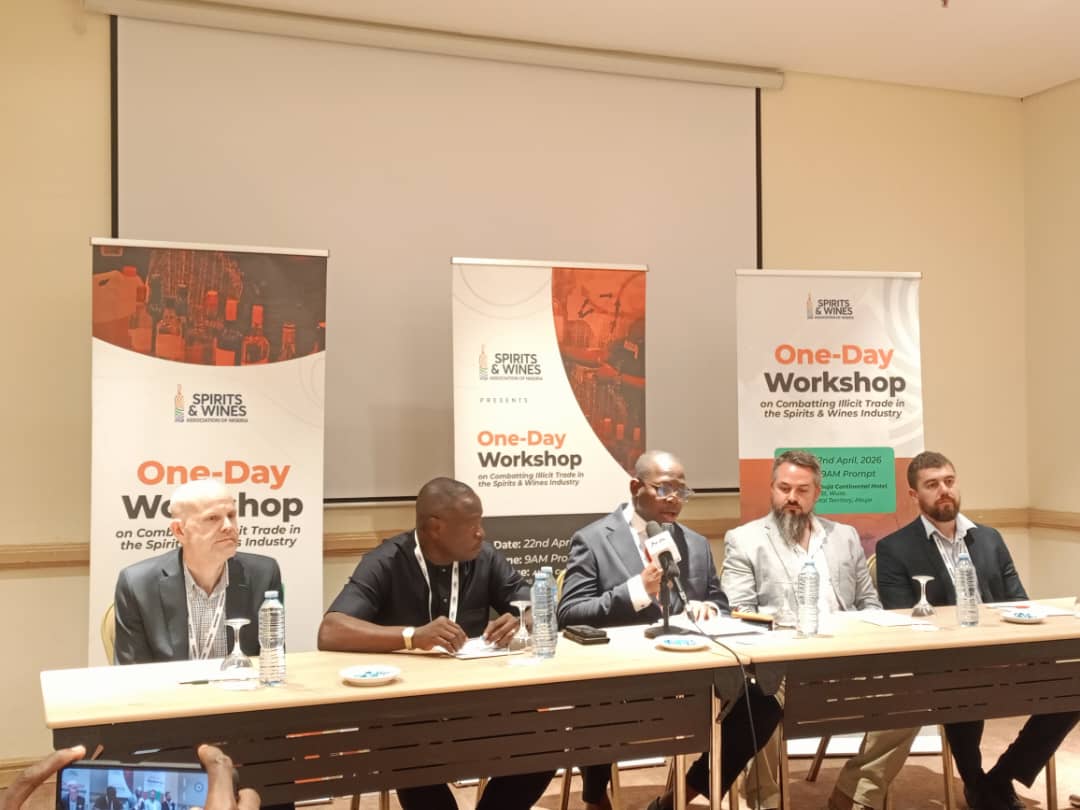
Speaking at a stakeholder workshop on combating illicit trade in Abuja on Wednesday, SWAN President, Michael Ehindero, described the situation as a major economic and health crisis requiring urgent intervention.
He warned that beyond the financial implications, the increasing circulation of counterfeit alcoholic beverages has been linked to rising cases of deaths and serious health complications.
Ehindero said, “We will not look at this conversation in monetary terms primarily; we will look at it in terms of the value of human lives. We have seen reports of loss of life and serious health damage from exposure to illicit and counterfeit alcohol.”
He explained that illicit alcohol trade includes smuggling, tax evasion, and unregulated parallel imports, while counterfeit products—though a subset—pose the greatest danger due to unsafe production conditions.
“Counterfeit is a subsection of illicit trade, but it carries unique risks because of unregulated and uncontrolled production,” he added.
The SWAN president attributed the surge in illicit trade to several factors, including consumer preference for cheaper alternatives, regulatory loopholes, and what he described as excessive taxation.
“There is an incentive for people to cheat. Because this is a business, people are looking for cheaper alternatives. Also, when taxation is excessive, it can open the door for some of these practices,” Ehindero said.
He noted that the problem cuts across multiple sectors of the economy, stressing that no single stakeholder can address it alone.
According to him, effective response would require stronger collaboration among regulatory agencies, law enforcement bodies, and private sector players, as well as improved public awareness.
“Effective action will require stronger collaboration across the public and private sectors, improved regulatory alignment, consistent enforcement, and increased consumer awareness,” he said.
Also speaking, SWAN Director-General, Tony Okwoju, cited findings from a 2024 Euromonitor survey which put the level of illicit trade in Nigeria’s spirits and wines market at about 40 per cent.
“This means that for every five bottles sold, two are illicit. That alone gives you a sense of how huge the problem is,” Okwoju said.
He added that the financial impact on government revenue remains significant, with estimated losses put at N428bn annually.
Okwoju further disclosed that the association is working closely with regulatory agencies, including the National Agency for Food and Drug Administration and Control, to curb the menace.
“Our members are continually collaborating with enforcement agencies, not just NAFDAC, with a view to tackling this problem. It is a continuous effort,” he said.
The association, however, warned that without sustained enforcement and coordinated action, the illicit alcohol market could continue to expand, with far-reaching consequences for public health, legitimate businesses, and government finances.
 '
' '
'Do you want to share a story with us? Do you want to advertise with us? Do you need publicity for a product, service, or event? Contact us on WhatsApp +2348183319097 Email: platformtimes@gmail.com
We are committed to impactful investigative journalism for human interest and social justice. Your donation will help us tell more stories. Kindly donate any amount HERE
