

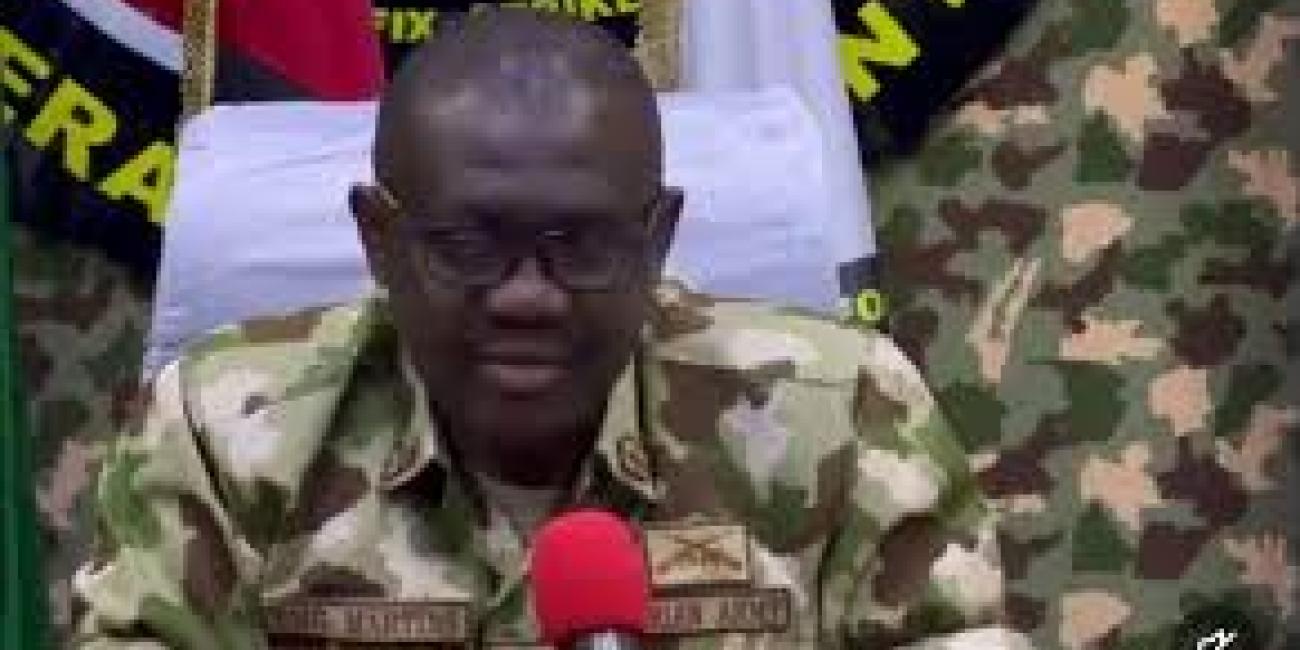
The Nigerian Army has raised fresh concerns over the survival of Boko Haram insurgents in the North-East, revealing that elements within the civilian population, alongside activities in cattle markets and transport networks, are inadvertently or deliberately sustaining terrorist logistics in the region.
The Commander of Sector 2, Operation HADIN KAI, Brigadier General Beyidi Martins, disclosed this on Tuesday while briefing defence correspondents on ongoing counter-insurgency operations in Yobe and Borno States.
Martins said troops had uncovered what he described as “high-level collusion” between some residents and insurgents, noting that terrorists continue to obtain food supplies, communication gadgets, motorcycle spare parts and other logistics through civilian-linked channels.
According to him, while some collaborators act under coercion, others willingly support the terrorists, enabling them to maintain operational capacity despite sustained military pressure.
“The asymmetric nature of the environment makes it easy for logistics items, food and spare parts to get to the terrorists through the civil population,” he said.
The commander explained that the difficult terrain and close interaction between communities and insurgents have made detection of supply chains more complex, allowing Boko Haram fighters to blend into local commercial activities.
He added that troops have intensified infiltration of transport unions and business associations across the North-East as part of efforts to dismantle the insurgents’ support networks.
“We have succeeded in infiltrating transport networks and various associations within the area, and we are able to track movements and supplies,” Martins said, adding that arrests are being made “on a daily basis.”
Martins further disclosed that security forces had intercepted and seized more than 400 Starlink satellite internet devices allegedly used by insurgents for communication, describing it as part of efforts to cut off their digital coordination channels.
He also identified major supply routes running from Kano through Nguru to Bukarti, Geidam and into parts of the Gujba forest as key corridors being monitored by troops.
Beyond logistics movement, the army commander highlighted the role of cattle markets in sustaining the insurgency, alleging that rustled livestock from attacked communities are often sold through local markets if not intercepted.
“The various cattle markets also serve as points where animals rustled by terrorists are sold,” he said.
Martins noted that the military, in collaboration with the governments of Borno State and Yobe State, has introduced monitoring mechanisms to identify stolen livestock before they enter commercial circulation.
He explained that animals must now undergo proper identification before sales can be completed, in a move aimed at disrupting terrorist financing channels.
“So an animal to be sold must be properly identified to the owner,” he said.
The commander stressed that the continued interaction between civilians and members of Boko Haram remains a major factor prolonging the conflict in the North-East, despite sustained military operations across the theatre.
 '
' '
'Do you want to share a story with us? Do you want to advertise with us? Do you need publicity for a product, service, or event? Contact us on WhatsApp +2348183319097 Email: platformtimes@gmail.com
We are committed to impactful investigative journalism for human interest and social justice. Your donation will help us tell more stories. Kindly donate any amount HERE
