

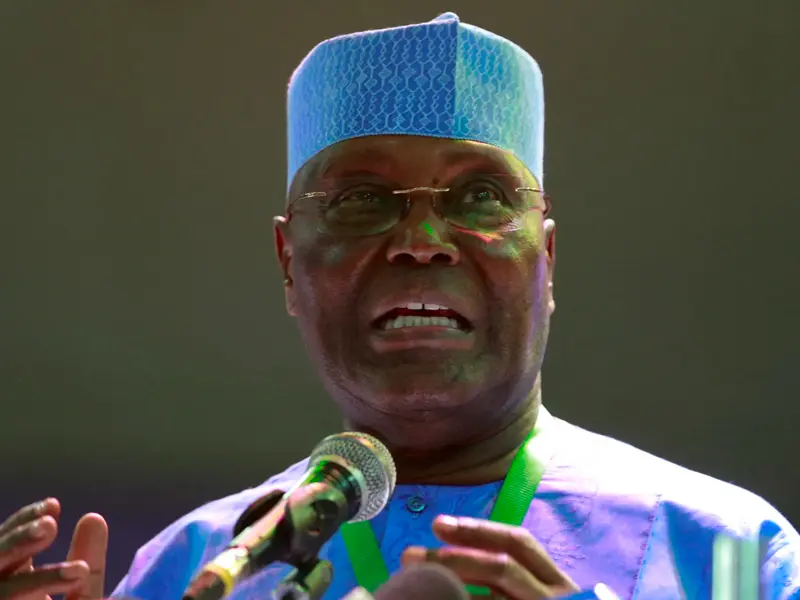
The Presidency on Sunday rejected former Vice-President Atiku Abubakar’s claim that the Federal Government realised a N7.98 trillion oil windfall under President Bola Tinubu’s administration, describing the allegation as unfounded and challenging the former presidential candidate to provide evidence.
The rebuttal came days after Atiku criticised the government’s continued domestic borrowing despite what he described as higher-than-expected oil revenues, accusing the administration of fiscal opacity and poor economic management.
Responding in a statement, the Special Adviser to the President on Information and Strategy, Bayo Onanuga, dismissed Atiku’s economic analysis as “deficient”, insisting that no such oil windfall existed.
He said the opposition leader’s calculations ignored key variables, including production costs, revenue-sharing arrangements with oil companies and crude oil sales tied to existing financial obligations.
“There is no such windfall of N7.98 trillion,” Onanuga said.
“Former Vice-President Atiku Abubakar, in his typical pastime, has accused the administration of President Bola Ahmed Tinubu of fiscal recklessness, citing excess borrowing, questioning the removal of fuel subsidy, criticising tax reforms and concocting an oil windfall of N7.98 trillion.
“Atiku will do well to show the workings for his N7.98 trillion oil windfall.”
Atiku, through his Senior Special Assistant on Public Communication, Phrank Shaibu, had alleged that Nigeria earned an estimated additional $5.76 billion (about N7.98 trillion) between March 1 and July 14, 2026, due to higher international crude oil prices.
He argued that with average oil production of about 1.5 million barrels per day, the country generated roughly $42.7 million in additional daily revenue.
The former Vice-President questioned why the government still borrowed about N5 trillion from the domestic bond market in the first half of 2026 despite the purported revenue windfall.
According to him, such borrowing would only be justified if government revenues had declined.
But Onanuga maintained that Atiku’s assumptions were flawed, explaining that increases in international oil prices do not automatically translate into equivalent government earnings.
He noted that although Brent crude averaged about $90 per barrel in the first half of 2026, compared with the budget benchmark of $64.85, Nigeria’s average crude production remained below projections.
According to him, daily production averaged about 1.6 million barrels against the projected 1.84 million barrels, reducing the expected gains from higher oil prices.
He further explained that part of the country’s crude oil production had already been committed to servicing loans obtained to finance the now-removed fuel subsidy.
“The convenient mistake many analysts make is to multiply the oil price by the daily crude production volume to determine revenue to the government,” Onanuga said.
“Such analyses ignore the cost of production, the share of crude belonging to the oil-producing companies and the impact of crude sale contracts such as forward contracts designed to hedge against price volatility.”
The presidential spokesman also said any additional earnings from improved crude prices were already reflected in the monthly allocations distributed by the Federation Account Allocation Committee.
Onanuga further criticised Atiku for relying on what he described as outdated economic arguments centred on developments in the 2024 fiscal year.
“Economies are dynamic. Reforms are processes, not events. Judging a reform programme solely by its earliest and most painful phase is like judging chemotherapy by the nausea it induces while ignoring the remission it seeks to achieve,” he said.
Defending the government’s borrowing profile, Onanuga argued that Nigeria had not exceeded sustainable debt levels.
He said the country’s debt-to-GDP ratio stood at about 40 per cent, while debt service-to-revenue ratio remained below 60 per cent and was improving.
According to him, Nigeria’s relatively low revenue-to-GDP ratio necessitated borrowing to finance essential public services, adding that ongoing fiscal reforms were improving revenue generation, widening the tax base and reducing leakages.
“The debt debate should examine not only how much Nigeria borrows but also whether the country’s capacity to generate and manage revenue continues to improve.
“At a mere 40 per cent debt-to-GDP ratio and less than 60 per cent debt service-to-revenue ratio, the argument of overborrowing is alarmist and does not stick,” he said.
The latest exchange is the newest chapter in the growing war of words between the Presidency and Atiku, the African Democratic Congress presidential candidate for the 2027 general election.
 '
' '
'Do you want to share a story with us? Do you want to advertise with us? Do you need publicity for a product, service, or event? Contact us on WhatsApp +2348183319097 Email: platformtimes@gmail.com
We are committed to impactful investigative journalism for human interest and social justice. Your donation will help us tell more stories. Kindly donate any amount HERE
