

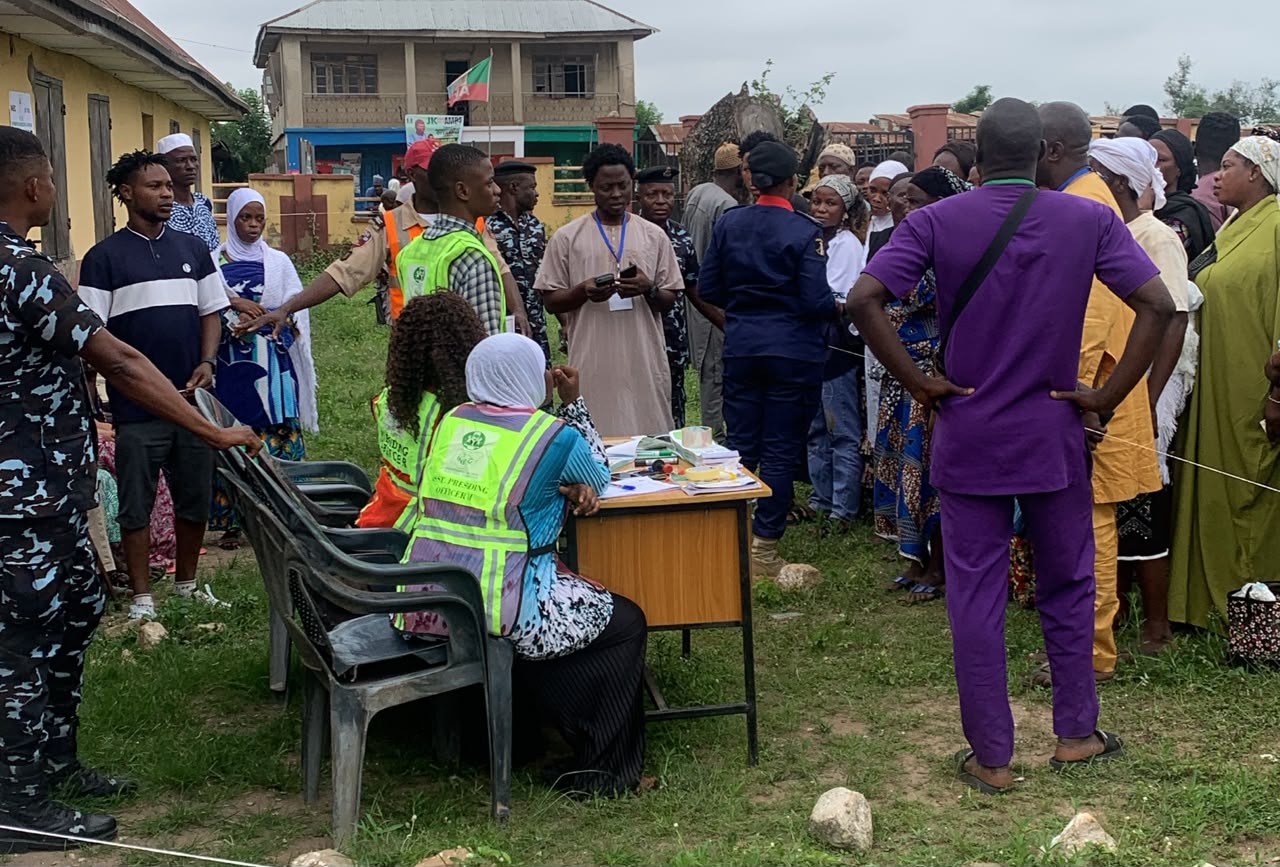
— Elderly, pregnant women, PWDs get priority as voting continues peacefully in many areas
— Vote buying allegations surface in several LGAs; voters report payments of up to ₦15,000
— BVAS, ink shortages delay voting in some polling units, while high turnout recorded in others
Daud Olatunji
The Osun State governorship election witnessed a mixed pattern of voting on Saturday morning, with reports of peaceful and orderly voting in several parts of the state alongside incidents of vote buying, biometric accreditation challenges, long queues, crowd control problems and isolated disagreements among voters, party agents and security personnel.
As of 10:48am, field reports from across the state’s 30 local government areas showed that voting was generally underway, with electoral officials attending to voters at several polling units.
However, the exercise was slowed down in some locations by malfunctioning or delayed Bimodal Voter Accreditation System machines, difficulty capturing the faces of elderly voters, shortages of electoral ink and crowd-management challenges.
The situation also exposed recurring concerns over alleged vote buying, with field reporters documenting instances in which voters were allegedly asked to collect money after casting their ballots.
The data were obtained by PLATFORM TIMES from the situation room of the Centre for Journalism Innovation and Development (CJID), whose field reporters were deployed across the local government areas of Osun State to independently monitor the governorship election.
The reports, filed from individual polling units and registration areas between about 7:54am and 10:48am, provide a snapshot of the election as voting progressed across the state.
Vote buying allegations emerge
One of the most significant patterns emerging from the field reports was the allegation of vote buying in several locations.
In Atakunmosa East Local Government Area, a field reporter at Local Government Polling Unit 10 reported that voters were allegedly being asked to meet someone outside the polling unit after voting to receive payment.
The reporter further alleged that APC supporters were offering ₦15,000, while Accord supporters were allegedly offering ₦10,000.
At another polling unit in Atakunmosa East, the reporter said vote buying was “prominent”, with voters allegedly being directed to collect payment outside the polling area after voting.
A similar allegation was reported in Boluwaduro Local Government Area, where a field reporter at NUD Primary School 2, Polling Unit 005, reported seeing an individual identified as an APC agent allegedly calling voters aside and giving them money after persuading them to vote for the party.
At another polling unit in Boluwaduro, the reporter said a man in blue agbada was observed allegedly handing ₦500 notes to voters.
In Iwo, a field report from the Customary Court, Ode-Oba II, described an argument involving a woman who allegedly confronted an elderly voter after discovering that she had voted for Accord rather than the woman’s preferred party. The woman was quoted as saying she could have given the voter more than what Accord allegedly offered.
Similarly, at a polling unit in Ola-Oluwa, voters were reportedly discussing whether they should be paid before voting, while party agents were said to be insisting that they should vote before receiving any payment.
At Ilesa East, another report said a voter was seen showing proof to a party agent that she had voted for the APC.
These reports are allegations from field observers and do not, on their own, establish that any political party or candidate officially authorised vote buying.
BVAS problems delay voting
The other major issue reported across the state was difficulty with the BVAS accreditation process.
At Ora Maternity Centre, Polling Unit 7, in Ifedayo Local Government Area, voting was temporarily suspended after the accreditation process encountered problems.
An initial report blamed the delay on BVAS, but subsequent observation indicated that the available ink had been exhausted.
The situation became more complicated when water was reportedly added to the ink board for thumb printing, with the presiding officer asking voters to touch the ink lightly because the ink was being managed.
Voting later resumed, although voters complained about partiality and the slow process.
At Ilesa East, a field reporter reported that the BVAS was unable to capture the faces of many elderly voters, causing delays and frustration among those waiting in the queue.
Some elderly voters reportedly became impatient and left the polling unit.
At Irepodun, the problem appeared particularly serious at AUD Primary School, where only four voters had reportedly cast their ballots by 10:46am because of BVAS malfunction.
Voters at the location attributed the problem partly to poor network connectivity.
At another Irepodun polling unit, voters complained that the BVAS had rejected some people more than once, prompting calls for affected voters to step aside temporarily so others could be accredited.
In Ilesa West, an APO was reportedly struggling to operate the BVAS, although the machine itself was said to be functioning.
In Ife North, some elderly voters reportedly had difficulty completing biometric verification despite the BVAS working, forcing them to sit and wait.
At Oriade, some voters also reported that the BVAS failed to capture their faces while successfully capturing others.
Ink shortage compounds accreditation problems
Beyond BVAS, shortages of electoral ink were reported in some locations.
At Ifedayo, voters said the ink used for thumbprinting had been exhausted, forcing a pause in the voting process.
At Methodist Primary School II in Ilesa West, a field reporter observed that the presiding officer’s stamp and voters’ thumbprints were barely visible, raising concerns about the quality of the ink.
The development added another layer to the accreditation challenges already being experienced in some polling units.
High turnout in several communities
Despite the challenges, several polling units recorded significant voter turnout.
High turnout was reported in parts of Ejigbo, Isokan, Oriade, Boluwaduro, Aiyedire, Ede North, Ilesa West and other local government areas.
At St Matthew Primary School ‘A’, Ijebu Jesa, in Oriade LGA, a field reporter described the turnout as massive and said BVAS accreditation was moving quickly at the time of observation.
At another polling unit in Oriade, however, the BVAS was reported to have delayed capturing voters.
In Ejigbo, high voter turnout was repeatedly reported at different polling units, including Baptist Day School, Masifa; Masifa Postal Agency; and a polling unit at Oke Ibukun Oluwa Community Junction.
At Isokan, large turnout was reported at Aponmu and Odo Osun, while voting was described as orderly at some polling units.
Aiyedire also recorded growing queues, with voters arriving in their numbers at polling units around Oluponna and Araromi Market.
In Ede North, voting was described as smooth and relatively fast at Y.T.D. School, Ojoro, where the field reporter recorded 1,033 registered voters.
Another polling unit at Baba Okunsehinde Compound had 799 registered voters, although some voters complained about the slow pace of voting.
At Ilesa West, a polling unit at Methodist Primary School recorded 962 registered voters, with 70 accredited voters reported by 10:27am. The BVAS was said to be working perfectly at the location.
Low turnout in parts of Osun
The election, however, did not attract the same level of participation everywhere.
Low voter turnout was reported in several polling units in Ife Central, Olorunda, Isokan and other locations.
At one polling unit in Olorunda, voters were described as being mostly youths, but the turnout was low.
At a polling unit in Ife Central, the field reporter also recorded low turnout, while another polling unit in the same local government recorded voters going through accreditation and voting peacefully.
In Isokan, one polling unit was described as having low turnout even though voting was orderly.
The contrasting reports suggest that voter participation varied considerably from one polling unit to another.
Elderly, pregnant women, PWDs get priority
A recurring feature across many polling units was the prioritisation of elderly voters, pregnant women, nursing mothers and persons with disabilities.
In Olorunda, elders were given priority during voting.
At Boluwaduro, elderly people, nursing mothers and pregnant women were reportedly given priority, with security personnel positioned near the polling officials to maintain order.
At Iwo, seats were provided for elderly people, pregnant women and breastfeeding mothers, who were prioritised.
Similar arrangements were reported in Ibokun, Boripe, Ola-Oluwa, Osogbo and other areas.
However, the policy also generated disagreements in some polling units.
At Ede North, some voters complained that prioritising elderly people was slowing the process.
At Araromi Area, Orolu, voters reportedly disagreed over giving elderly people and nursing mothers priority over younger voters who had arrived earlier.
Queues, crowd control problems
Long queues and growing crowds were reported across several polling units.
At Ibokun Post Office Polling Unit, a long queue was observed, with party agents helping to coordinate voters.
At Ola-Oluwa, growing crowds became difficult for security officials to control at Baptist Primary School, where only four security personnel were reportedly present.
At Aiyedire, security personnel were deployed to maintain order as the crowd increased.
At Irewole, a polling unit at Aseyin Popo, Ikire, became rowdy after voters complained that people arriving later were being allowed to vote ahead of those who had been waiting.
The situation was later described as having been resolved.
Tensions and disagreements
Although the election was peaceful in many areas, field reports recorded isolated disputes.
At Ibokun Post Office Polling Unit, a disagreement arose among party agents after one agent reportedly appeared without an identification tag.
At another Ibokun polling unit, there was a disagreement after security personnel allowed an AGPA agent to assist an elderly woman during the voting process.
At Egbedore, a disagreement between voters and security personnel reportedly caused arguments, although security officials moved to calm the situation and voting continued.
At Aiyedire, security officials had to intervene in a developing fight among voters.
At Ifelodun, a heated argument was reported at a polling unit, although the reason was not immediately established.
At Ife South, voters complained about the presence of unauthorised persons within the restricted voting area and questioned whether security personnel were doing enough to control access.
Alleged voter intimidation in Ifewara
A serious allegation was also made concerning Ifewara.
A field report, based on information attributed to the governorship candidate of the African Democratic Congress, alleged that individuals linked to a local political figure had been involved in attempts to intimidate voters and prevent some residents from voting.
The candidate reportedly alleged that voters’ cards were being forcefully collected and destroyed.
The report also linked the allegation to an earlier incident involving a former APC lawmaker who was said to have been arrested over alleged possession of a firearm in a campaign vehicle and later released.
However, the field reporter expressly stated that the allegation was based on the candidate’s account and that there was no photograph or independent evidence attached to the report.
The allegation could therefore not be independently verified by PLATFORM TIMES at the time of publication.
Voters were reportedly asked to write names and account details
Another worrying pattern emerged in some polling units where voters were reportedly approached after voting and asked to provide personal information.
At St Peter’s Primary School in Ife South, field reporters reported that voters who had cast their ballots were approaching a particular woman who was allegedly recording their names.
One report identified the woman as “Iya Goodluck” and said some voters were showing their ballot papers before approaching her to have their names recorded.
At another polling unit in Oriade, voters were reportedly being asked to write their account numbers on paper before or after voting. A woman was allegedly overheard referring to ₦20,000.
At a polling unit in Surulere Area, Orolu, an APC agent and party members were reportedly seen talking to voters, allegedly encouraging them to vote for APC and subsequently record their numbers in a book.
These reports raise concerns about the possibility of monitoring voters’ choices and potential vote buying. They remain field observations and allegations requiring further investigation.
Assistance for voters with disabilities and language barriers
The field reports also highlighted instances of voters helping others navigate the electoral process.
At Olorunda, voters were reportedly helping to move a person with disability to enable the voter to cast a ballot.
In Ife North, some Hausa-speaking voters were reportedly being assisted by other voters who could read to locate their names on the displayed voters’ register.
At several locations, however, disputes arose over whether party agents or other individuals could assist voters who had difficulty navigating the voting process.
At Atakunmosa East, party agents reportedly objected to voters calling individuals to assist them, insisting that voters should have learned how to vote before arriving at the polling unit.
Security presence generally visible
Security personnel were deployed across many of the locations monitored by the CJID field reporters.
At several polling units in Atakunmosa East, security personnel were described as being on guard, with as many as 12 officers reportedly observed at one location.
At Ayedade, five security officers were reported at one polling unit, while four officers were observed at another.
In Ola-Oluwa, three security personnel were reported at a polling unit where they were able to manage the crowd effectively, while another location had only four officers struggling to control a growing crowd.
At Olorunda, security personnel were also seen assisting with maintaining order.
Overall Picture
The reports from across Osun as of 10:48am paint a picture of an election that was largely underway and peaceful in many polling units, but with significant operational and integrity concerns in pockets of the state.
The biggest operational problems were BVAS delays, difficulty accrediting elderly voters, shortages or poor quality of electoral ink, slow queues and crowd-management challenges.
At the same time, field observers documented several allegations of vote buying, voters displaying ballot papers after voting, names being recorded after voters cast their ballots and political agents allegedly monitoring or influencing voters.
The reports also showed a striking contrast in voter participation: while some communities recorded long queues and heavy turnout, others witnessed relatively low participation.
For many elderly voters, pregnant women, nursing mothers and persons with disabilities, priority arrangements helped ease access to the ballot, although the policy sometimes generated complaints from other voters who had arrived earlier.
With voting still continuing at the time of the latest reports, the situation remained fluid.

 '
' '
'Do you want to share a story with us? Do you want to advertise with us? Do you need publicity for a product, service, or event? Contact us on WhatsApp +2348183319097 Email: platformtimes@gmail.com
We are committed to impactful investigative journalism for human interest and social justice. Your donation will help us tell more stories. Kindly donate any amount HERE
