

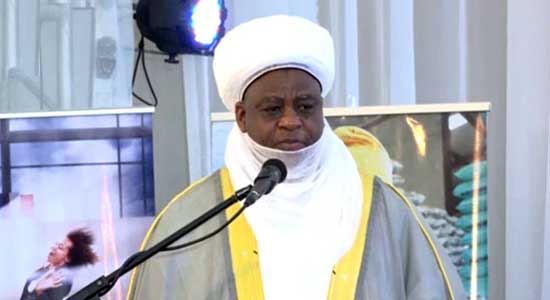
The Sultan of Sokoto, Alhaji Muhammad Sa’ad Abubakar III, has warned politicians and public office holders against using allegedly stolen or corruptly obtained public funds to sponsor Muslims and Christians on pilgrimages to Mecca and Jerusalem.
The Sultan said religious obligations could not legitimise proceeds of corruption, stressing that money obtained through dishonest means would not become acceptable merely because it was spent on religious activities.
Abubakar spoke on Wednesday in Abuja at the opening of a stakeholders’ meeting organised by the Nigeria Inter-Religious Council, NIREC, with the theme, “Shared Sacred Flourishing in Nigeria.”
The Sultan said religious leaders had a responsibility to confront corruption and work with anti-graft agencies to strengthen accountability in the country.
He declared, “We, as religious leaders, must fight corruption because God Almighty doesn’t like corruption.”
He added, “You cannot steal money and send people to Jerusalem or Mecca with corrupt funds and think God will accept your deeds. God is not corrupt, so you cannot use corrupt money for Hajj or anything else.”
The monarch’s warning comes amid persistent concerns over corruption, public-sector accountability and the use of public resources for political and religious patronage.
Abubakar also called on the Economic and Financial Crimes Commission to deal firmly with corruption cases without regard to the political, religious or social standing of suspects.
He said offenders should not be shielded because of their positions or religious affiliations.
He added, “When someone is facing the law, do not tell me he is the pastor of so-and-so church or the chief imam of so-and-so mosque. We do not want to hear that.”
The Sultan further urged the EFCC to carry out its responsibilities without political interference, stressing that the fight against corruption should not be selective.
Abubakar also challenged Christian and Muslim leaders to move beyond condemning corruption in principle and actively use their religious platforms to promote integrity and accountability.
He particularly commended NIREC as an avenue for sustained interaction between Christians and Muslims, saying regular dialogue was critical to peace, stability and national development.
According to him, religious harmony should be based on genuine understanding rather than mere tolerance.
“I keep telling people that I don’t want you to just tolerate me, because tolerance means enduring something you have no choice about,” he said.
“But if you understand me, we can work together because we know who we are to each other.”
The Sultan also cautioned clerics against making inflammatory statements from the pulpit, particularly during election periods.
He urged religious leaders to pray for national leaders and avoid using religious platforms to incite division or attack public officials.
The meeting also featured an overview of the Interfaith Anti-Corruption Manuals Project, presented by Prof. Adedibu Ojerinde, Chairman of the Interfaith Anti-Corruption Advisory Committee.
Ojerinde described the initiative as a joint strategic effort involving the EFCC and religious leadership to confront corruption through Nigeria’s churches and mosques.
He said the initiative had its roots in the 2007 National Interfaith Forum on Corruption and was designed to mobilise the pulpit and minbar in promoting ethical conduct and public accountability.
According to him, the manuals were originally inaugurated in 2014 and re-inaugurated in January 2024 by President Bola Tinubu before being expanded to address emerging challenges, including youth vulnerability, cybercrime and money laundering within religious institutions.
Ojerinde said the handover of the manuals to NIREC represented a transition from producing anti-corruption materials to implementing them through religious institutions.
He urged religious leaders to incorporate anti-corruption messages into Friday sermons and Sunday services.
The meeting was attended by Christian and Muslim leaders, government officials, security representatives and members of the media.
The Sultan also used the occasion to commend the outgoing Executive Secretary of NIREC, Prof. Cornelius Omonokhua, for what he described as an eight-year tenure that transformed the council into a vibrant platform for national dialogue.
 '
' '
'Do you want to share a story with us? Do you want to advertise with us? Do you need publicity for a product, service, or event? Contact us on WhatsApp +2348183319097 Email: platformtimes@gmail.com
We are committed to impactful investigative journalism for human interest and social justice. Your donation will help us tell more stories. Kindly donate any amount HERE
