

Daud Olatunji
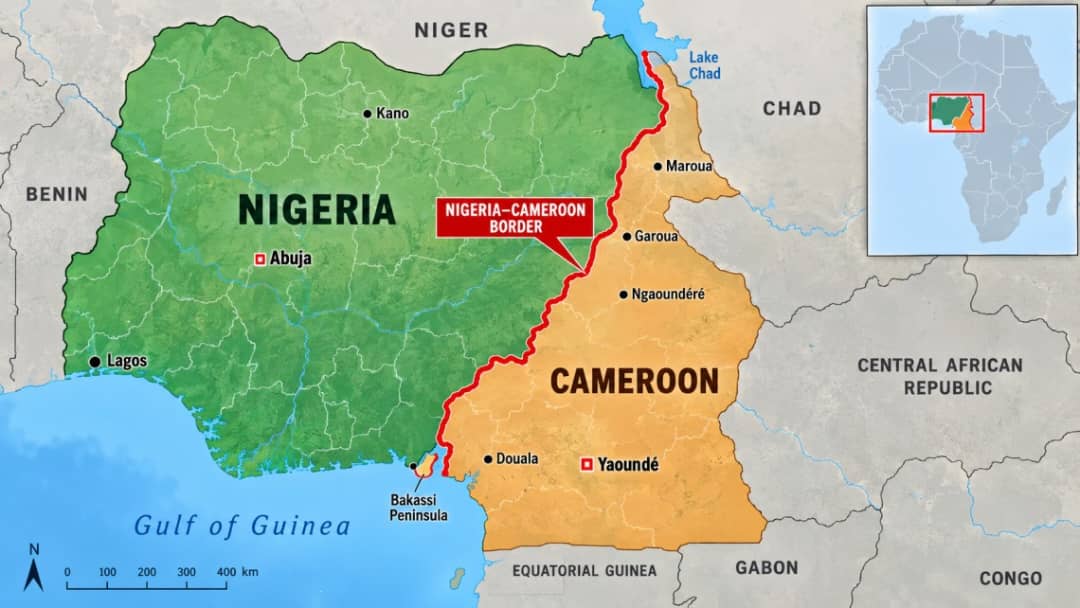
Nearly 24 years after the International Court of Justice ruled on the Nigeria-Cameroon boundary dispute, the physical demarcation of the two countries’ 2,100-kilometre international border is expected to be completed before the end of 2026.
The Director-General of the National Boundary Commission, Adamu Adaji, disclosed this in an interview with the News Agency of Nigeria in Abuja on Sunday.
Adaji said the remaining work was concentrated largely in the Adamawa sector, where more than 260 boundary pillars were being installed to make the internationally recognised boundary visible on the ground.
He said the demarcation could be completed within the next two to three months.
“Hopefully, before the end of the year, we should be done with the demarcation,” Adaji said.
The development comes almost 24 years after the ICJ, sitting at The Hague, Netherlands, delivered its judgment on October 10, 2002, resolving the long-running Nigeria-Cameroon land and maritime boundary dispute and awarding sovereignty over the Bakassi Peninsula to Cameroon.
Following the judgment, Nigeria and Cameroon, under United Nations auspices, established the Nigeria-Cameroon Mixed Commission to implement the court’s decision and resolve outstanding issues along the boundary.
According to Adaji, the process initially faced difficulties in some areas because the boundary lines created challenges for communities whose historical, cultural and demographic identities did not correspond neatly with the court-defined boundary.
He said the disagreements had since been resolved through interventions by the governments of both countries, with adjustments and concessions made to protect affected communities and prevent the boundary from splitting predominantly Nigerian or Cameroonian settlements.
“One of the things we had to do was to consider the interests of the people living along the boundary.
“For example, a boundary line should not place a settlement that is predominantly recognised as Nigerian on the Cameroonian side while placing a settlement recognised as Cameroonian on the Nigerian side,” he explained.
Adaji cited Koja as one of the communities significantly affected by the original boundary alignment.
According to him, about 90 per cent of Koja was initially placed on the Cameroonian side under the ICJ-defined boundary, but negotiations between the two countries resulted in the entire community being retained in Nigeria.
He said concessions were made elsewhere, citing Turu, where the population was predominantly Cameroonian.
“While an area such as Koja, where Nigerians are predominant, was retained in Nigeria, an area such as Turu, where Cameroonians are predominant, was treated as a concession to Cameroon.
“That is what was done. It is not simply about defining a boundary; it is also about taking the interests of affected communities into account,” the NBC boss said.
He said such arrangements were necessary to promote lasting peace and cooperation between the two neighbouring countries.
The Nigeria-Cameroon boundary, according to Adaji, is Nigeria’s longest international land boundary, stretching approximately 2,100 kilometres from the Chad Basin through the states bordering Cameroon to the Atlantic coast.
He said Nigeria shares approximately 770 kilometres of land boundary with Benin Republic and 1,500 kilometres with Niger Republic.
With the physical demarcation nearing completion, Adaji said the next phase would focus on managing the boundary and addressing the socio-economic needs of communities affected by the process.
He said the NBC had already assessed the needs of affected communities and was working with the United Nations towards improving their living conditions.
“As soon as we receive support from international partners and the governments of the two countries, we will begin arrangements to provide what is necessary for the affected communities along the international boundary,” he stated.
Adaji stressed that physical demarcation alone would not resolve the challenges confronting communities along the border, noting that many of them shared longstanding cultural, linguistic and historical ties.
He said cross-border cooperation would therefore remain critical to maintaining peace, facilitating legitimate movement and combating criminal activities such as smuggling and irregular migration.
The NBC director-general disclosed that the commission had established what he described as the first Economic Community of West African States platform for cross-border cooperation in the region.
He added that local committees had also been established at the state level to strengthen cooperation between Nigerian communities and their counterparts across international borders.
“We cannot prevent people from moving around, because this is not a war between Nigerians and their neighbours. The communities are often the same.
“Sometimes, if you move a short distance, you have entered another country,” he said.
Adaji noted that the peculiar nature of some border communities meant that individuals could have homes or farmlands straddling both sides of an international boundary.
He said such situations required sustained cooperation and cross-border engagement rather than measures that could unnecessarily disrupt the lives and livelihoods of affected residents.
On Nigeria’s maritime boundaries, Adaji said the country shared maritime boundaries in the Gulf of Guinea with Equatorial Guinea, Cameroon, Ghana and Benin Republic.
He explained that, unlike land boundaries where pillars could be physically installed, maritime boundaries were defined using coordinates and maps.
According to him, Nigeria’s maritime boundary with Cameroon has been resolved, while negotiations are continuing over outstanding portions with Equatorial Guinea and Ghana.
He said approximately three nautical miles remained to be resolved with Equatorial Guinea, while about eight nautical miles were still under negotiation with Ghana.
The maritime boundary with Benin Republic, he added, had already been defined by treaty.
Adaji said the NBC was working to properly define Nigeria’s maritime boundaries and establish accurate coordinates to guide naval operations, shipping and other activities within the country’s territorial waters.
He said the completion of the Nigeria-Cameroon demarcation would effectively move the two countries into a new phase focused not merely on where their boundary lies, but on how communities living along it could coexist, trade and develop peacefully.
The NBC boss added that Nigeria and Cameroon would remain neighbours, stressing that respect for the international boundary must be accompanied by measures to safeguard the welfare and legitimate interests of border communities.
 '
' '
'Do you want to share a story with us? Do you want to advertise with us? Do you need publicity for a product, service, or event? Contact us on WhatsApp +2348183319097 Email: platformtimes@gmail.com
We are committed to impactful investigative journalism for human interest and social justice. Your donation will help us tell more stories. Kindly donate any amount HERE
