

Ayomide Awe
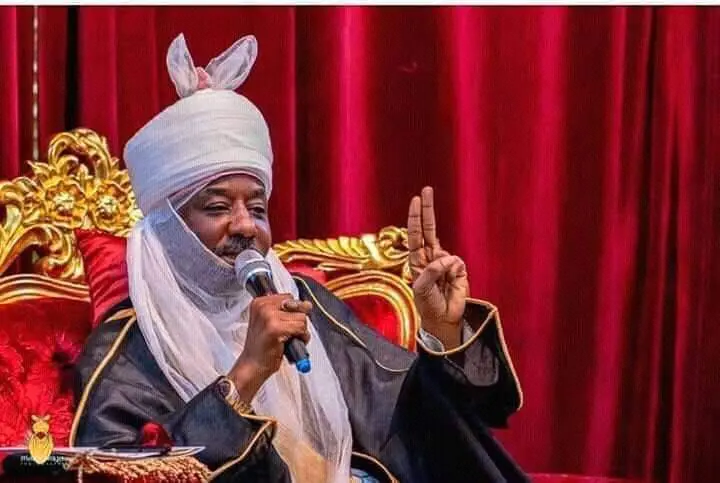
The Emir of Kano, Muhammadu Sanusi II, has raised concerns over the implementation of Nigeria’s anti-corruption laws, alleging that political connections can determine how corruption cases are investigated, prosecuted and ultimately resolved.
Sanusi said some people facing corruption allegations had escaped prosecution because of their political affiliations or support, while others could find themselves subjected to prolonged legal battles depending on the political circumstances surrounding their cases.
The Emir made the remarks in Lagos during an interview with Channels Television at the public presentation of Unexplained Wealth: A Trilogy of Nigerian Financial Law, a three-volume work authored by Senior Advocate of Nigeria, Dr Wahab Shittu.
According to Sanusi, Nigeria does not necessarily lack laws or institutions to fight corruption, but the effectiveness of the anti-corruption campaign depends largely on how those laws and institutions are applied.
He said, “The laws are one thing. Even the existing laws we have need to be implemented better. You have institutions that are supposed to identify corrupt people and prosecute them. You have courts that are supposed to do it.”
The former Central Bank of Nigeria governor alleged that political considerations could influence the handling of corruption cases, including situations where charges against some suspects were discontinued.
“We have seen in this country people who are facing corruption charges who basically just get those charges dropped because they belong to the right political environment or have the right political support,” he said.
Sanusi also questioned whether some corruption proceedings were consistently driven by the objective of accountability or whether political considerations sometimes influenced their direction.
He asked, “So people begin to wonder, is this really a fight against corruption or is it a political battle?”
The Emir cited the case of former Kaduna State Governor, Nasir El-Rufai, as an example of the concerns he raised about the application of the legal process.
Sanusi said El-Rufai, whom he described as his brother, had been denied bail and had spent seven months in detention without being convicted.
“An example is my brother Nasir El-Rufai, who’s been denied bail. He’s been in detention for seven months, not having been convicted of anything in court,” he said.
Sanusi’s reference to the former governor was presented as his concern about the legal process and did not, in itself, establish that El-Rufai’s detention was politically motivated or unlawful.
Speaking on the book launched at the event, Sanusi welcomed efforts to examine Nigeria’s legal framework for tackling unexplained wealth and recovering assets suspected to have been acquired illicitly.
He said Shittu’s three-volume work examined existing laws, identified weaknesses and proposed measures that could strengthen the fight against corruption.
“I think what Dr Shittu has done is to look at the laws. I’m not a lawyer, I’m still an undergraduate law student, and this would be something that I would find extremely useful in my studies,” he said.
Sanusi, however, stressed that legislative reforms alone would not resolve Nigeria’s corruption challenges unless the institutions charged with enforcing the laws were strengthened and allowed to operate effectively.
“So the laws are one thing, and I think it’s a good thing that we’re looking at the laws, but we also have to look at the institutions that are involved in the promotion of the law, and that is how you make progress,” he said.
He further urged politicians, public officials and members of the judiciary to ensure that anti-corruption laws were applied for the purposes for which they were enacted.
“Now until the politicians and those who control political office and the judiciary decide that they are going to use these laws for the purpose for which they are set up, we’re not going to get anywhere,” Sanusi said.
He concluded that weak enforcement could undermine the effectiveness of Nigeria’s anti-corruption framework.
“Otherwise, anyone knows that you can get away with anything if you have the right political connections.”
The presentation of Shittu’s trilogy brought together prominent figures from Nigeria’s political, legal, traditional and academic circles. Former President Olusegun Obasanjo chaired the event, while former Vice-President Yemi Osinbajo was among those associated with the programme.
Shittu has described unexplained wealth as a major obstacle to Nigeria’s development and argued that stronger mechanisms are needed to distinguish legitimately acquired wealth from assets obtained through illicit means.
 '
' '
'Do you want to share a story with us? Do you want to advertise with us? Do you need publicity for a product, service, or event? Contact us on WhatsApp +2348183319097 Email: platformtimes@gmail.com
We are committed to impactful investigative journalism for human interest and social justice. Your donation will help us tell more stories. Kindly donate any amount HERE
