

Ayomide Awe
The Nigerian Senate has urged the Federal Government to seek international climate adaptation funding and make adequate budgetary provisions to protect coastal communities facing relentless ocean surges, warning that about 80 per cent of homes and infrastructure in Ayetoro, Ilaje Local Government Area of Ondo State, have been lost to sea incursion.
The lawmakers also directed the National Emergency Management Agency and relevant state authorities to provide immediate humanitarian assistance to residents whose homes and livelihoods have been destroyed by the advancing sea.
The proposed intervention includes access to safe drinking water, healthcare services and temporary shelter for displaced residents, as affected communities continue to grapple with the devastating consequences of coastal erosion.
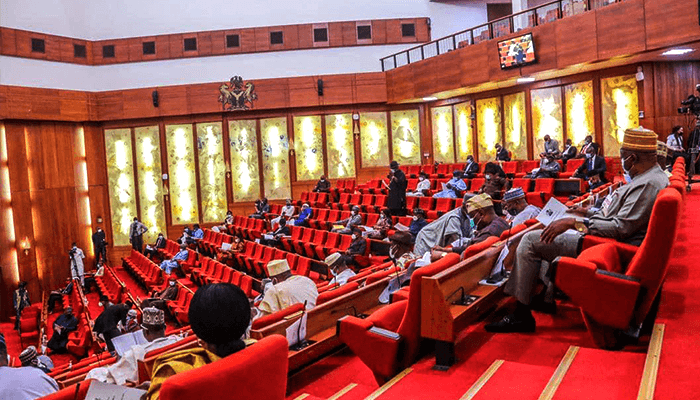
The resolutions were adopted during plenary on Thursday following a motion on the urgent need to construct shoreline protection infrastructure to prevent the further destruction of Ayetoro, a coastal community that has battled the encroaching Atlantic Ocean for decades.
The motion was sponsored by Senator Francis Faduyile, representing Ondo South Senatorial District, who warned that the scale of destruction required urgent and coordinated intervention by the Federal Government, the Ondo State Government, development commissions and international development partners.
Faduyile called on the Federal Ministry of Environment and the Niger Delta Development Commission to collaborate with the Ondo State Government to implement a comprehensive and adequately funded shoreline protection programme for the embattled community.
He stressed the need for immediate action to prevent further destruction of homes, public infrastructure and the livelihoods of residents who depend largely on fishing and other coastal economic activities.
The Senate’s intervention comes amid growing concerns about the vulnerability of Nigeria’s coastal settlements to ocean surges, erosion and the effects of climate change.
The lawmakers also mandated the Senate Committees on Environment, NDDC and Special Duties to engage relevant ministries, agencies and stakeholders, monitor the implementation of the proposed measures and report back to the chamber within four weeks.
During the debate, Senator Ekong Sampson, representing Akwa Ibom South, supported the motion, noting that communities in his constituency were also facing the threat of sea incursion.
Similarly, Senator Adeniyi Adegbonmire, representing Ondo Central, said the Ondo State Government lacked the financial capacity to tackle the crisis alone.
He urged the Senate to intensify pressure for Federal Government intervention, warning that the scale of the environmental challenge required resources beyond the capacity of the state government.
Senate President Godswill Akpabio assured the lawmakers that the legislature would take the threat seriously, acknowledging that some state governments lacked the financial resources to protect vulnerable communities from the advancing sea.
Akpabio pledged to look into the situation in Ayetoro and other coastal settlements affected by similar environmental challenges across the country.
14,820 Residents Affected As Ocean Destroys Homes
The scale of the crisis in Ayetoro is reflected in an assessment conducted by NEMA in August 2024.
According to the agency, ocean surges had submerged 1,820 buildings, displaced 2,470 households and affected 14,820 people in riverine communities in Ilaje Local Government Area.
The assessment also documented damage to schools and the community’s independent electricity system, leaving residents without power.
Beyond the loss of buildings and infrastructure, the continuing sea incursion has disrupted economic activities and threatened food security, particularly among fishing households whose livelihoods depend on access to the coastline and productive waters.
The destruction of fishing equipment, homes and other assets has further increased the vulnerability of residents, many of whom face the prospect of repeated displacement as the ocean advances.
Schools and other essential facilities have also suffered damage, raising concerns about access to education and basic services in communities struggling to recover from successive ocean surges.
For residents of Ayetoro, the crisis extends beyond environmental degradation to a growing humanitarian challenge involving shelter, livelihoods, electricity and access to essential services.
The NDDC reportedly awarded a shoreline protection contract for the community in 2004. However, the initial contract was terminated after the contractor reportedly failed to execute the project satisfactorily.
The contract was subsequently re-awarded in 2009, but the shoreline protection works remained incomplete, leaving residents exposed to recurring ocean surges and further destruction.
The prolonged failure to establish effective coastal protection infrastructure has intensified concerns about the implementation of environmental projects in vulnerable communities.
The Senate’s latest resolution places renewed emphasis on the need for a comprehensive intervention supported by adequate funding, effective project monitoring and cooperation among the federal, state and development authorities.
However, the immediate challenge remains how quickly the proposed measures can be translated into practical action to protect residents and prevent further losses.
The Senate’s call for international climate adaptation financing reflects the growing need for additional resources to address environmental threats that exceed the financial capacity of some affected states.
For Ayetoro and other vulnerable coastal settlements, the proposed intervention would require more than emergency relief, with sustained investment in shoreline protection and other long-term coastal adaptation measures.
Such measures could include properly engineered coastal defences, shoreline stabilisation and other interventions based on scientific assessments of the affected areas.
The lawmakers’ call for collaboration among the Federal Ministry of Environment, NDDC and the Ondo State Government is expected to provide a framework for addressing the crisis.
The four-week reporting deadline for the relevant Senate committees is also intended to ensure that the proposed measures receive legislative scrutiny.
Nevertheless, the effectiveness of the intervention will depend on whether the government moves beyond resolutions to provide funding, complete outstanding projects and establish durable protection for communities facing repeated displacement.
 '
 '
Do you want to share a story with us? Do you want to advertise with us? Do you need publicity for a product, service, or event? Contact us on WhatsApp +2348183319097 Email: platformtimes@gmail.com
We are committed to impactful investigative journalism for human interest and social justice. Your donation will help us tell more stories. Kindly donate any amount HERE
 '
