

Daud Olatunji
Oyo State Governor and Allied Peoples Movement presidential candidate, Seyi Makinde, has challenged his political opponents to demonstrate their physical stamina, declaring that Nigerians should vote for candidates capable of handling the rigours of the presidency.
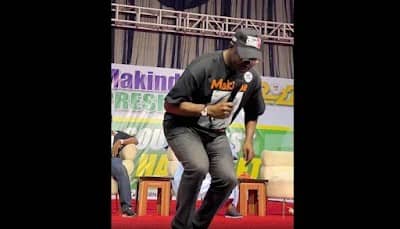
Makinde made the challenge on Thursday during the South-West town hall meeting of the Makinde/Daura campaign organisation in Akure, the Ondo State capital, where he jumped off the stage to demonstrate his point.
The governor, who is positioning himself for the 2027 presidential election, said age should not be the central issue in determining who becomes Nigeria’s next president, insisting that energy, endurance and the ability to respond to the country’s challenges should take precedence.
Daring other presidential hopefuls to replicate his action, Makinde said, “When they bring their presidential candidate, let the candidate come here and also jump down.
“If they can do that, vote for them.”
He added, “I will not make age an issue in this campaign, but I will make it about energy — having energy, being able to stay up late, and having the rigour to deal with the challenges in the country.”
The stunt appeared aimed at drawing attention to the physical and mental demands of the presidency as political parties and aspirants position themselves ahead of the 2027 general elections.
Makinde’s remarks could also intensify the debate over the capacity of presidential contenders to cope with the demanding responsibilities of governing Africa’s most populous country.
However, his demonstration does not, in itself, establish a candidate’s competence or fitness for office, which also depend on sound judgment, policy direction, leadership experience and the ability to deliver results.
The governor also defended his decision to contest the presidency despite President Bola Tinubu, a fellow South-West politician, seeking re-election.
Makinde said the presence of a South-West president should not prevent other qualified politicians from the region from seeking the country’s highest political office.
According to him, Nigeria’s democratic history provides a precedent for multiple presidential candidates from the same region contesting against one another.
He cited the 1999 presidential election, in which former President Olusegun Obasanjo of the Peoples Democratic Party and Olu Falae of the Alliance for Democracy and All People’s Party contested the presidency.
Makinde said the contest demonstrated that presenting multiple candidates from the South-West did not undermine the region’s interests or threaten national stability.
“In 1999, the entire Nigeria ceded the presidency to the South-West, and we had two of our fathers, Baba President Obasanjo and Baba Olu Falae, contest the presidency, both from the South-West. And heaven did not fall,” he said.
He added, “As a matter of fact, what the South-West did was to present two of its finest, two of its best, for Nigeria to choose from.
“Is there anything wrong with us this time around?”
The governor’s position challenges the argument that the South-West should rally behind Tinubu’s re-election bid simply because he hails from the region.
His comments suggest that he intends to frame the 2027 contest around competing political choices rather than regional loyalty.
Makinde also criticised the Tinubu administration over what he described as the wasteful use of taxpayers’ money, questioning the necessity of a trip by Nigeria’s Permanent Representative to the United Nations, Jimoh Ibrahim, from New York to Abuja to present the UN budget to the President.
The governor argued that the expenditure was difficult to justify when, according to him, the Federal Government had yet to clarify the national budget under which it was operating.
He said the government should prioritise transparency and accountability in managing public funds.
“Well, they can waste the taxpayers’ money, but I refuse to agree that you must use the taxpayers’ money to fly from New York to Abuja to present the UN budget when, indeed, this is an administration where, right now, we don’t know which budget they are operating on for Nigeria,” Makinde said.
He continued, “Is it the 2023, 2024, 2025 or 2026 budget? And then they are coming with the UN budget to say, ‘Look, this is the UN budget.’”
The governor’s criticism raised questions about budget implementation, fiscal transparency and the government’s management of public resources.
However, his remarks on the trip and the country’s budget situation were not accompanied by a detailed breakdown of the expenditure involved or an official response from the Federal Government.
The Presidency and Ibrahim were not reported to have responded to the allegations in the account of the event.
Makinde’s comments come as political activities gather momentum ahead of the 2027 general elections, with prospective candidates seeking to distinguish themselves through their policy positions, political records and criticisms of the incumbent administration.
His emphasis on stamina, coupled with his defence of a multi-candidate contest in the South-West, signals an attempt to challenge both the age-focused dimension of presidential politics and the argument for regional political consolidation behind Tinubu.
Whether the demonstration will resonate with voters remains to be seen, as Nigerians weigh the records, programmes and capacity of the aspirants seeking to lead the country from 2027.
 '
 '
Do you want to share a story with us? Do you want to advertise with us? Do you need publicity for a product, service, or event? Contact us on WhatsApp +2348183319097 Email: platformtimes@gmail.com
We are committed to impactful investigative journalism for human interest and social justice. Your donation will help us tell more stories. Kindly donate any amount HERE
 '
