

Daud Olatunji
Nigeria and the United States have secured 41 extraditions through joint operations between the Economic and Financial Crimes Commission and the Federal Bureau of Investigation in the last five years, as both countries intensify efforts to dismantle transnational cybercrime networks.
The United States Diplomatic Mission to Nigeria disclosed this on Monday, saying the extraditions were facilitated through the collaboration between the EFCC and the FBI Legal Attaché Office at the US Embassy in Abuja since 2022.
The figure includes five extraditions completed in 2026, representing a significant increase compared with the period between 2012 and 2021, when the two countries recorded four arrests and five extraditions.
The latest development followed a visit to Abuja by the United States Deputy Assistant Secretary of State for International Narcotics and Law Enforcement Affairs, Michael Gonzales, who held meetings with senior Nigerian officials on strengthening bilateral cooperation against financially motivated sextortion, romance scams and other forms of international cybercrime.
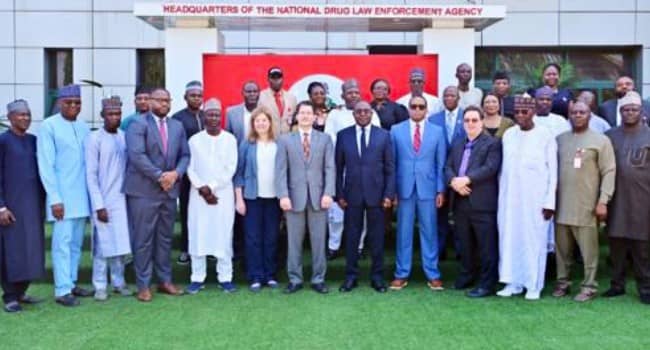
According to a statement issued by the Public Affairs Section of the US Diplomatic Mission on Monday, the engagements involved officials of the EFCC, Office of the National Security Adviser, National Drug Law Enforcement Agency and Nigeria Police Force.
The discussions, which coincided with Nigeria’s Cybercrime Awareness Week, focused on improving intelligence sharing, strengthening investigations and expanding cooperation to target criminal networks operating across national borders.
The US mission also disclosed that Nigeria extradited two alleged cybercriminals to the United States in August over separate financially motivated sextortion cases involving American minors who died by suicide.
It commended the contributions of the EFCC, Federal Ministry of Justice and Office of the Attorney-General of the Federation to investigations and extradition proceedings.
The American government, however, stressed the need to move beyond the arrest and extradition of individual suspects to dismantling the wider criminal networks, financial infrastructure and facilitators sustaining cybercrime operations.
On the growing threat of sextortion, the US government cited figures from the National Center for Missing & Exploited Children, which received more than 50,000 reports of financially motivated sextortion in 2025.
This translates to approximately 137 reports daily, highlighting the scale of the threat confronting young people, particularly those exposed to online exploitation.
The statement noted that the FBI had identified Nigeria and other parts of West Africa, alongside Southeast Asia, as locations where some of the most prevalent sextortion networks had operated.
It added that the FBI, through Operation Artemis and related initiatives, was working with Nigerian authorities to identify and disrupt criminal networks targeting American citizens.
The US government also expressed concern over romance scams, which it said exploit victims’ trust and emotional relationships to defraud them of their life savings and retirement funds.
Meanwhile, the Nigeria Police Force National Cybercrime Centre launched a nationwide online safety and cyber-hygiene campaign in March to raise awareness about romance scams, sextortion, phishing, identity theft and business email compromise.
During his meeting with the EFCC, Gonzales reportedly commended the commission for its record of high-profile prosecutions, asset recovery and public engagement, describing it as one of Africa’s most recognised economic crime enforcement agencies.
The US mission said the EFCC-FBI partnership demonstrated the importance of international law enforcement cooperation through intelligence sharing, suspect identification, arrests and the handling of complex extradition proceedings.
The latest engagement is part of broader security cooperation between Nigeria and the United States, including the establishment of a Nigeria-US Joint Working Group to coordinate responses to shared security challenges.
In November 2025, the National Security Adviser, Nuhu Ribadu, led a high-level Nigerian delegation to Washington, where it held meetings with officials of the US Congress, White House Faith Office, State Department, National Security Council and Department of War.
The delegation included the Attorney-General of the Federation, the Chief of Defence Staff and the Inspector-General of Police.
Subsequent engagements included a meeting between Ribadu and US Vice President JD Vance in May 2026 and a visit to Abuja by US Assistant Secretary of State Frank Garcia in July.
The discussions covered counterterrorism, intelligence sharing, defence cooperation and regional security.
The US government identified improved information sharing, faster investigations involving cyber and financial intelligence, wider public awareness campaigns and stronger investigative and prosecutorial capacity as key priorities for the next phase of the partnership.
However, the increasing number of extraditions also underscores the cross-border nature of cybercrime and the need for sustained cooperation among law enforcement agencies to track suspects, trace illicit financial flows and protect vulnerable internet users.
 '
 '
Do you want to share a story with us? Do you want to advertise with us? Do you need publicity for a product, service, or event? Contact us on WhatsApp +2348183319097 Email: platformtimes@gmail.com
We are committed to impactful investigative journalism for human interest and social justice. Your donation will help us tell more stories. Kindly donate any amount HERE
 '
