

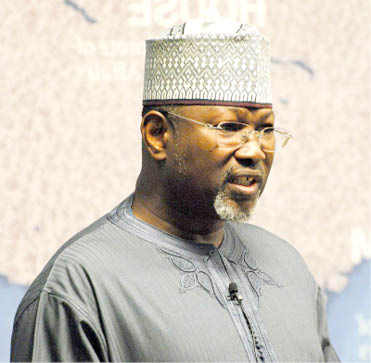
Daud Olatunji
As Nigeria moves towards the 2027 general elections, former Chairman of the Independent National Electoral Commission, Prof. Attahiru Jega, the incumbent INEC Chairman, Prof. Joash Amupitan, and the European Union Ambassador to Nigeria and ECOWAS, Gautier Mignot, have raised concerns over the growing threat of artificial intelligence-driven disinformation to electoral credibility.
The stakeholders warned that the increasing sophistication and accessibility of Artificial Intelligence tools could provide politicians and other malicious actors with new opportunities to manipulate public opinion, circulate fabricated electoral information and undermine citizens’ confidence in the electoral process.
They spoke on Monday in Abuja at a national summit on Artificial Intelligence, Foreign Information Manipulation and Interference, and electoral information integrity, themed, ‘Beyond The Ballot: Safeguarding Electoral Information Integrity In The Age Of AI’.
Jega, who advocated the deployment of AI-powered chatbots by INEC, said the technology could help voters access accurate electoral information and verify questionable claims before they spread across communities and social media platforms.
The former INEC chairman, however, stressed that the commission must not wait until the election period before developing mechanisms to tackle emerging technological threats.
He urged the electoral umpire and other stakeholders to anticipate possible challenges, strengthen their preparedness and establish a rapid-response framework capable of addressing disinformation before it causes significant damage.
Jega said, “What is most important, of course, is how we prepare, anticipate these challenges, and take appropriate measures, particularly in terms of setting up a framework of rapid response to address this.”
Drawing from his participation in the 2024 Cambridge Conference on Electoral Democracy, he said election management bodies, particularly in Africa, should consider using chatbots equipped with officially verified information to provide reliable answers to voters.
According to him, such platforms could enable citizens to obtain accurate information and determine the authenticity of electoral claims circulating online.
He said, “I participated in the 2024 Cambridge Conference on Electoral Democracy, during which a lot of time was spent on discussing the need for election management bodies specifically in Africa to consider, among other things, employing chatbots with officially provided accurate data and information so that people who are looking for information can quickly obtain it, over the day, and for ascertaining the verity or otherwise of information being circulated.”
Jega maintained that AI should not be viewed exclusively as a threat, noting that its constructive applications could help electoral institutions improve communication and protect information integrity.
He added that public confidence in INEC and other electoral stakeholders would depend largely on their ability to respond promptly and effectively to emerging challenges.
The incumbent INEC chairman, Amupitan, also warned that the rapid spread of generative AI tools had lowered the barriers for individuals and organised groups seeking to interfere with electoral processes.
He explained that although AI could improve voter registration, election logistics, data analysis and administrative efficiency, its misuse could produce highly convincing falsehoods capable of misleading voters and provoking political tension.
Amupitan identified cloned voices, fabricated videos of electoral officials, fake operational directives and automated online campaigns designed to create artificial public outrage as some of the emerging threats.
He warned that malicious actors could circulate forged accreditation portals, fabricate information about voter registration and manipulate announcements concerning election results or the cancellation of elections in strategic constituencies.
Such false announcements, he noted, could confuse voters, trigger unrest and weaken public confidence in the credibility of the 2027 elections.
The INEC chairman consequently called for stronger collaboration among the commission, security agencies, independent fact-checkers, media organisations and technology platforms to identify emerging threats, authenticate evidence and provide timely responses.
He also stressed the need to strengthen INEC’s digital infrastructure and intensify voter education to ensure that citizens could distinguish official electoral communications from manipulated content.
In his remarks, the European Union Ambassador to Nigeria and ECOWAS, Mignot, warned that the manipulation of electoral information posed a direct threat to citizens’ ability to make informed democratic choices.
He explained that fabricated announcements about polling units could send voters to wrong locations, while false election results could fuel suspicion and political tension before authentic information became available.
Mignot noted that although AI offered opportunities to improve translation, accessibility and public communication, it had equally made deception easier to produce and more difficult to detect.
The EU envoy, however, cautioned that Nigeria’s response should go beyond identifying deepfakes, arguing that the broader challenge was to create an electoral information environment where credible information was readily available and institutions could communicate transparently.
He said, “The task is therefore broader than detecting deepfakes. It is to build an electoral information environment in which reliable information is available, institutions communicate credibly, independent journalism can flourish and manipulation has a prepared response.”
Mignot outlined three priorities for Nigeria ahead of the 2027 elections: early preparedness, functional partnerships among relevant stakeholders and the protection of democratic rights while safeguarding electoral information.
He urged INEC and other institutions to establish clear verification procedures, communication responsibilities and escalation channels before election day.
According to him, waiting until election day to determine who should verify information or authorise official announcements could undermine efforts to contain falsehoods.
He also warned against using the fight against disinformation as a justification for suppressing legitimate criticism, investigative journalism or political disagreement.
The ambassador said, “A citizen questioning an institution is not necessarily spreading disinformation. A journalism reporting a failure is performing the democratic function.”
He stressed that journalists must retain their editorial independence, fact-checkers must be free to reach independent conclusions, academics must operate within their areas of competence, while digital platforms should explain their decisions and provide appropriate avenues for review.
Mignot further called for deliberate measures to protect women from online intimidation, falsehoods and coordinated digital attacks.
He advocated making verified electoral information accessible in local languages, through community media and in formats suitable for persons with disabilities.
Delivering the keynote address, Prof. Abigail Ogwezzy-Ndisika warned that Nigeria’s experience during the 2015, 2019 and 2023 general elections showed an increasingly sophisticated pattern of digital electoral manipulation.
She explained that the 2015 elections exposed the country to data-driven political interference, including psychological profiling of voters and targeted advertising by foreign political consultants seeking to exploit existing ethnic and religious divisions.
By 2019, she said, the manipulation had evolved into a domestic disinformation economy involving paid social media influencers, political operatives and coordinated networks spreading unverified information.
Ogwezzy-Ndisika warned that the trend could become more dangerous in 2027 if relevant institutions failed to develop a coordinated response.
She urged Nigerians to stop forwarding unverified messages, particularly during election periods, and rely on authoritative information from INEC and credible media organisations.
The professor called for the institutionalisation of an Electoral Information Integrity Response Protocol before the 2027 elections, warning that fragmented responses could allow fabricated information to spread unchecked.
She identified five major threats requiring urgent attention: AI-generated political manipulation, foreign influence operations, the weaponisation of authentic evidence, institutional fragmentation and possible government overreach in efforts to combat disinformation.
According to her, even genuine photographs, videos and other authentic materials could be manipulated, taken out of context or selectively presented to mislead voters.
She also cautioned that measures introduced to tackle disinformation without adequate judicial oversight and human rights safeguards could be abused to restrict civic space, suppress investigative journalism and undermine freedom of expression.
To address the threats, Ogwezzy-Ndisika proposed a six-stage operational framework involving early warning and detection, incident triage, independent forensic verification, digital evidence preservation, strategic escalation and rapid public counter-messaging, followed by post-incident reviews.
She said the framework should incorporate joint monitoring mechanisms, multiple social-listening channels and automated systems capable of identifying emerging synthetic content before it gains widespread circulation.
Emphasising the importance of early intervention, she said, “Prevention is very important before virality because it will have permeated so hard and, you know, the damage will have been done.”
The keynote speaker also advocated the establishment of a non-partisan verification hub where flagged synthetic content could undergo independent examination.
She called for standardised procedures for capturing, preserving and archiving digital evidence to ensure that manipulated electoral content could be properly investigated.
However, she warned that the protection of electoral information integrity must not become a cover for authoritarian practices.
She said, “Protecting that information integrity must never become a pretext for authoritarian overreach because we’re looking at rights and safeguards.”
The stakeholders’ warnings come amid growing concerns over the capacity of political actors and other non-state groups to exploit digital platforms to influence public perception, particularly as political activities ahead of the 2027 general elections gather momentum.
They maintained that credible elections would require more than the deployment of technology, stressing the importance of institutional transparency, independent journalism, public awareness and coordinated responses to emerging threats.
 '
 '
Do you want to share a story with us? Do you want to advertise with us? Do you need publicity for a product, service, or event? Contact us on WhatsApp +2348183319097 Email: platformtimes@gmail.com
We are committed to impactful investigative journalism for human interest and social justice. Your donation will help us tell more stories. Kindly donate any amount HERE
 '
