

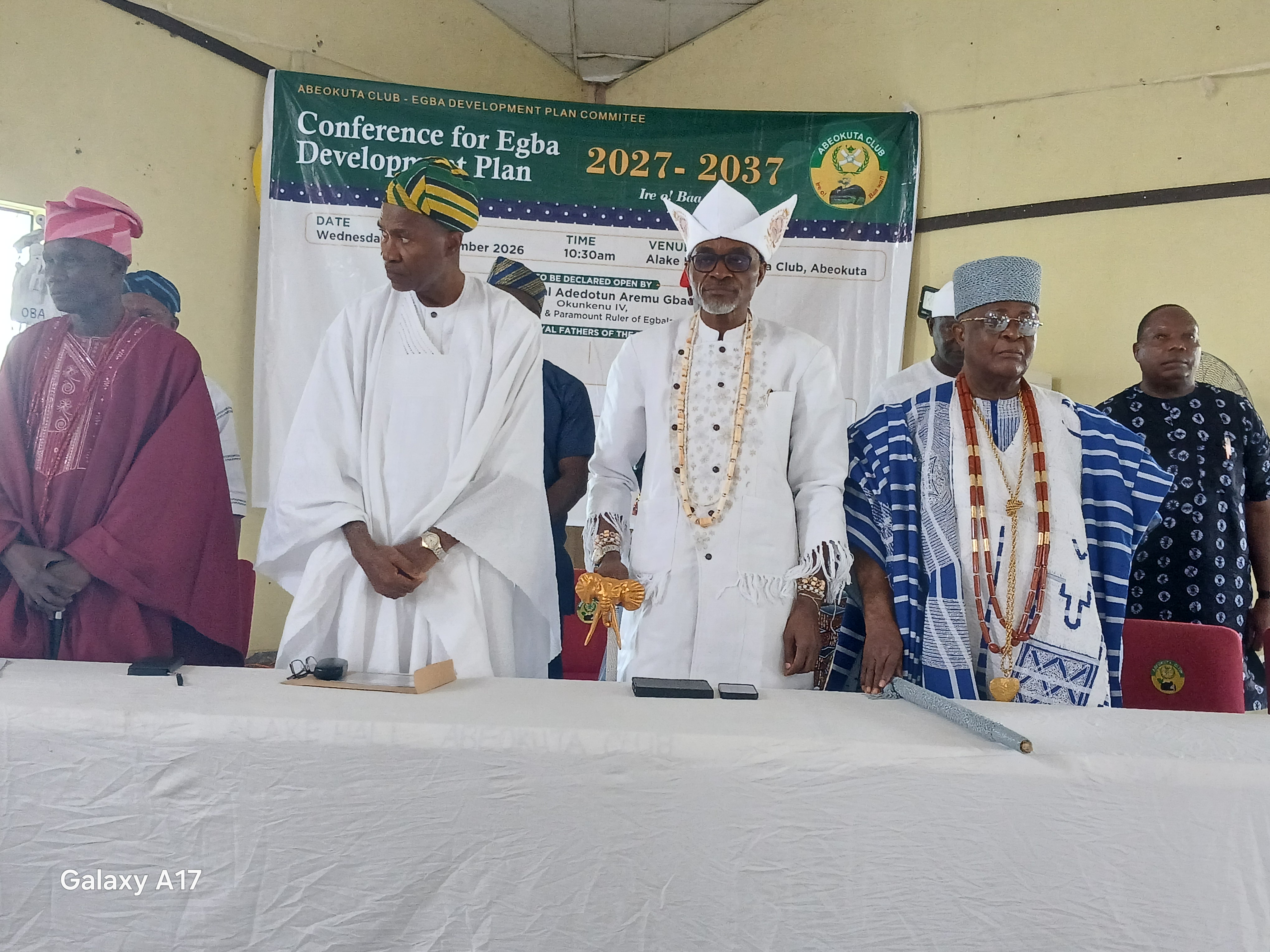
..Alake says Egbaland has been short-changed, demands greater attention for Ogun State capital
…Olowu identifies tourism, education, technology, manufacturing as growth drivers
Daud Olatunji
The Alake and Paramount Ruler of Egbaland, Oba Dr Michael Gbadebo, has charged Egba indigenes at home and in the diaspora to unite behind a proposed 10-year development blueprint aimed at restoring Egbaland’s lost economic, educational and infrastructural glory.
The monarch lamented that Egbaland had been short-changed over the years, insisting that Abeokuta, as the capital of Ogun State, deserved greater attention and development commensurate with its historical status and contributions to Nigeria.
Oba Gbadebo gave the charge on Wednesday during the stakeholders’ conference on the Egba Development Plan 2027–2037, organised by Abeokuta Club at its clubhouse in Abeokuta.
The conference brought together traditional rulers, professionals, business leaders and other stakeholders to deliberate on a comprehensive development framework for the six local government areas making up Egbaland.
The monarch, who delivered the royal goodwill message, described the initiative as timely, particularly with the state government approaching a transition period, and urged Egba sons and daughters to take ownership of the development agenda
He said the success of the plan would depend largely on the commitment of stakeholders to promote and defend its objectives wherever they found themselves.
“I want to charge all of you that wherever and whatever post you occupy, you are ambassadors of Egbaland. The moment the development plan is communicated, you will be the ones to represent Egbaland in promoting it,” the monarch said.
Expressing concern over what he described as the region’s prolonged developmental disadvantage, Gbadebo said the present condition of Egbaland did not reflect its historical importance and contributions.
“We have been short-changed over the years because we are not supposed to be where we are now,” he lamented.
The Alake also questioned why Abeokuta had not enjoyed the level of economic concentration and infrastructural development associated with Lagos when it served as Nigeria’s capital, arguing that the relocation of the Federal Capital to Abuja had further affected the distribution of development opportunities.
“When Lagos was the capital of Nigeria, it got everything, and our economic position today is because of Abuja, which has taken virtually everything we have for development. Why not Abeokuta, the capital of Ogun State?” he queried.
He also recalled the contributions of a former Egba leader whose reforms, he said, attracted opposition but were necessary for the advancement of the area.
The Alake, however, maintained that Egbaland must not allow its historical achievements to become an excuse for complacency, particularly in the area of education.
Describing Egbaland as the educational capital of Nigeria, Gbadebo urged the people to consolidate their longstanding reputation in education and remain ahead through sustained investment in human capital .
We are the Educational Capital of Nigeria. Nobody is competing with us, and when we have education, we have everything else. So, how can they catch us up if we don’t stop? We should keep on moving,” he said.
He further emphasised the need for cooperation among the traditional institutions, noting that the Egba Traditional Council and all its constituent monarchs had responsibilities to promote development across their respective domains.
“Every king in Egbaland must therefore develop and get what is best for each party,” he added.
The monarch expressed optimism that the initiative would mark the beginning of a new chapter of development and collective achievements for the Egba people.
Olowu seeks Abeokuta’s emergence as leading West African city
Similarly, the Olowu of Owu, Oba Saka Matemilola, called for a comprehensive transformation of Abeokuta from a city celebrated mainly for its historical achievements into a modern, economically competitive and internationally recognised urban centre.
The monarch made the call in a presentation titled, “Abeokuta Among the Great West African Cities: Proud Heritage, Present Strengths and a Bold Vision for the Future.”
He argued that Abeokuta possessed the historical foundation, cultural identity, human capital and geographical advantages required to compete with major West African cities, including Lagos, Accra, Abidjan, Dakar, Kumasi, Ibadan and Cotonou.
According to him, the challenge before the city is to translate its historical accomplishments and existing economic potential into measurable development outcomes.
“Few cities in West Africa capture the story of survival, intellect and modern transformation as vividly as Abeokuta. But our dear city must move from being a city celebrated principally for what it was to becoming a city admired for what it is building and what it will become,” he said.
He identified heritage tourism, education, Adire production, creative industries, agricultural innovation, manufacturing and technology as sectors capable of driving Abeokuta’s transformation.
The Olowu also highlighted the city’s strategic proximity to Lagos, describing it as an advantage that could attract businesses, investors, tourists and young professionals seeking opportunities outside Nigeria’s commercial hub.
He called for deliberate urban renewal, improved public transportation, better water supply, effective waste management and flood-control infrastructure.
On the implementation of the proposed vision, the monarch advocated a phased development strategy spanning 2027 to 2036.
The first phase, according to him, should focus on laying the institutional foundation, strengthening partnerships among universities, government and industry, and establishing measurable performance indicators for development projects.
Oba Matemilola also called for a diversified funding structure involving government allocations, public-private partnerships, private sector investment, diaspora contributions and international development grants.
He warned against a development culture driven by announcements rather than actual delivery.
“Every major project should have a clear business case, implementation structure, funding strategy, maintenance plan and measurable public benefit. We must move away from a culture of announcing projects to a culture of delivering sustainable results,” he stated.
The monarch further urged traditional institutions, government, businesses, educational institutions, community organisations, women, youths and Egba indigenes in the diaspora to take collective responsibility for the city’s transformation.
He said the success of the vision should be measured through increased employment, improved infrastructure, higher investment, better educational outcomes, reduced flooding, improved sanitation and greater participation of women and young people in economic activities.
Concluding his presentation, Matemilola said Abeokuta must preserve its cultural identity while embracing modernisation and economic expansion.
“Our heritage is our foundation. Our people are our greatest assets. Our present strengths are our building blocks. Our collective vision is our roadmap. Our determination must be our driving force,” he said.
He recalled that the Egba people once operated a recognised system of self-government before the amalgamation of Nigeria in 1914, noting that the historical experience demonstrated the capacity of the people to organise institutions and pursue collective development.
The President of Abeokuta Club Adewale Adeola, said the club consequently constituted a committee to develop an evidence-based and forward-looking framework that would guide Egbaland’s political, economic, social and infrastructural development over the next decade.
He explained that the stakeholders’ conference was designed to obtain contributions from different segments of the society, identify pressing challenges and determine the projects and policies required to secure a more prosperous future.
According to him, the outcome of the deliberations would be compiled into a comprehensive report and presented to the Alake as a strategic document for engaging successive governments, political office seekers and development partners.
He stressed that the document would remain non-partisan and would not be tied to any political party or administration.
The plan shall thereafter serve as the strategic reference document for engagement, advocacy and negotiation with successive governments, with those seeking political office and with development partners, so that the collective aspirations of our people are clearly articulated, properly documented and consistently advanced, irrespective of political affiliation or change of administration,” Ayodele said.
The representatives of the Osile of Oke-Ona Egba and the Agura, Chiefs Oluranti Adebayo and Festus Kehinde, respectively, alongside a representative of the Olubara of Ibara, pledged their support for the Egba Development Plan 2027–2037.
They urged sons and daughters of Egbaland to unite behind the proposed development agenda, stressing the need for collective commitment to secure the region’s progress.
….Committee identifies six development pillars
In his welcome address, the Chairman of the Committee on Egba Development Plan 2027–2037, Adebayo Ayodele, traced the historical development of Egbaland, noting that the Egba people began settling in Abeokuta around 1830, with the different sections occupying separate quarters of the town.
He identified the four traditional sections of Egbaland as Egba Alake, comprising Eku, Aarin and Agbeyin; Egba Oke-Ona; Egba Agura; and Egba Owu.
The committee chairman also recalled the January 18, 1893 Treaty of Independence between the Egba Kingdom and the British colonial authorities, which provided for freedom of trade between the Egba Nation and Lagos and addressed restrictions on roads connecting the two territories.
He highlighted the subsequent establishment of the Egba United Government in February 1898 and the development of institutions covering commerce, industry, education, transportation, healthcare and security.
Among the historical milestones highlighted were the establishment of the Egba United Government Police Force in 1904 and the Government Hospital in 1908.
However, he lamented that many of the institutions and developmental structures established by the forefathers had deteriorated, resulting in setbacks in the region’s economic, educational, infrastructural and administrative development.
He cited historical accounts from a 1937 Abeokuta Intelligence Report compiled by Major J.H. Blair, which described the city as having electrically lit roads, pipe-borne water, substantial commercial activities, well-built houses and a thriving indigenous transport sector.
The proposed blueprint, he said, was built around six major pillars: economic sovereignty, infrastructure, human capital, security and justice, identity and culture, and institutional capacity for development.
He disclosed that specialised consultants had provided professional inputs into the proposed framework, which would also incorporate memoranda and recommendations from stakeholders in Nigeria and the diaspora.
Describing the initiative as non-partisan, the committee chairman said its ultimate objective was to promote the greatest happiness for the greatest number of people.
He expressed optimism that the plan would provide a practical roadmap for sustainable development and move the region away from what he described as a stomach-infrastructure-driven approach to governance.
“Our forefathers laid a solid foundation for us. It is our responsibility to build upon that foundation, address the challenges of the present and bequeath a stronger, more prosperous and progressive Egbaland to future generations,” he said.
The conference is expected to provide the foundation for a collective development framework that will guide advocacy, investment mobilisation and engagement with successive administrations over the next decade.
For the Egba people, the central challenge now is translating the proposed blueprint, historical lessons and royal calls into funded projects, accountable institutions and tangible improvements in the lives of residents across the six local government areas.
In his closing remarks, the Mayegun Egba, High Chief Adeshina Luwoye, commended participants for their contributions, describing the stakeholders’ conference as a significant step towards reclaiming Egbaland’s developmental future.
He said the contributions made during group discussions and through submitted demand forms would form the foundation of the Egba Development Plan 2027–2037, stressing that the initiative belonged to the people across the six local government areas, irrespective of political affiliation.
“This Plan is yours. It belongs to no party and to no government. It belongs to the six local governments of Egbaland and to the people who live in them,” he declare
Luwoye assured participants that every demand form and group report submitted would be carefully examined and documented, while their identified priorities would be incorporated into the development blueprint.
He also pledged that the committee would report back to stakeholders on how their contributions had been utilised.
He urged Egba indigenes to take the development message to their communities, associations and representatives, insisting that collective commitment would be necessary to translate the proposed vision into reality.
Acknowledging possible challenges, he expressed confidence that the initiative would succeed, saying the spirit of Egbaland’s forebears had been rekindled through the collective decision to pursue a shared development agenda.
“Generations born and unborn will be proud of each one of us, for the path we have chosen and for the sacrifice we have made today to change the destiny of Egbaland and bring prosperity to our land, our people, and all who live and do business here,” he said.


Do you want to share a story with us? Do you want to advertise with us? Do you need publicity for a product, service, or event? Contact us on WhatsApp +2348183319097 Email: platformtimes@gmail.com
We are committed to impactful investigative journalism for human interest and social justice. Your donation will help us tell more stories. Kindly donate any amount HERE

