

Daud Olatunji
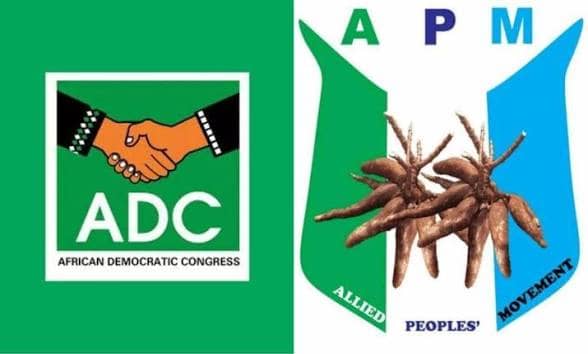
The African Democratic Congress (ADC) and the Allied Peoples Movement (APM) have condemned a statement attributed to former Osun State Governor, Chief Bisi Akande, suggesting that President Bola Tinubu should remain in office for another 10 years.
The two opposition parties described the reported proposal as unconstitutional and dangerous to Nigeria’s democracy, warning that it could signal attempts to test public opinion on tenure elongation ahead of the 2027 general elections.
The controversy followed comments by former Osun State Governor, Chief Bisi Akande, who reportedly urged President Bola Tinubu to remain in office for up to 10 years, if possible, to enable him to complete his ongoing projects and reforms.
Akande made the appeal during an interview on the Frankly Speaking with Icon podcast, published on Friday, expressing optimism that Tinubu’s policies would produce lasting positive changes if given sufficient time to mature.
He argued that the President needed more time to consolidate his initiatives and tackle challenges inherited from years of military rule, emphasising that continuity in leadership was essential to achieving meaningful national development.
While the ADC described the proposition as alarming and politically reckless, the APM alleged that it exposed a possible agenda within the ruling All Progressives Congress to extend Tinubu’s stay in office beyond the constitutional limit.
The reactions followed comments attributed to Akande, a former interim National Chairman of the APC and a longstanding political associate of Tinubu, advocating an additional decade for the President in office.
In a statement issued in Abuja on Sunday, the ADC Presidential Campaign Council, through its Director of Media and Publicity, Kola Ologbondiyan, reminded Akande that the 1999 Constitution, as amended, provides for a four-year presidential term, renewable only once.
The council insisted that there was no constitutional provision for a third term or any arrangement permitting a president to remain in office beyond the prescribed eight-year limit.
It said: “There is no constitutional provision for a third term or any form of tenure elongation.
“It is brazenly arrogant, politically reckless and constitutionally indefensible for Chief Akande to canvass an additional ten years for President Tinubu, particularly at a time when Nigerians are grappling with unprecedented economic hardship, insecurity and deepening public dissatisfaction with the performance of the present administration.”
The ADC campaign council expressed concern that Akande, having served as deputy governor and governor of Osun State, would support an idea it considered inconsistent with the democratic principles that enabled him to occupy public office.
It also argued that Nigerians should not dismiss the reported proposal as an ordinary political comment, considering Akande’s longstanding relationship with Tinubu and his influence within the ruling political establishment.
The council recalled Nigeria’s political history, particularly the failed self-succession ambition of the late Head of State, General Sani Abacha, and the controversial third-term bid of former President Olusegun Obasanjo.
It said the episodes remained important reminders of the country’s resistance to attempts by political leaders to prolong their stay in power beyond constitutional provisions.
Describing Nigeria as a democracy rather than a monarchy, the ADC maintained that the presidency could not be treated as the inheritance of an individual, political family or group.
“The ADC will not accept a third term by proxy, tenure elongation by political suggestion or dictatorship by trial balloon,” the statement declared.
The campaign council called on the National Assembly, judiciary, civil society organisations, traditional rulers, religious leaders and the media to speak out against any proposition capable of undermining constitutional democracy.
It also challenged Tinubu to publicly distance himself from Akande’s reported position and reaffirm his commitment to the Constitution and the principle of presidential term limits.
According to the ADC, the 2027 presidential election provides Nigerians with an opportunity to exercise their democratic rights and determine the country’s political direction.
Similarly, the Allied Peoples Movement, through the Makinde-Daura Presidential Campaign Organisation (MDPCO), described Akande’s reported proposal as a threat to democratic governance, national unity and political stability.
In a statement signed by its Director of Strategic Communications, Richard Ihediwa, the organisation alleged that the former governor’s comments had reinforced concerns about a possible plan to extend Tinubu’s presidency beyond the constitutionally permitted period.
It described Akande as a longstanding ally and confidant of Tinubu, arguing that his reported remarks should not be treated lightly.
The organisation said: “This subversive comment by Chief Akande, a long-standing ally and confidant of President Tinubu, and embodiment of a deep state under the current administration, evokes a hidden agenda for tenure elongation for the President beyond the constitutional limit.”
The MDPCO further alleged that the reported proposal was particularly disturbing amid growing dissatisfaction with the Tinubu administration and preparations for the 2027 general elections.
It described the suggestion of an additional 10 years as an invitation to anarchy, claiming that it could provide political justification for attempts to manipulate the forthcoming presidential election.
The organisation also linked the controversy to Tinubu’s recent campaign remarks in Enugu, where the President reportedly described the opposition as non-existent.
It argued that the comments, alongside what it alleged to be increasing pressure on opposition parties, raised concerns about efforts to weaken political competition and establish a one-party system.
The campaign organisation further alleged a pattern of political intimidation, attempts to acquire opposition mandates, sponsored internal crises within opposition parties, legal battles against opposition leaders and threats of political violence.
It also expressed concern over reported attacks on opposition campaign activities, insisting that such developments could undermine democratic competition.
Questioning whether Tinubu was seeking to emulate African leaders who remained in power for extended periods, the organisation asked: “Is President Tinubu playing Robert Mugabe, Paul Biya or Mobutu Sese Seko?”
It warned against what it described as the gradual weakening of democratic institutions, including the National Assembly, and urged Nigerians to resist any attempt to undermine constitutional governance.
“The question is; should our country be allowed to slide into a full-blown tyranny? NEVER!” the statement declared.
The APM further insisted that Nigeria was not Zimbabwe under the late Robert Mugabe, Cameroon under Paul Biya or the former Zaire under Mobutu Sese Seko.
“Nigeria is not Mugabe’s Zimbabwe, Biya’s Cameroon or Mobutu’s Zaire. Nigerians will resist any attempt to rig the 2027 general elections or any illegitimate contraption for tenure elongation,” it added.
The organisation called on Nigerians to remain vigilant and support what it described as a new political direction under Oyo State Governor, Seyi Makinde, whom it urged voters to elect as the next President on the APM platform.
It said the country needed leadership capable of strengthening constitutional governance, revitalising the economy, promoting national unity and improving citizens’ living conditions.
The two opposition reactions have added a fresh dimension to the political debate ahead of the 2027 general elections, with both parties demanding respect for constitutional term limits.
However, the statements contained allegations of a possible tenure elongation agenda and wider attempts to weaken opposition parties. No evidence of an established plan by the Federal Government or the APC to extend Tinubu’s tenure was presented in the statements.
Under Section 137(1)(b) of the 1999 Constitution, as amended, a person is disqualified from election to the office of President if elected to that office at any two previous elections. The constitutional framework therefore limits a president to two elected terms.
Tinubu, who assumed office on May 29, 2023, is currently serving his first four-year term and would be eligible to seek re-election in 2027, subject to the provisions of the Constitution.


Do you want to share a story with us? Do you want to advertise with us? Do you need publicity for a product, service, or event? Contact us on WhatsApp +2348183319097 Email: platformtimes@gmail.com
We are committed to impactful investigative journalism for human interest and social justice. Your donation will help us tell more stories. Kindly donate any amount HERE