

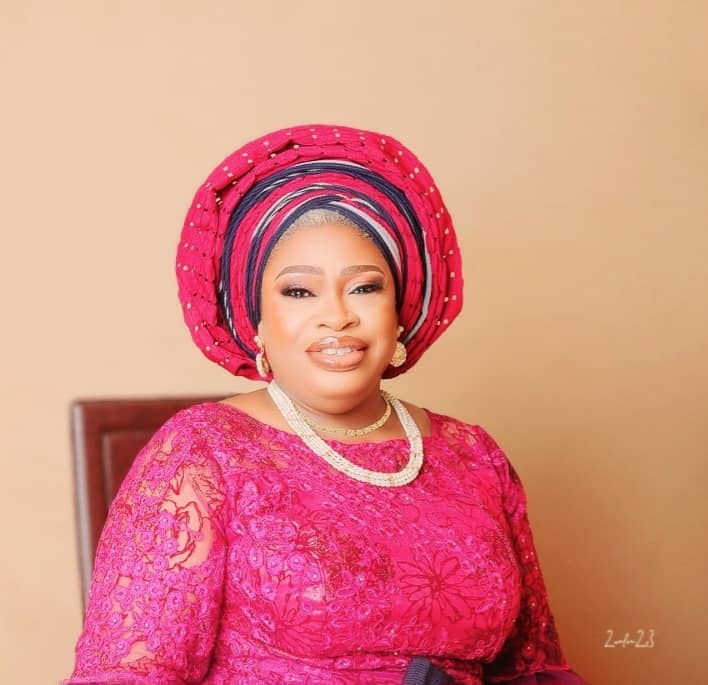
After 26 years in public service, Mrs Olufunke Francisca Salako reflects on career, widowhood, faith, and the values she believes Nigeria must urgently rediscover.
After 26 years in Nigeria’s public service, rising from a junior officer to become the pioneer South-West Zonal Director of the National Orientation Agency, Mrs Olufunke Francisca Salako is bowing out of service.
A trained journalist who once worked briefly in the newsroom before life redirected her path, Salako rebuilt her professional life after a decade-long career break and the loss of her husband. Through resilience, faith and a steadfast belief in integrity, she rose steadily through the ranks of the NOA.

In this interview with Editor of PLATFORM TIMES, DAUD OLATUNJI, the outgoing zonal Director, speaks about retirement, the twists of her career journey, marriage across cultural divides, surviving widowhood, and why she believes Nigeria’s greatest challenge is the erosion of integrity. Enjoy the excerpts;
You are leaving the service after 26 years. How does that feel?
It is honestly bittersweet. There is the sweet part, the prospect of not having to wake up early every morning, dress up and live that regimented routine anymore. I can go where I want and do what I want, when I want.
But there is also the other side, the adjustment. I have always had somewhere to go every day. So you wonder what life will be like without that structure. Whenever I told people I would soon retire, they always asked what I planned to do next. My answer was always the same: nothing for now. I want to enjoy this period, rediscover myself and do the things I like. If I eventually get bored, then I will think about the next step. But for now, my priority is simply having time for myself.
Beyond your career title, how would you describe yourself?
First, I am a mother. I hope I have been a good friend to those who consider me one, a good boss to those who worked under me and a supportive colleague to my contemporaries.
Above all, I am a child of God. That has always been my anchor. My principles come from my relationship with God. Even when it comes to work, I believe some of the best work ethics are found in the Bible. I have always tried to give my best, to the best of my ability.
Tell us about your educational journey.
I began my education at Yewa Memorial Nursery and Primary School in Lagos. For secondary school, I left in Primary Five and took the private entrance examination into Our Lady of Apostles (OLA) Convent School in Ijebu-Ode.
I lived with my grandparents there for two years. Because life was comfortable and relaxed, my academic performance was not very impressive. My parents — my mother, a teacher, and my father, a chartered accountant, were not pleased.
They eventually transferred me to Marywood Grammar School in Costain/Apongbon, Lagos, another Catholic girls’ school, where I completed my School Certificate in 1979.
Afterwards, I went to Abeokuta for my A-Levels at Ogun State Polytechnic, a two-year programme. During that period, I sat for JAMB twice without success. My father had warned me about the realities of university admissions and catchment areas, but I was young and idealistic.
My first choices were the University of Nigeria and the University of Sokoto. No admission. The second time I chose Ahmadu Bello University, Zaria, and the University of Jos — still nothing.
The third time, I listened to my father and chose the University of Ife as my first choice. I was admitted in the first batch and studied English and Literary Studies, graduating around 1986 or 1987.
After graduating from Ife, what came next?
I was posted to Kano for my National Youth Service but was later redeployed to Kaduna, where I served with the Daily Times of Nigeria.
That experience deepened my interest in journalism. After NYSC, I returned to Lagos and enrolled at the Times Journalism Institute. During my studies, I interned with The Guardian newspapers.
After graduating, I joined the Nigerian Tribune as a cub reporter. My postgraduate diploma in journalism effectively marked the end of my formal academic journey.
Your time in journalism was short. What happened?
Life happened. After joining Tribune, I was transferred to Kaduna. I got married shortly afterwards, and during pregnancy I had health complications that required complete bed rest.
What I thought would be a short break turned into about 10 years. During that time, I had my children and returning to work became difficult.
There was also the security situation in Kaduna — the Zango-Kataf crisis, the Sharia riots and other conflicts. They were terrifying experiences, especially with children.
The final turning point was the Sharia riots. Houses around us were burnt and people were killed right in front of our house. There was a two-week curfew. After that, I knew we had to leave.
We moved to Abuja and that was when I decided to revive my career.
How would you describe your experience in journalism?
It was a wonderful experience. One thing I appreciated about Tribune was the rotation system for young reporters. You would move from one beat to another — international, finance, and other major beats. It gave us exposure and helped build networks.
The newsroom environment was also exciting. This was before the digital age. After assignments, reporters would rush back to file stories through analogue telephones or telex machines.
You would literally read your story over the phone to someone at the headquarters while others did the same beside you. It seemed chaotic but it was exhilarating.
And if your story made the front page with your byline, you felt on top of the world. I was fortunate to have front-page bylines even within that short period.
How did you eventually join the National Orientation Agency?
It was not exactly a planned move. When we relocated to Abuja, I applied to several organisations. NOA was one of them.
Interestingly, other employment offers came after I had already accepted NOA’s offer, but I had made a commitment and decided to keep it.
During the recruitment process, someone suggested I might prefer a local government posting because it would be less stressful and I might not need to come to work every day.
I rejected that immediately. I said if I didn’t want to work every day, I wouldn’t take the job. I asked to be posted to headquarters because I wanted all the experience I could get.
Tell us about your rise through the ranks at NOA.
I started in the Publicity and Enlightenment Department as a Level 10 Senior Programme Officer.
Over time, the department evolved into Social Justice and Civic Education. I chose Social Justice because it aligned with my values.
Later, departments were merged into the Orientation and Public Enlightenment Department, where I spent several years.
When Dr Garba Abari became Director-General, he introduced new initiatives including the e-Poll platform. One day I received a memo to report to his office. After an interview and an assignment, I was transferred to the DG’s office to manage the e-Poll platform.
From there I was promoted to Assistant Director and later moved to the Planning, Research and Strategy Department, where I became Assistant Director of Research.
In 2021, I was posted to Ogun State where I eventually became State Director. In February 2025, I was appointed pioneer Zonal Director for the South-West.
What do you believe is Nigeria’s fundamental problem?
The loss of integrity. Integrity used to be part of our culture. Every Nigerian ethnic group has a concept similar to omoluabi — character, honour and responsibility.
But somewhere along the line, in the pursuit of wealth and success, we lost that value.
If integrity exists, accountability will follow. Unfortunately, we have normalised shortcuts — bribery, cutting corners, manipulating systems.
Until we rediscover integrity as a people, government policies alone will not fix Nigeria.
What advice would you give younger public servants?
Always do your best, whether someone is watching or not.
Work with integrity so that if you leave your office tomorrow, no one can question your actions.
I always asked myself two questions: if my children discovered what I did here, would I be proud? And what does God say about this decision?
If you can answer those questions honestly, you will do your job well.
Also, stay current. The world is changing rapidly — technology, artificial intelligence and new ways of working. Do not become rigid.
When exactly do you retire?
March 9 — which is also my birthday.
What comes next after retirement?
Rest. I want to read. I have piles of books waiting for me. I have also considered writing a book someday. But immediately? Rest.
Finally, what message do you have for Nigerians?
Patience. Nigeria has been through a lot, and progress may be slow, but this is the only country we have.
Instead of constantly running it down, we should give policies and reforms a chance to work.
With patience, integrity and commitment, I believe we can eventually get things right.
 '
' '
'Do you want to share a story with us? Do you want to advertise with us? Do you need publicity for a product, service, or event? Contact us on WhatsApp +2348183319097 Email: platformtimes@gmail.com
We are committed to impactful investigative journalism for human interest and social justice. Your donation will help us tell more stories. Kindly donate any amount HERE
