
Daud Olatunji
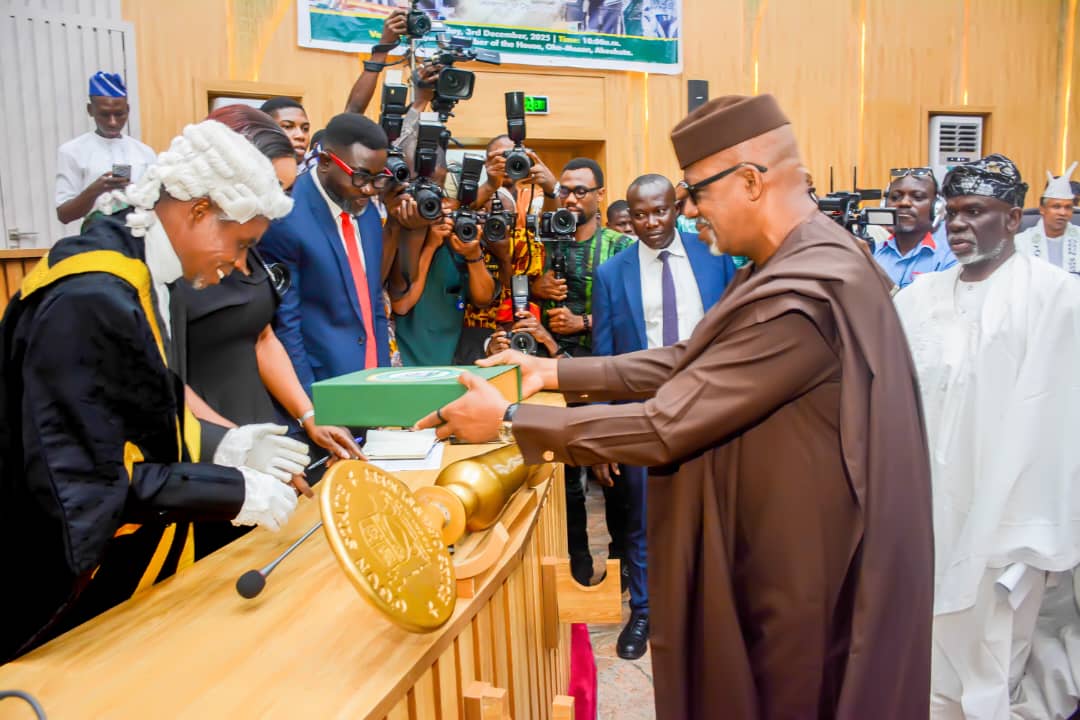
Ogun State Governor on Wednesday presented a N1.669 trillion Appropriation Bill for the 2026 fiscal year, with infrastructure receiving the largest allocation as the administration pushes to consolidate six years of what it described as unprecedented economic and structural growth.
The budget, tagged the “Budget of Sustainable Legacy,” marks the seventh consecutive financial plan of the administration and reflects what the governor called a deliberate commitment to continuity, consolidation and long-term impact.
Giving a broad overview of the State’s economic progress, the Governor disclosed that Ogun’s economy has expanded to an estimated ₦17 trillion Gross Domestic Product (GDP)—a growth he attributed to reforms, massive infrastructure development and private-sector confidence.
He added that Internally Generated Revenue (IGR) has grown remarkably from ₦52 billion in 2020 to ₦192 billion in 2024, and is projected to hit ₦250 billion by the end of 2025.
Highlighting achievements that shaped the 2026 spending plan, the Governor announced that the administration has constructed and rehabilitated over 1,500 kilometres of roads—a feat he said surpasses the combined achievements of previous administrations in 16 years.
He also listed the rehabilitation of over 140 Primary Health Centres equipped with solar power and Electronic Medical Records (EMR), describing the transformation as “life-changing and measurable.”
On major projects, he revealed that the once-stalled 250-bed Specialist Hospital in Oke-Mosan, now renamed the Ogun State Medical Centre of Excellence—is nearing completion.
Concessioned to Viewpoint Health Management Services Limited, he said the facility will provide world-class medical services, serve as a referral hub and create new jobs.
According to him, the administration also completed a dedicated access road to the Prof. Wole Soyinka Railway Station, and prioritised federal corridors including the 103km Sagamu–Papalanto Road and the 72km Ota–Abeokuta Road, described as critical to regional integration and transport efficiency.
Breaking down the expenditure, Abiodun said a total expenditure of ₦1,668,997,993,125.44 (₦1.669 trillion) is proposed for 2026—a 63% increase from the 2025 budget.
He disclosed that recurrent Expenditure takes ₦624.76bn which is 37% while the capital expenditure gulps ₦1.044tn , which is 63%.
He added that personnel Costs takes ₦167.92bn,consolidated Revenue Charges, ₦65.80bn, Public Debt Charges, ₦99.98bn, and overhead Costs, ₦291.06bn.
Infrastructure again takes centre stage with ₦526.15 billion, representing 32% of the entire budget, far ahead of any other sector and reflecting the administration’s heavy capital investment philosophy.
Abiodun said Education takes ₦275.40bn (17%) and Health takes ₦210.59bn (13%).
According to him, education spending covers new schools, facility upgrades and teacher development, while the health vote will fund hospital expansion, PHC revitalisation and recruitment of professionals.
Housing & Community Development: ₦166.96bn (10%), statewide projects: ₦129.67bn (8%)
Social Protection gulps ₦72.82bn (4%), Recreation, Culture & Religion get ₦42.24bn (3%)
General Public Service (Executive),₦55.65bn (3%)
Financial & Fiscal Affairs, ₦52.30bn (3%)
Legislature, ₦33.67bn (2%)
Agriculture & Industry, ₦40.54bn (2%)
Public Order & Safety gets ₦36.00bn (2%)
General Personnel Service gets ₦3.86bn (0.2%)
Economic Affairs gets ₦7.45bn (0.4%)
Judiciary gets ₦15.70bn (1%).
 '
' '
'Do you want to share a story with us? Do you want to advertise with us? Do you need publicity for a product, service, or event? Contact us on WhatsApp +2348183319097 Email: platformtimes@gmail.com
We are committed to impactful investigative journalism for human interest and social justice. Your donation will help us tell more stories. Kindly donate any amount HERE