
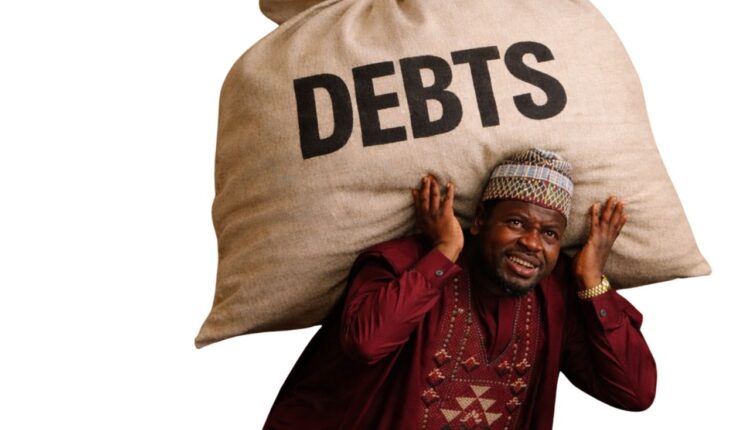
A review of Kaduna State’s fiscal projections has revealed that the government plans to spend more than 70 per cent of its internally generated revenue (IGR) on debt servicing between 2025 and 2028, raising fresh concerns about the sustainability of public finances and priorities in the state.
An analysis of the Kaduna State Medium Term Expenditure Framework (MTEF) for the four-year period shows that out of an estimated N385bn expected as IGR, about N275bn will be committed to servicing debts — representing roughly 71.4 per cent of the state’s own revenue.
According to the MTEF document, the state projects IGR of N112.1bn in 2025, N84.5bn in 2026, N90.4bn in 2027 and N98.3bn in 2028. However, debt servicing alone is estimated at N70.8bn in 2025, N76.6bn in 2026, N66.3bn in 2027 and N61.9bn in 2028.
Beyond the heavy debt burden, the document also shows that Kaduna plans to deepen its reliance on borrowing, with fresh loans totalling about N659bn within the same four-year period.
The state expects to borrow N145.7bn in 2025, N184.1bn in 2026, N166bn in 2027 and N163.8bn in 2028.
As of June 2025, Kaduna’s external debt stood at $658.7m, making it the most indebted state in the North-West zone. The figure accounts for about 63 per cent of the region’s total foreign debt stock of $1.047bn.
Despite the rising debt profile and huge debt servicing commitments, budget performance documents indicate continued spending on items widely considered non-essential.
Between January and September 2025, the state reportedly spent N3.2bn on estacodes for international trips by public officials.
This amount exceeded allocations to several key social sectors within the same period. For instance, Barau Dikko Teaching Hospital received N2.4bn, while the Kaduna State College of Nursing and Midwifery spent just N333.1m.
Spending on estacodes also matched the N3.2bn allocated to capital projects under the Primary Healthcare Board.
Similarly, only N3bn was spent on the construction and provision of health centres, while N477m went into water facilities between January and September 2025 — figures that fell below expenditure on foreign travel allowances.
Earlier budget reviews also showed that the state earmarked N3.8bn in the 2025 budget for the purchase of vehicles for lawmakers, despite having spent N1.5bn on the same purpose in 2024.
If fully utilised, spending on lawmakers’ vehicles within two years would reach N5.3bn.
In contrast, water infrastructure appeared underfunded, with N2.9bn allocated for construction and provision of water facilities in 2025 and just N602.8m set aside for rehabilitation of existing infrastructure.
Concerns have also been raised about poor spending on internal security in a state battling persistent banditry. In 2024, although N15.4bn was budgeted for capital expenditure under the Ministry of Internal Security, only N27.8m was reportedly spent between January and October.
In 2023, N4.1bn was budgeted, but actual spending stood at N2.7bn.
The low security spending has coincided with repeated attacks across Kaduna communities. In 2024 alone, bandits reportedly attacked churches and hospitals, abducted village heads and residents, and displaced hundreds of thousands of people across several local government areas.
Fiscal experts warn that unless Kaduna rebalances its spending priorities and curbs excessive borrowing, the growing debt burden could further constrain investments in critical sectors such as health, water, education and security, with long-term implications for development and social stability in the state.
 '
' '
'Do you want to share a story with us? Do you want to advertise with us? Do you need publicity for a product, service, or event? Contact us on WhatsApp +2348183319097 Email: platformtimes@gmail.com
We are committed to impactful investigative journalism for human interest and social justice. Your donation will help us tell more stories. Kindly donate any amount HERE
