

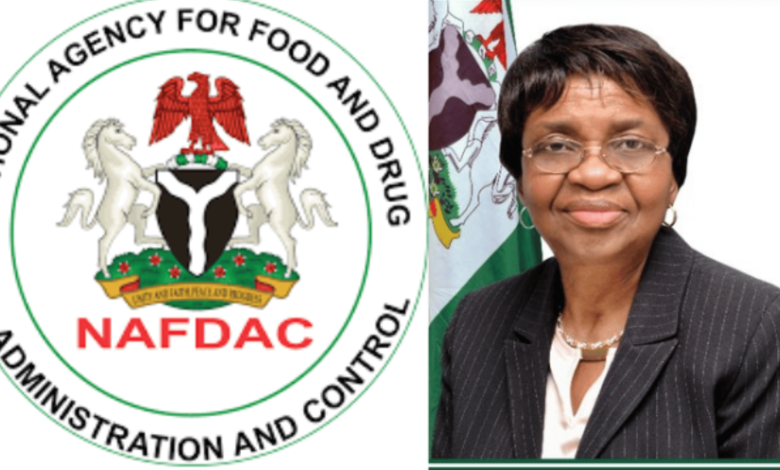
The National Agency for Food and Drug Administration and Control on Thursday resumed full enforcement of its ban on alcoholic beverages packaged in sachets and small plastic or glass bottles below 200 millilitres, insisting that the move is aimed at protecting children and other vulnerable Nigerians from harmful alcohol use.
The agency said no alcohol-producing company had been shut down, dismissing claims circulating on social media that factories had been sealed, and clarified that only specific packaging formats were affected.
Speaking on the enforcement, the Director-General of NAFDAC, Prof. Mojisola Adeyeye, said the action followed a directive of the Nigerian Senate and was backed by the Federal Ministry of Health and Social Welfare, in line with the agency’s statutory mandate to safeguard public health.
“NAFDAC did not close down any company that makes alcohol. What we have banned is alcohol in sachets and in small containers below 200 millilitres,” Adeyeye said.
She explained that the widespread availability of high-alcohol-content drinks in sachets and mini bottles had made alcohol cheap, easily accessible and easy to conceal, especially among minors and commercial drivers, fuelling rising cases of addiction, domestic violence, road crashes, school dropouts and other social vices.
“This ban is not punitive; it is protective. It is aimed at safeguarding the health and future of our children and youth by not allowing alcohol in small pack sizes,” she said.
“The decision is rooted in scientific evidence and public health considerations. We cannot continue to sacrifice the wellbeing of Nigerians for economic gain. The health of a nation is its true wealth.”
Adeyeye rejected suggestions that warning labels such as “Not for Children” could sufficiently address underage consumption, arguing that such measures were difficult to enforce within the Nigerian context.
“Many parents do not know their children take alcohol in sachets because the pack size is cheap and can be easily concealed,” she said.
“Reports from schools show that students hide sachet alcohol. A teacher recently reported that a student said he could not sit for an examination without first taking sachet alcohol.”
She recalled that the policy was not sudden, noting that manufacturers had been given several years to adjust.
In December 2018, NAFDAC, the Federal Ministry of Health and the Federal Competition and Consumer Protection Commission signed a five-year Memorandum of Understanding with industry associations to phase out sachet and small-volume alcohol packaging by January 31, 2024, a deadline later extended to December 2025.
“The current Senate resolution aligns fully with the spirit and letter of that agreement,” she said, adding that the action also fulfilled Nigeria’s commitment to the World Health Assembly’s Global Strategy to Reduce the Harmful Use of Alcohol, which prioritises the protection of vulnerable populations.
Adeyeye stressed that NAFDAC would continue to approve alcoholic beverages in larger pack sizes, saying the objective was to make alcohol less accessible to minors.
“The small size of sachets makes it easy for children to conceal alcohol from parents and teachers. Larger pack sizes do not,” she said.
NAFDAC reiterated that only two packaging formats were affected — spirit drinks in sachets and small PET or glass bottles below 200 millilitres — and warned that no further extension of the phase-out deadline beyond December 2025 would be granted.
The agency said it would intensify nationwide sensitisation in collaboration with the Federal Ministry of Health and Social Welfare, the Federal Competition and Consumer Protection Commission and the National Orientation Agency to educate Nigerians on the health and social dangers of alcohol misuse.
“NAFDAC remains resolute in ensuring that only safe, wholesome and properly regulated products are available to Nigerians,” Adeyeye added.
 '
' '
'Do you want to share a story with us? Do you want to advertise with us? Do you need publicity for a product, service, or event? Contact us on WhatsApp +2348183319097 Email: platformtimes@gmail.com
We are committed to impactful investigative journalism for human interest and social justice. Your donation will help us tell more stories. Kindly donate any amount HERE
