

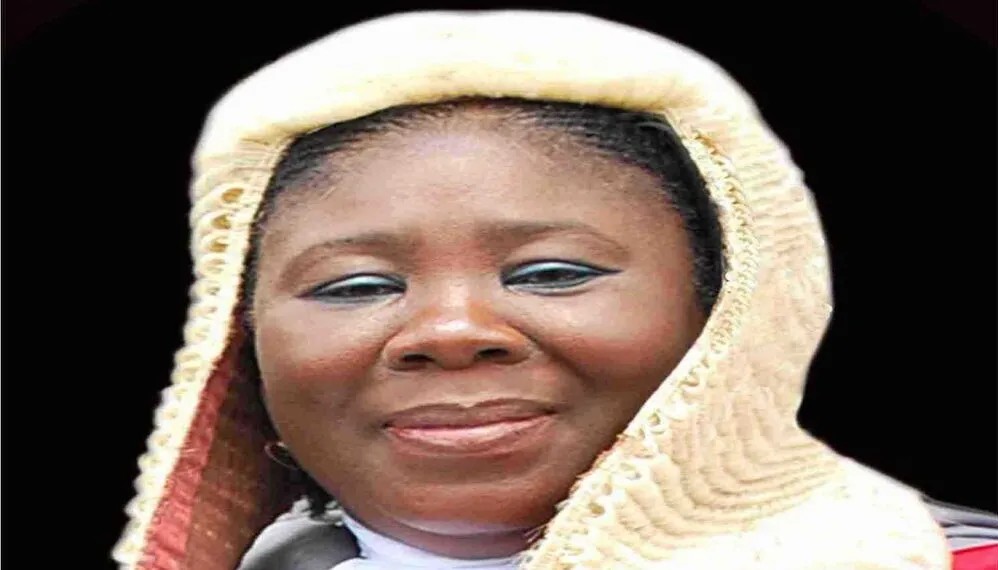
The National Judicial Council (NJC) has cleared the Chief Judge of Osun State, Justice Oyebola Ojo, of all allegations of financial impropriety and judicial misconduct, bringing to an end months of controversy that rocked the state’s judiciary.
The decision was reached at the Council’s 110th meeting held on Wednesday and presided over by the Chief Justice of Nigeria, Justice Kudirat Kekere-Ekun.
In a statement issued by the NJC’s Deputy Director of Information, Kemi Babalola-Ogedengbe, the Council said it upheld the findings of a three-member investigative committee that probed multiple petitions against Justice Ojo and found them to be without merit.
The petitions were filed by Eludire Kunle, a staff member of the Osun State Customary Court of Appeal and Chairman of the Judiciary Staff Union of Nigeria (JUSUN) in the state, alongside three other complainants.
Additional petitions also came from the Speaker of the Osun State House of Assembly, Adewale Egbediran; one Temitope Fasina; and a joint petition by the state Attorney-General, Oluwole Bada, and four alleged members of the State Judicial Service Commission.
Justice Ojo was accused of unilaterally suspending judiciary staff, manipulating promotion processes, halting training programmes, disobeying court orders and misappropriating funds, including N7.4m meant for judges’ and magistrates’ retreats, N5m robe allowances and proceeds from e-affidavit services.
However, the NJC committee found that the suspension of judiciary staff followed due process and was based on recommendations from the appropriate disciplinary body.
It also affirmed that staff training and promotions fall within the statutory powers of the State Judicial Service Commission.
The committee further concluded that there was no evidence linking Justice Ojo to the misappropriation of robe allowances, retreat funds or e-affidavit proceeds, stressing that she did not personally benefit from any of the financial transactions under scrutiny.
Based on these findings, the committee recommended the outright dismissal of all petitions, a position fully adopted by the NJC.
Justice Ojo’s ordeal had contributed to a prolonged crisis in Osun State’s judiciary, with court activities paralysed for over a year due to strike actions by JUSUN over unresolved grievances.
The situation was further complicated by political tensions involving the administration of Governor Ademola Adeleke.
In November 2023, Governor Adeleke suspended Justice Ojo following allegations of misconduct, abuse of office and corruption levelled against her by the State House of Assembly, and appointed a High Court judge, Justice David Afolabi, as Acting Chief Judge.
Justice Afolabi, however, rejected the appointment, citing constitutional provisions that vest disciplinary powers over judicial officers solely in the NJC.
The NJC had earlier directed the Osun State Government to maintain the status quo, insisting that only the Council had the constitutional authority to investigate and recommend sanctions against judicial officers.
The Nigerian Bar Association also condemned the governor’s action, describing it as a violation of the principle of separation of powers and a breach of due process.
Meanwhile, the NJC also reversed the one-year suspension without pay earlier imposed on Justice Jane Inyang of the Court of Appeal, Uyo Division.
Justice Inyang had been sanctioned over allegations of granting improper ex parte orders while serving as a Federal High Court judge.
The Council noted that the matter was already under appeal and that the petition against her was filed outside the six-month statutory window, prompting the reversal of the suspension.
In other decisions, the NJC dismissed a petition against Justice Gentu Timi of the Delta State High Court after the complainant withdrew it following the resolution of the underlying chieftaincy dispute.
Overall, the Council reviewed 39 petitions, dismissing 26 for lack of merit, recommending seven for further investigation and cautioning two judicial officers over procedural lapses, including delayed delivery of judgments and inappropriate language.
The NJC reiterated its warning to judges against the indiscriminate grant of ex parte orders and urged Heads of Court to exercise restraint in assigning complex cases to newly appointed judges.
 '
' '
'Do you want to share a story with us? Do you want to advertise with us? Do you need publicity for a product, service, or event? Contact us on WhatsApp +2348183319097 Email: platformtimes@gmail.com
We are committed to impactful investigative journalism for human interest and social justice. Your donation will help us tell more stories. Kindly donate any amount HERE
