

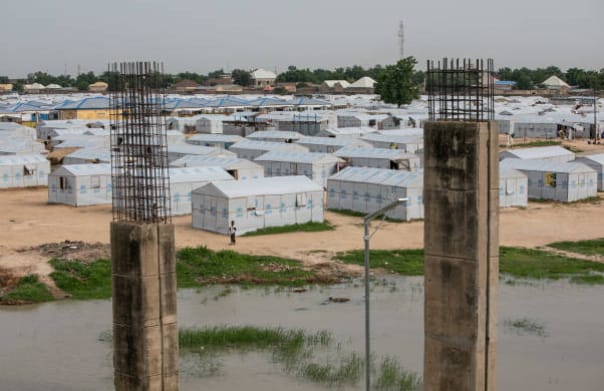

Credit: Getty Image. Internally Displaced Person’s Camp After Being Attacked by BokoHaram
As 2026 unfolds with a grim escalation of violence, marked by deadly bandit attacks, mass kidnappings and insurgent assaults that claimed 481 lives and led to 269 abductions in January alone, culminating in the February 3 to 4 massacre of at least 162 residents in Woro and Nuku communities near Ilorin in Kwara State as well as how banditry tightens its grip on Zamfara and Sokoto with Boko Haram remnants continuing to harass farming communities in Borno, and as projections warn that 35 million Nigerians could face acute food insecurity during the 2026 lean season, one can say terrorism in the country has worsened despite anti-terrorism efforts.
Soldier lives have been lost, families displaced, children dead, fathers bereaved and mothers left hopeless with the North being the most affected region in the country. PlatformTimes earlier published a report depicting deadly regions in Nigeria and why. According to the report, while Southwest grapples with bad infrastructures, causing death for many people on the road, in the north, insecurity is the cause of residents’ deaths.
In this investigation, Fawaz Adebisi reports the total amount spent by the Nigerian Army compared to what was approved by the Federal Government in the 2025 budget. In 2025, the Nigerian Army was allocated roughly ₦1.48 trillion in the 2025 federal budget, however, public records published on the Open Treasury Portal (via GovSpend tracking) reveal only ₦684 billion in visible transactions for the same year, showing less than half the budgeted amount.
The discrepancy raises urgent questions about transparency, execution and whether the massive resources earmarked for national defence are translating into improved security on the ground. To understand why security gains remain elusive, Platform Times examined the actual spending disclosed on the Open Treasury Portal.
.
The Numbers: A ₦800 Billion Gap
AMOUNT SOENT VS BUDGETED
According to breakdowns published by the BudgIT Foundation and cross-referenced with the 2025 Appropriation Act, the Nigerian Army received approximately ₦1.48 trillion as its share of the Ministry of Defence’s ₦3.10 trillion budget envelope. This allocation covers personnel costs, the single largest component, as well as overhead and capital expenditure intended for equipment, operations, and infrastructure.
PLATFORM TIMES examined high-value transactions disclosed on the Open Treasury Portal for 2025. The portal, established to enhance fiscal accountability, routinely publishes payments exceeding ₦10 million, therefore, our analysis identified 171 transactions linked to the Nigerian Army, with a total value of ₦684,375,682,532, or ₦684.38 billion approximately.
The average transaction size stood at ₦4.00 billion. However, the largest individual payments, clustered between ₦21 billion and ₦22.33 billion, were significantly higher, a pattern consistent with monthly salary and allowance disbursements processed through the Integrated Personnel and Payroll Information System (IPPIS). Across the disclosed data, the majority of significant outflows were directed toward salaries, allowances, and routine operational funding, rather than one-off capital projects.
Even accounting for the portal’s publication threshold, the visible spending represents only about 46 percent of the Army’s budgeted allocation. The remaining ₦800 billion-plus could have fallen into several possible categories as some funds may be routed through channels not captured in high-value public disclosures, such as direct IPPIS bulk transfers or smaller payments below the reporting threshold.
Others could also be classified under national security exemptions, subject to implementation shortfalls where budgeted amounts were neither released nor spent, or carried over and re-appropriated in ways that are not yet fully transparent. The ₦684 billion in visible transactions reveals what the Army prioritized, and what it neglected.
Project Gets Underfunded as Allowance, Salary Leads Nigerian Army’s Visible 2025 Spending
AMOUNT SPENT PER CATEGORY
A detailed breakdown reveals a stark imbalance; allowances and salaries consumed the overwhelming majority of visible funds, while capital projects received only a tiny fraction of the total.
According to the data gathered, when categorised, allowances emerged as the single largest line item, accounting for ₦487,354,003,031, more than 71 percent of the total visible spend. Salaries followed closely at ₦161,185,553,588, representing approximately 23.5 percent of the disclosed amount.
Together, these two personnel-related categories absorbed nearly 95 percent of the funds that appeared in public records.
In contrast, spending classified under “Projects” totalled just ₦272,378,933, less than 0.04 percent of the visible budget. Overhead costs stood at ₦2,762,319,876.25, while warehousing of balances, meetings, unspecified items, and other miscellaneous outflows made up the small remaining share.
Breakdown of the distribution:
Allowances ₦487,354,003,031
Salary ₦161,185,553,588
Overhead ₦2,762,319,876.25
Projects ₦272,378,933
Warehousing ₦424,716,406
Unspecified ₦14,273,840,057
Other ₦18,093,570.75
Meetings ₦8,900,000
The heavy tilt toward recurrent personnel expenditure is consistent with patterns observed in previous defence budgets, where salaries, allowances, and administrative overhead routinely dominate military allocations. However, the near-absence of visible capital spending raises fresh questions about investment in equipment, infrastructure, technology, and operational capabilities needed to confront Nigeria’s persistent insecurity challenges.
Allowances, primarily non-regular allowances paid on top of base salaries, have long been a significant component of military compensation. These payments, often tied to operational deployments, special duties, or hardship postings, are intended to boost troop morale and retention. Yet budget transparency advocates and defense analysts argue that when allowances consistently outpace base salaries and dwarf capital outlays, it signals structural priorities that favour personnel costs over long-term force modernisation.
The low project allocation is particularly notable given the scale of threats facing the country. Banditry, insurgency, and communal violence continue to displace communities, disrupt agriculture, and drive food insecurity projections for 2026. Capital investments, such as new vehicles, surveillance systems, communication equipment, and border infrastructure, are widely regarded by security experts as essential to improving operational effectiveness.
Over ₦400m Warehoused
The warehousing data exposes bureaucratic dysfunction at its worst. While Nigerian Army University Biu received a mere ₦272.38 million for all capital projects in 2025—barely enough for basic construction, ₦424.72 million in surplus personnel funds sat frozen in a transit account “awaiting further directives.”
More money was trapped in limbo than invested in developing the institution.
The December 31 transaction carried an ominous label: “batch i.”
This suggests a systematic process of warehousing funds across multiple Army units, yet the military has disclosed neither how many batches exist nor their total value. If this practice extended beyond the university, billions in budgeted funds could be sitting frozen in transit accounts, offering one explanation for the ₦800 billion gap between what was allocated and what appears in public spending records.
Why Are Allowances Outpacing Salaries in Nigerian Army’s 2025 Spending?
ALLOWANCES GET MOFE FUNDING
The ₦684.38 billion in visible transactions already painted a picture of heavy recurrent spending. A deeper look inside that figure reveals an even more striking detail; non-regular allowances paid to Nigerian Army personnel significantly exceeded base salary disbursements last year.
This investigation’s breakdown of the categorised payments shows allowances totalling ₦487,354,003,031, more than three times the ₦161,185,553,588 recorded for regular salaries. In the Nigerian military, non-regular allowances typically include operational, hardship, duty-tour, risk, and special-duty payments. These entitlements are intended to compensate troops for deployments in active theatres, hazardous assignments, or extended field service, conditions not faced by personnel in headquarters, administrative, training, or rear-echelon roles.
The dominance of allowances over base salaries in the public records therefore suggests that a substantial portion of the visible recurrent spending was directed toward supplementing the pay of soldiers in high-risk, operational environments. Yet the sheer scale of these payments, nearly triple the base salary figure, invites scrutiny over how the compensation structure is balanced and whether the funds are reaching their intended recipients efficiently.
Military welfare specialists point out that non-regular allowances have become a critical tool for retention and morale, particularly in prolonged counter-insurgency and anti-banditry operations. However, when supplementary payments consistently dwarf core salaries, questions arise about the adequacy of base pay adjustments, potential delays or leakages in allowance disbursements, and whether the current model is sustainable or equitable across ranks and postings.
Nigerian Army Spending Peaks in December 2025 Around X-mas, New Year Season
AMOUNT SPENT PER MONTH
Disclosed payments by the Nigerian Army reached their highest monthly level in December 2025, coinciding with the Christmas and New Year festive period, according to high-value transactions tracked via GovSpend.
December emerged as the standout month, with outflows amounting to ₦196.26 billion, 8.8 times higher than April’s ₦22.25 billion and nearly double November’s ₦112.46 billion. This represented more than 28 percent of the entire year’s visible spending concentrated in a single month.
The surge was driven almost entirely by end-of-year salary and non-regular allowance disbursements processed through IPPIS. Analysis of the transactions revealed no major capital projects, equipment purchases, or infrastructure investments to justify the spike, it was pure personnel costs. Large batches aligned with routine payroll cycles, but their concentration in December suggests a deliberate push to clear outstanding entitlements before the fiscal year-end.
Military finance practices in Nigeria often see accelerated payments in December as agencies rush to utilize funds before the fiscal close and avoid surrender of unspent allocations. Troops and their families frequently rely on these year-end inflows for holiday expenses, school fees, and debt repayment.
Yet the timing is notable given that December 2025 saw no major reported reduction in violence across the Northeast or Northwest, the spike prioritized troop welfare during a high-visibility period while capital and operational funding remained absent.
Other months showed more moderate levels: November recorded ₦112.46 billion, July and June hovered around ₦106-112 billion, while earlier months ranged from ₦22-86 billion. The December figure stands out not only for its size but for confirming the recurrent-heavy pattern observed throughout the year, even during the spending peak, not a single naira of the surge went to weapons, vehicles, or infrastructure.
The ₦14.27 Billion “Black Hole”: Payments With No Description
Beyond the lopsided allocation toward salaries and allowances, the Army’s 2025 spending records contain another troubling anomaly: ₦14,273,840,032.57 in payments classified simply as “None,” with no description, justification, or stated purpose in public records.
This ₦14.27 billion in unspecified disbursement represents approximately 2.1 percent of the visible ₦684 billion spent, a figure that might seem modest until placed in proper context. The undescribed payment is52 times larger than the entire ₦272 million allocated to capital projects during the year. Put differently, the Army channeled enough money through opaque, unlabeled transactions to fund its entire visible construction, consultancy, and infrastructure budget fifty-two times over.
The scale becomes even more striking when measured against tangible needs. According to defense procurement specialists, ₦14.27 billion could acquire approximately 28 new armored personnel carriers at ₦500 million each, or fund the construction of 14 fully-equipped forward operating bases in bandit-prone zones at ₦1 billion per base. It could procure advanced surveillance drones, communication systems, or night-vision equipment for multiple battalions, or finance comprehensive training programs for thousands of troops in counter-insurgency tactics and modern warfare technology.
Instead, that ₦14.27 billion lacked any public description or purpose, leaving no public trace of where the funds went, or what goods, services, or operations they supported. The absence of description is not a minor clerical oversight; under Nigeria’s Public Procurement Act and Treasury regulations, every government payment above certain thresholds must be documented with clear purpose, beneficiary details, and approval trails, especially when published on transparency platforms like the Open Treasury Portal.
The “None” entries flagged in this investigation appear alongside fully labeled transactions for salaries, allowances, overhead, and the few project payments recorded. This inconsistency suggests either deliberate omission, data entry failures, or payments routed through channels exempt from standard disclosure requirements, possibly under national security classifications. Yet even classified expenditures typically carry generic descriptors such as “operational logistics” or “strategic procurement” to maintain basic accountability without compromising sensitive details.
Expert, Gov’t React
The year-end spending surge has drawn varied reactions from political analysts, actors, Non Governmental Organizations, and government representatives, reflecting ongoing debates on military welfare, fiscal discipline, and security outcomes.
NGO voices have been critical of the pattern’s broader implications. BudgIT Foundation, a leading fiscal transparency advocate, has long flagged recurrent-heavy defence budgets. In a March 2025 infographic on the 2025 defence budget breakdown, BudgIT highlighted that personnel costs dominated the N3.10 trillion Ministry of Defence envelope, with capital expenditure receiving far less priority.
Civil Society Legislative Advocacy Centre, CISLAC, another key NGO, has also repeatedly warned about corruption risks in defence spending. In a December 2025 statement, CISLAC’s Executive Director Auwal Musa Rafsanjani stated, “No volume of military spending or sophisticated equipment will deliver results if diverted funds, weak oversight, and entrenched impunity continue to undermine the defence sector.”
CISLAC echoed this in a November 2025 report, calling for independent audits and greater transparency in procurement to address how mismanagement exacerbates insecurity.
The Federal Government’s response has emphasized ongoing reforms. Chief of Defence Staff General Olufemi Oluyede, in a January 2026 briefing during the Armed Forces Celebration and Remembrance Day, affirmed that modalities for enhanced armed forces salaries and allowances were being finalized under President Bola Tinubu’s directive, aiming to address welfare gaps, including soft loans for spouses and affordable housing schemes.
The Nigerian Army, in a January 19, 2026 statement, refuted claims of mutiny threats over unpaid allowances, describing them as “false and misleading” while highlighting structured welfare improvements, such as periodic salary reviews and enhanced operational allowances.
In the same vein, Chief of Army Staff Lt.-Gen. Waidi Shaibu, in a December 2025 address at the Chief of Army Staff Annual Conference, reiterated commitment to soldier welfare, including expanded support programs and modernization efforts.
Vice President Kashim Shettima, during the same December 2025 conference, pledged full federal support for modernization and welfare, noting recent acquisitions and allowance increases to motivate troops.
These comments underscore a divide; while government actors frame the December peak as part of welfare enhancements, NGOs demand greater scrutiny to ensure funds drive security gains rather than seasonal payouts.
So what? The Cost of Mispriorities in a Nation Under Siege
The numbers tell a story that extends far beyond spreadsheets and budget documents. They reveal a military institution consuming enormous resources while the insecurity it is meant to combat continues to worsen, and a fiscal structure that prioritizes immediate personnel payouts over the long-term investments needed to actually win the fight.
When allowances triple base salaries, when 95 percent of visible spending goes to recurrent costs, when projects receive 0.04 percent while ₦14.27 billion disappears without explanation, and when ₦800 billion of a ₦1.48 trillion budget leaves no public trace, the implications are profound.
The 481 deaths and 269 abductions recorded in January 2026 alone, the 162 villagers massacred in Kwara, the 35 million Nigerians projected to face acute food insecurity due to bandit-disrupted farming, these are not abstract statistics.
They are the human price of a defense establishment that appears structurally incapable of translating money into meaningful security outcomes. Soldiers cannot defeat well-armed bandits with allowances. Communities cannot be protected by payroll disbursements. Insurgents are not deterred by December spending spikes.
What Nigeria’s frontline troops need, and what the budget fails to provide, are armored vehicles that can withstand ambushes, surveillance drones that can track insurgent movements, communication systems that prevent unit isolation, night-vision equipment for operations in remote terrain, and forward operating bases that allow sustained presence in contested areas.
The ₦272 million allocated to projects in 2025 could not purchase even a single modern military helicopter. Meanwhile, the ₦14.27 billion that was unspecified could have equipped multiple battalions with life-saving technology.
The 2025 spending data is not just a fiscal autopsy of one year’s budgeting failures. It is a warning. Without structural reform, transparent accounting for every naira budgeted, rebalancing toward capital investment, elimination of opaque payments, and consequences for mismanagement, 2026 will reproduce the same pattern: massive spending, minimal security impact, and mounting casualties.
Nigeria’s insecurity crisis is not simply about insufficient funding. It is about an institutional culture that treats defense budgets as personnel entitlement programs rather than strategic investments in national survival.
The choice facing Nigeria’s leaders is stark: reform the defense budgeting structure now, or watch another ₦1.5 trillion disappear in 2026 while insecurity claims more lives, displaces more families, and pushes more regions toward the brink.
 '
' '
'Do you want to share a story with us? Do you want to advertise with us? Do you need publicity for a product, service, or event? Contact us on WhatsApp +2348183319097 Email: platformtimes@gmail.com
We are committed to impactful investigative journalism for human interest and social justice. Your donation will help us tell more stories. Kindly donate any amount HERE
