

Aishah Waliyyulah
The Ogun State Teaching Service Commission has defended its newly introduced whistleblower policy, insisting that public secondary schools in the state have enough teachers but suffer from poor distribution, particularly between urban and rural areas.
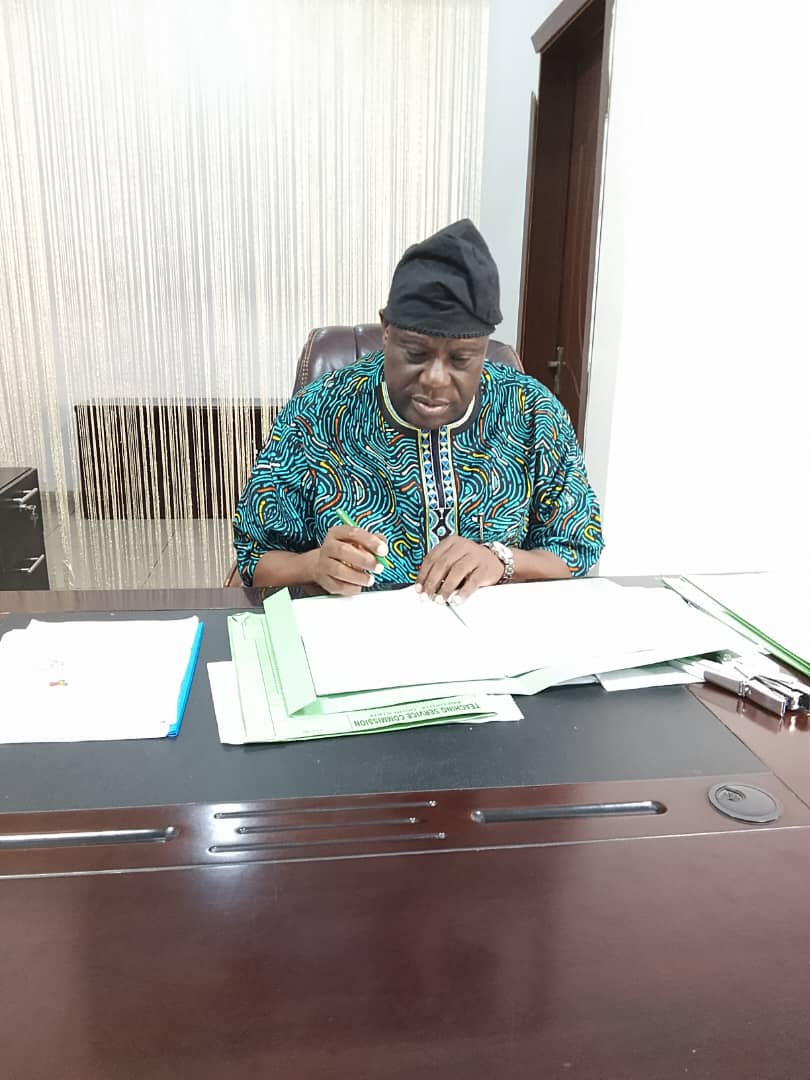
The TESCOM Chairman, Mr Abiodun Sanyaolu, said the policy was designed to strengthen discipline, accountability and real-time monitoring of teachers, not to witch-hunt staff, as critics have suggested.
Sanyaolu spoke during an interaction with journalists, where he clarified that while the Ministry of Education is responsible for education policy and infrastructure, TESCOM remains the employer and regulator of secondary school teachers, with oversight on recruitment, deployment, promotion and discipline.
He disclosed that the commission had concluded a comprehensive assessment of public secondary schools across the state to determine the exact number of teachers available, subject by subject, and their student population.
According to him, findings from the assessment showed that Ogun State does not face an absolute shortage of teachers, but rather a long-standing imbalance in their distribution.
“There are schools with three teachers handling a single subject, while others have only one or none at all. The problem is not numbers; it is distribution,” he said.
Sanyaolu noted that shortages remain pronounced in core subjects such as Mathematics, English Language, Biology and History, especially in semi-urban and rural schools.
He revealed that schools have now been classified into Grade A, B and C based on enrolment figures and number of classes, a move he said would guide how many subject teachers each school should have.
“As a result, we are not embarking on mass transfers. What we are doing is strategic redistribution to ensure equity and fairness,” he said, adding that excess teachers in some urban schools would be redeployed to areas with critical needs.
The TESCOM boss admitted that resistance from teachers unwilling to leave urban centres remains a major challenge.
“Many teachers don’t want to work in rural or semi-rural areas, yet that is where vacancies exist. Anyone who is not ready for such postings should not accept appointment letters in the first place,” he said.
He also accused some influential individuals of mounting political pressure on the commission to secure preferential postings or promotions for their associates, stressing that TESCOM would not compromise due process.
“We have received calls and requests, but we have made it clear that policies will not be bent for anyone,” he said.
On capacity building, Sanyaolu said the state government had continued to invest in teacher training, disclosing that the governor recently approved another round of programmes involving experts, including former vice-chancellors of education-focused universities.
He added that the commission was exploring the use of artificial intelligence to improve teaching and learning outcomes in public schools.
The chairman said TESCOM maintains strict monitoring through its 22 zonal officers, who conduct monthly school visits and submit reports, alongside unannounced inspections by senior officials to ensure teacher attendance and accountability.
Urging teachers to see their profession as a calling, Sanyaolu said, “Education is a right and a light. Whatever effort you make in building a child today shapes not only that child’s future but the future of the nation.”
He assured that ongoing reforms were aimed at promoting fairness, equity and improved learning outcomes across all public secondary schools in Ogun State.
 '
' '
'Do you want to share a story with us? Do you want to advertise with us? Do you need publicity for a product, service, or event? Contact us on WhatsApp +2348183319097 Email: platformtimes@gmail.com
We are committed to impactful investigative journalism for human interest and social justice. Your donation will help us tell more stories. Kindly donate any amount HERE
