

Daud Olatunji
Four candidates contesting the February 6, 2027, Lagos State governorship election have disagreed over how to address the state’s persistent challenges of flooding, traffic congestion, housing shortages, poor waste management and access to quality education.
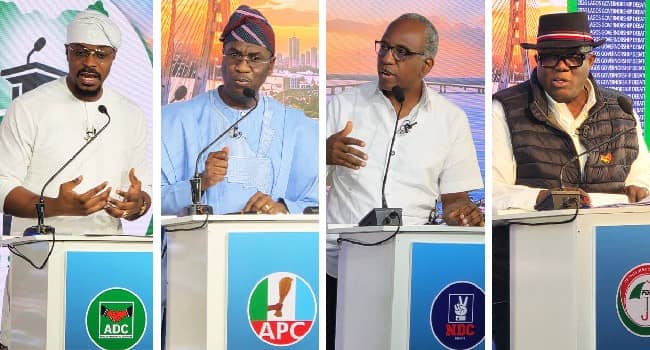
The candidates, Gbadebo Rhodes-Vivour of the African Democratic Congress, ADC; Obafemi Hamzat of the All Progressives Congress, APC; Funso Doherty of the Nigeria Democratic Congress, NDC; and Deji Doherty of the Peoples Democratic Party, PDP, presented contrasting policy proposals during a governorship debate organised by the Nigeria Debate Consortium in Lagos on Sunday.
The debate, the first public engagement involving the four candidates, provided an opportunity for them to defend their parties’ records, explain their proposed policies and respond to questions on issues affecting millions of Lagos residents.
While opposition candidates questioned aspects of the APC-led administration’s performance, Hamzat, who is the incumbent deputy governor, defended the government’s interventions and outlined plans to expand infrastructure, transportation and social services.
On environmental management and flooding, Rhodes-Vivour attributed some of Lagos’ recurring challenges to what he described as decades of poor governance, promising a technology-driven approach to environmental protection and improved waste management.
The ADC candidate said his administration would prioritise residents’ safety, environmental cleanliness and affordability, arguing that development policies should benefit ordinary residents rather than a privileged section of society.
He said, “All of us are experiencing the damage that has come from bad governance that has been endemic in this state for the last 20 years.
“We want a cleaner Lagos. We want a safer Lagos. We want a more affordable Lagos, and we want a Lagos that works for everybody, not just the privileged few.”
However, Hamzat defended the state’s drainage infrastructure, describing its network as fantastic.
He argued that the major challenge was ensuring that drainage channels remained free of refuse and other obstructions to allow water to flow freely into the creeks.
The APC candidate maintained that effective maintenance of existing infrastructure was critical to reducing flooding across the state.
On the perennial traffic congestion confronting motorists and commuters, Hamzat unveiled plans to strengthen the state’s multi-modal transportation system through investments in rail, roads and waterways.
He said the APC administration was targeting the movement of one million passengers daily through the deployment of 4,000 compressed natural gas-powered buses.
He also disclosed plans to expand water transportation with 77 electric ferries, saying the initiative would increase the number of commuters transported through Lagos waterways and reduce pressure on roads.
Defending the government’s investment in rail infrastructure, Hamzat argued that private-sector financing of railway systems was uncommon across Africa.
Rhodes-Vivour, however, maintained that traffic congestion should not become a normal part of life for Lagos residents, calling for improved water transportation and additional infrastructure to address the growing mobility crisis.
Housing was another major flashpoint, with Rhodes-Vivour promising to deliver more than 100,000 housing units if elected.
The ADC candidate argued that successive APC administrations had concentrated development policies around the interests of affluent residents while neglecting people in rural and underserved communities.
He also questioned the benefits ordinary Lagosians derived from the state’s internally generated revenue, despite the government’s repeated celebration of its revenue performance.
“Lagos celebrates high IGR, yet people are not experiencing it,” he said.
Rhodes-Vivour promised to redirect government policies towards improving living conditions and reducing the economic pressure on residents.
Responding, Hamzat said the state government had established 24 housing estates within the last eight years but acknowledged the need to increase access to affordable and quality accommodation.
He pledged to expand mortgage facilities, complete ongoing housing projects and enforce the Lagos State Real Estate Regulatory Authority law, which regulates tenancy practices and restricts landlords from demanding rent beyond one year in advance in applicable circumstances.
The APC candidate said stronger enforcement would help address arbitrary rent demands and make accommodation more accessible to residents.
Meanwhile, the NDC candidate, Funso Doherty, promised to introduce what he described as genuinely free education if elected.
He argued that children should not be denied access to education because their parents could not afford tuition, examination fees and other school-related charges.
Doherty said his proposed education policy would go beyond the nominal removal of tuition fees to eliminate additional financial barriers confronting pupils and their families.
“So, our policies are aimed at capacitating the people, giving them skills, ensuring that there is no child born in Lagos who does not get an education because their parents cannot afford it.
“We have said we will make education truly free, not nominally free. Truly free, so people will not pay exam fees; they will not be asked to come and pay taxes at a point when they have to write their exams,” he said.
He also promised to introduce a programme to provide pupils in public schools with one affordable meal daily.
Beyond the social services debate, the PDP candidate, Deji Doherty, raised concerns over Lagos State’s debt profile, arguing that the cost of servicing domestic and external obligations was placing considerable pressure on the state’s finances.
He claimed that the state spent between N19bn and N20bn on debt servicing, describing the financial commitment as a burden on government resources.
“The debt burden (in Lagos) is heavy. When you are paying close to about N19bn to N20bn in external debt, in domestic debt, in foreign debt, then you have a burden you are carrying that is weighing you down,” he said.
Doherty also questioned the financial independence of local government areas, arguing that councils should have sufficient resources to address problems at the grassroots.
He maintained that local governments, being the closest tier of government to the people, should be adequately empowered to provide essential services and respond to community needs.
“When your LGAs are not independent, those are the closest to the people, and when you do not give them what they need, when you are taking in LASAA and putting it in the pocket of the state, these are the issues,” he added.
The debate was organised by the Nigeria Debate Consortium, comprising Channels Television, TVC News, Punch Newspaper, TheCable and Vanguard Newspaper, as part of a series of engagements ahead of the 2027 general elections.
The organisers said the initiative was designed to provide a credible and non-partisan platform for candidates to present their manifestoes, defend their policy decisions and respond to questions on issues affecting voters.
They identified transportation, infrastructure, security, housing, education, healthcare, job creation and economic growth as key areas requiring public scrutiny ahead of the February 6, 2027, governorship election.
 '
 '
Do you want to share a story with us? Do you want to advertise with us? Do you need publicity for a product, service, or event? Contact us on WhatsApp +2348183319097 Email: platformtimes@gmail.com
We are committed to impactful investigative journalism for human interest and social justice. Your donation will help us tell more stories. Kindly donate any amount HERE
 '
