

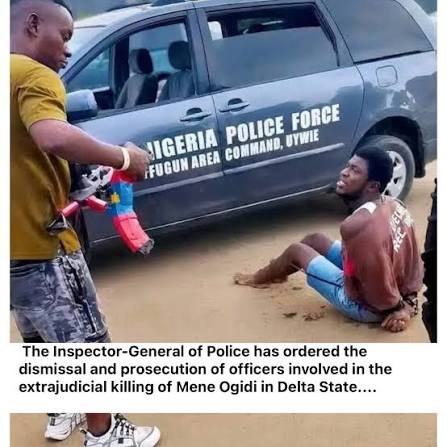
….Police, Military Operations Linked To Wave Of Controversial Killings
…Civil Society Calls For Urgent Institutional Reforms
Daud Olatunji
Fresh concerns have been raised over Nigeria’s human rights record as civil society organisations and rights monitors allege that about 3,000 Nigerians have been killed in suspected extrajudicial circumstances between 2020 and 2026.
The figure, drawn from combined reports by human rights organisations, sharply contrasts with conservative estimates of about 900 deaths within the same period, underscoring what activists describe as a “deepening crisis of unlawful killings and institutional impunity.”
The latest outrage follows the viral killing of 28-year-old Mene Ogidi in Effurun, Delta State, where a police officer identified as ASP Usman Nuhu was seen in a widely circulated video shooting a restrained suspect at close range.
The officer has since been arrested, with the authorities promising prosecution. But rights advocates say the incident is only one in a long list of unlawful killings that rarely receive sustained national attention unless captured on video.
For many Nigerians, the footage revived memories of the #EndSARS protests and renewed questions about police use of force, accountability, and oversight.
Rising toll across states
Investigations and compiled reports indicate that hundreds of deaths have been recorded annually in alleged extrajudicial circumstances, including 271 cases in 2020 and 253 in 2022, according to data attributed to an international rights monitoring group, Global Rights.
A Voice of Nigeria-linked report in 2023 also cited over 800 such cases within a three-and-a-half-year span, including 127 cases recorded in the first half of 2023 alone.
Beyond police operations, similar allegations have trailed military interventions, protest crackdowns, and enforcement exercises across the country.
In Abuja, a corps member, Abdulsamad Jamiu, was reportedly killed in April 2026 during a military response to an alleged robbery incident in Dei-Dei. The Guards Brigade said he was caught in crossfire, a claim his family has disputed.
In Ogun State, a labourer, Oluwaseyi Adeoye, was allegedly shot dead during a demolition exercise involving state officials and security operatives.
In Akwa Ibom, a 13-year-old boy, Timothy Daniel, was allegedly killed by a soldier following a confrontation linked to alleged harassment of his sister.
Similar cases have been reported in Lagos, Sokoto, Anambra, Adamawa, and other states, including the widely condemned killing of pregnant lawyer Bolanle Raheem in 2022, for which a police officer was convicted and sentenced to death.
‘Systemic failure driving impunity’
Rights organisations including Amnesty International and Rule of Law and Accountability Advocacy Centre (RULAAC) have repeatedly warned that Nigeria’s accountability system remains weak, with most cases either poorly investigated or stalled in court.
A civil society organisation, RULAAC, described several detention facilities as “torture hubs,” alleging repeated cases of custodial deaths, including in Imo State where the controversial Tiger Base police unit has faced scrutiny over allegations of abuse.
A senior official of the organisation, Okechukwu Nwaguma, said the persistence of extrajudicial killings reflects “systemic failure, weak oversight, and entrenched institutional impunity.”
He argued that internal disciplinary actions alone were insufficient to deter abuses without independent prosecution and transparent trials.
Similarly, Amnesty International has previously documented instances of excessive force during protests, including the 2024 #EndBadGovernance demonstrations, where at least 24 people were reportedly killed within 10 days across northern states.
Lawyers blame recruitment, training gaps
Legal practitioners and human rights lawyers say the recurring incidents point to deeper structural deficiencies within Nigeria’s security architecture.
A lawyer, Sonayon Hunjo, said such incidents qualify as alleged extrajudicial killings where state actors take lives outside due legal process, stressing that only courts can determine criminal liability.
He attributed the persistence of such cases to weak accountability systems, poor training, and inadequate supervision within security agencies.
Another rights advocate, Nnemeka Amaechina, warned that public confidence in law enforcement was eroding rapidly, adding that fear now discourages citizens from seeking police assistance.
He alleged that corruption and flawed recruitment processes had worsened the crisis, making justice delivery increasingly unpredictable.
Chijioke Ifenkwe, also a lawyer, described many of the killings as “clear executions,” calling for comprehensive restructuring of the police and improved political oversight to restore discipline and professionalism.
Courts, convictions and rare accountability
Despite widespread criticism, a few cases have resulted in judicial outcomes.
In Lagos, the officer involved in the 2022 killing of Bolanle Raheem was convicted and sentenced to death, a ruling hailed as rare accountability in police brutality cases.
Similarly, in Sokoto, a Court of Appeal judgment in 2024 condemned the killing of Shi’ite mourners in 2021, describing the police action as “deliberate and unlawful” and awarding damages to victims’ families.
However, rights groups argue that such convictions remain exceptions rather than the rule.
‘Why killings persist’
Activists insist that inconsistent enforcement of laws, weak investigations, and lack of independent oversight continue to fuel the cycle of abuse.
They also cite failure to preserve evidence, intimidation of witnesses, and internal interference as major reasons why many cases collapse in court.
Source :The Sun
 '
' '
'Do you want to share a story with us? Do you want to advertise with us? Do you need publicity for a product, service, or event? Contact us on WhatsApp +2348183319097 Email: platformtimes@gmail.com
We are committed to impactful investigative journalism for human interest and social justice. Your donation will help us tell more stories. Kindly donate any amount HERE
