

… Brain, liver, lungs among organs at risk
…Nigerians urged to shun alcohol, illicit substances
Daud Olatunji
The Neuropsychiatric Hospital, Aro, Abeokuta, has raised fresh concerns over the growing drug abuse epidemic in Nigeria, warning that the menace is fast evolving into a major public health crisis driven by poor parenting, the proliferation of new psychoactive substances and the increasing availability of methamphetamine.
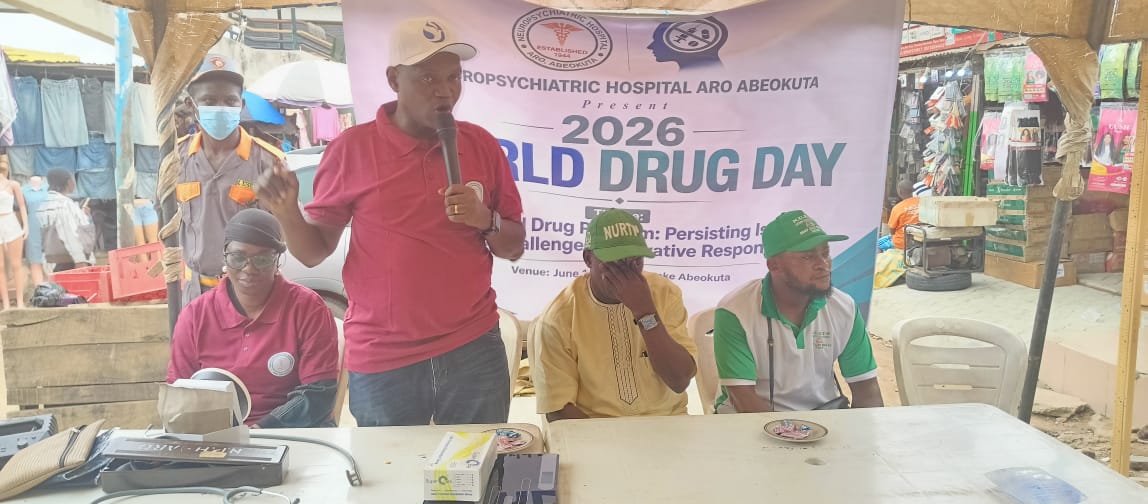
The Acting Provost of the hospital, Dr. Sunday Amosu, gave the warning on Friday, during a road walk and awareness campaign organised to commemorate the 2026 World Drug Day at Pamseke Market, Abeokuta, Ogun State.
Amosu said despite years of advocacy, efforts to curb substance abuse had yielded little because interventions remained inadequate and critical stakeholders, particularly families, had failed to play their roles.

He described current efforts as “a drop in the ocean,” blaming the worsening situation on what he called a failure of parenting.
“The problem is obvious. Whatever we are doing is like a drop in the ocean. How many people are really involved? There is a failure of parenting.
“If all we are interested in is making ends meet at the detriment of our families, the problem will continue. Parents, schools, churches and government must all pay closer attention to our families,” he said.
Amosu noted that traffickers and manufacturers of illicit drugs were continually introducing new substances into the market, making the fight against drug abuse increasingly difficult.
He revealed that illegal laboratories now produce methamphetamine, popularly known as ‘ice,’ in Nigeria, explaining that the COVID-19 lockdown inadvertently worsened the country’s drug problem.
According to him, restrictions on international movement during the pandemic prevented the export of the drug, forcing manufacturers to divert supplies into the local market.
He said the development crashed the street price of one gram of methamphetamine from about ₦10,000 to between ₦2,500 and ₦3,000, making it cheaper and more accessible, particularly to young people.
“More people became involved in its use, and that is why the problem has become deeper. We are yet to overcome it,” he added.
Speaking on this year’s World Drug Day theme, Amosu said the emergence of newer psychoactive substances demands fresh strategies from health professionals and policymakers.
“This year’s World Drug Day emphasises the emergence of newer drugs. Even practitioners and specialists must develop new approaches and areas of intervention to address the problem,” he said.
The awareness campaign attracted community leaders, transport workers, market women and youths, who marched through Pamseke Market carrying placards with inscriptions including “Stop Drug Abuse, Save Our Youth,” “Drugs Destroy, Education Empowers,” and “United Against Drug Abuse.”
Also speaking, Dr. Grace Adeniyi warned that substance abuse causes devastating damage to the brain and other vital organs.
She listed memory loss, loss of appetite, abnormal behaviour, kidney and liver damage, lung complications and mental health disorders among the health consequences of drug abuse.
Adeniyi urged individuals experiencing symptoms associated with substance abuse, including memory loss, to seek prompt medical attention rather than resort to self-medication.
Another resource person, Mrs. Ololade Oladunni, advised Nigerians to embrace healthy eating habits, saying good nutrition could improve overall wellbeing and reduce dependence on harmful substances.
“Our food should be our medicine,” she said while urging residents to reject drug abuse.
A consultant psychiatrist at the hospital, Dr. Rukayat Akinde, said June 26 is observed globally to raise awareness about drug abuse and illicit drug trafficking.
She identified alcohol, cigarettes, cocaine, methamphetamine, petrol and the misuse of prescription medications as some of the commonly abused substances in society.
Akinde warned that drug abuse could lead to mental illness, insomnia, organ failure and certain cancers, stressing that treatment for addiction and drug-induced illnesses was often costly.
She therefore urged Nigerians to prioritise prevention, abstain from alcohol and illicit substances, and seek professional help at the Neuropsychiatric Hospital, Aro, whenever addiction is suspected.
“We should stop drug abuse and choose life,” she said.
 '
' '
'Do you want to share a story with us? Do you want to advertise with us? Do you need publicity for a product, service, or event? Contact us on WhatsApp +2348183319097 Email: platformtimes@gmail.com
We are committed to impactful investigative journalism for human interest and social justice. Your donation will help us tell more stories. Kindly donate any amount HERE
 '
'