

— 620,000 forced from communities by banditry, kidnapping
— Zamfara records over 261,000 displaced persons
— Katsina has nearly 181,000 IDPs, 37,000 returnees
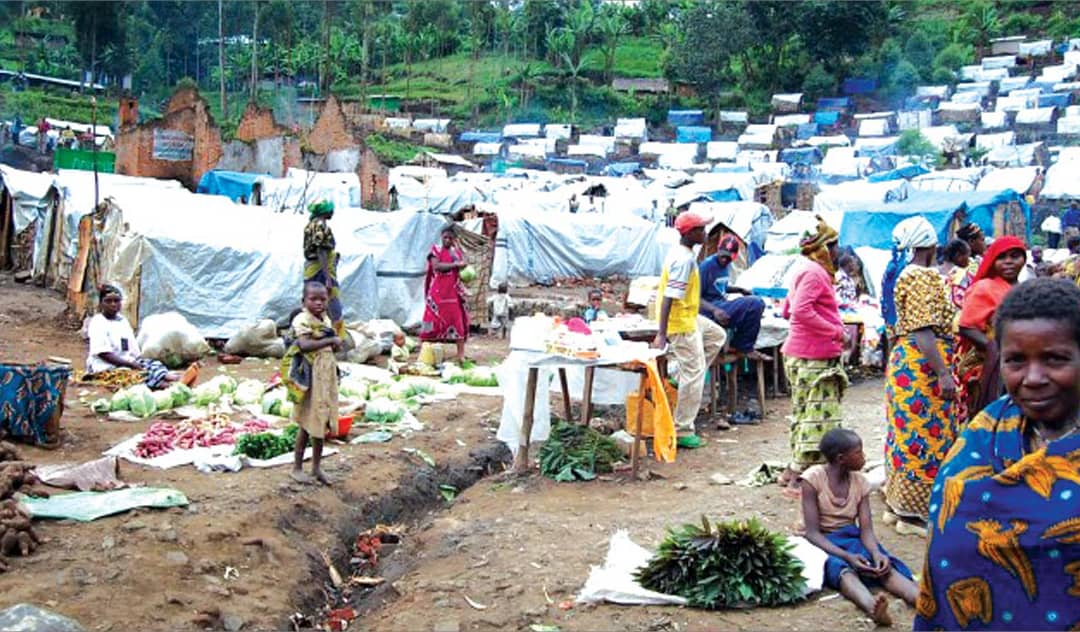
— 89% of IDP locations lack adequate sanitation
Daud Olatunji
The International Organisation for Migration has disclosed that no fewer than 737,073 internally displaced persons have been recorded across Nigeria’s North-West, with armed banditry and kidnapping accounting for about 84 per cent of the displacement.
The IOM Chief of Mission in Nigeria, Sharon Dimanche, disclosed this on Friday during a virtual press conference in Katsina, saying the figure was contained in the organisation’s latest Displacement Tracking Matrix assessment.
She said an additional 147,000 returnees had been documented across the region, but warned that the return of displaced persons did not necessarily mean that the underlying causes of displacement had been resolved.
According to her, about 620,000 people were forced to flee their communities because of banditry and kidnapping.
Dimanche said Katsina State had almost 181,000 displaced persons, while Zamfara recorded more than 261,000, making the two states among the worst affected by the displacement crisis in the region.
She added that Katsina alone had recorded more than 37,000 returnees.
The IOM chief said the scale of displacement went beyond the physical movement of people, as affected communities were also losing homes, livelihoods, security and social cohesion.
“Displacement is not only about moving from one location to another, but also about losing homes, livelihoods, safety and social cohesion,” she said.
Dimanche warned that the crisis in the North-West had consequences far beyond the affected communities, with implications for food production, livelihoods, education, access to basic services, local economies, social cohesion, stability and national development.
She disclosed that more than 138,000 people were displaced in Katsina between January 2025 and January 2026, noting that insecurity was not the only factor driving the crisis.
“Of that number, almost 72,000 were affected by floods, heavy rainfall and windstorms, while nearly 60,000 were displaced by banditry and kidnapping.
“The figures show that insecurity is not the only factor driving displacement, as climate-related shocks are also placing enormous pressure on vulnerable communities,” she said.
The development highlights the growing intersection between insecurity and climate-related disasters in northern Nigeria, where communities already weakened by conflict are increasingly exposed to floods, storms and other environmental shocks.
Dimanche said the consequences included loss of livelihoods, disruption of children’s education, fear and uncertainty, as well as weakened community resilience.
She, however, noted some signs of improvement, saying the number of assessed internally displaced persons across the North-West and North-Central regions declined by nearly five per cent between October 2025 and February 2026, while the number of returnees increased by almost five per cent.
She cautioned that returning home should not be regarded as a permanent solution unless the conditions that forced people to flee had been addressed.
“Return is not automatically a durable solution,” she said, stressing that returnees must be able to live safely, earn livelihoods, send their children to school and address the conditions that initially displaced them.
The IOM chief called for stronger peace-building initiatives and early warning mechanisms to prevent local tensions from escalating into violence and further displacement.
She said the organisation, in partnership with the European Union through its Foreign Policy Instrument, was implementing an 18-month Community-Based Protection, Conflict Resolution and Resilience Programme in Katsina and Zamfara.
The programme, she said, was designed to strengthen community resilience, conflict prevention and early response mechanisms in vulnerable communities.
Also speaking, the IOM Katsina Programme Manager and Head of Sub-Office, Jean Nahesi-Kutumbakana, said the programme had established 80 community peace and resilience committees and trained 1,700 community members and stakeholders in conflict prevention, early warning and early response.
He said 160 key informants had also been engaged across conflict hotspots and livestock movement corridors.
According to him, the programme monitored 41,000 livestock movements involving 2,405 herders and 60,440 livestock, in an effort to reduce tensions and prevent conflicts associated with livestock migration.
The humanitarian situation remains particularly challenging in displacement locations.
Nahesi-Kutumbakana said 74 per cent of surveyed IDP locations required shelter interventions, while 89 per cent lacked adequate sanitation facilities.
He disclosed that 552 vulnerable people had received integrated mental health, psychosocial and livelihood support, while 300 at-risk youths and women were trained in peace-building and skills acquisition.
The IOM official further said 13 quick-impact projects had been implemented in Katsina, benefiting 51,493 people through interventions including solar-powered boreholes, school blocks and veterinary clinics.
He added that the organisation’s peace-media campaign had reached 506,574 people across Katsina and Zamfara through radio jingles, participatory drama and other public awareness activities.
The officials urged governments, development partners, humanitarian organisations and communities to sustain collaboration and improve the accuracy of information on displacement, humanitarian needs and peace-building initiatives.
They stressed that reliable data remained critical to ensuring that humanitarian interventions reached the most vulnerable people and that returnees were supported to rebuild their lives sustainably.
 '
' '
'Do you want to share a story with us? Do you want to advertise with us? Do you need publicity for a product, service, or event? Contact us on WhatsApp +2348183319097 Email: platformtimes@gmail.com
We are committed to impactful investigative journalism for human interest and social justice. Your donation will help us tell more stories. Kindly donate any amount HERE
 '
'