

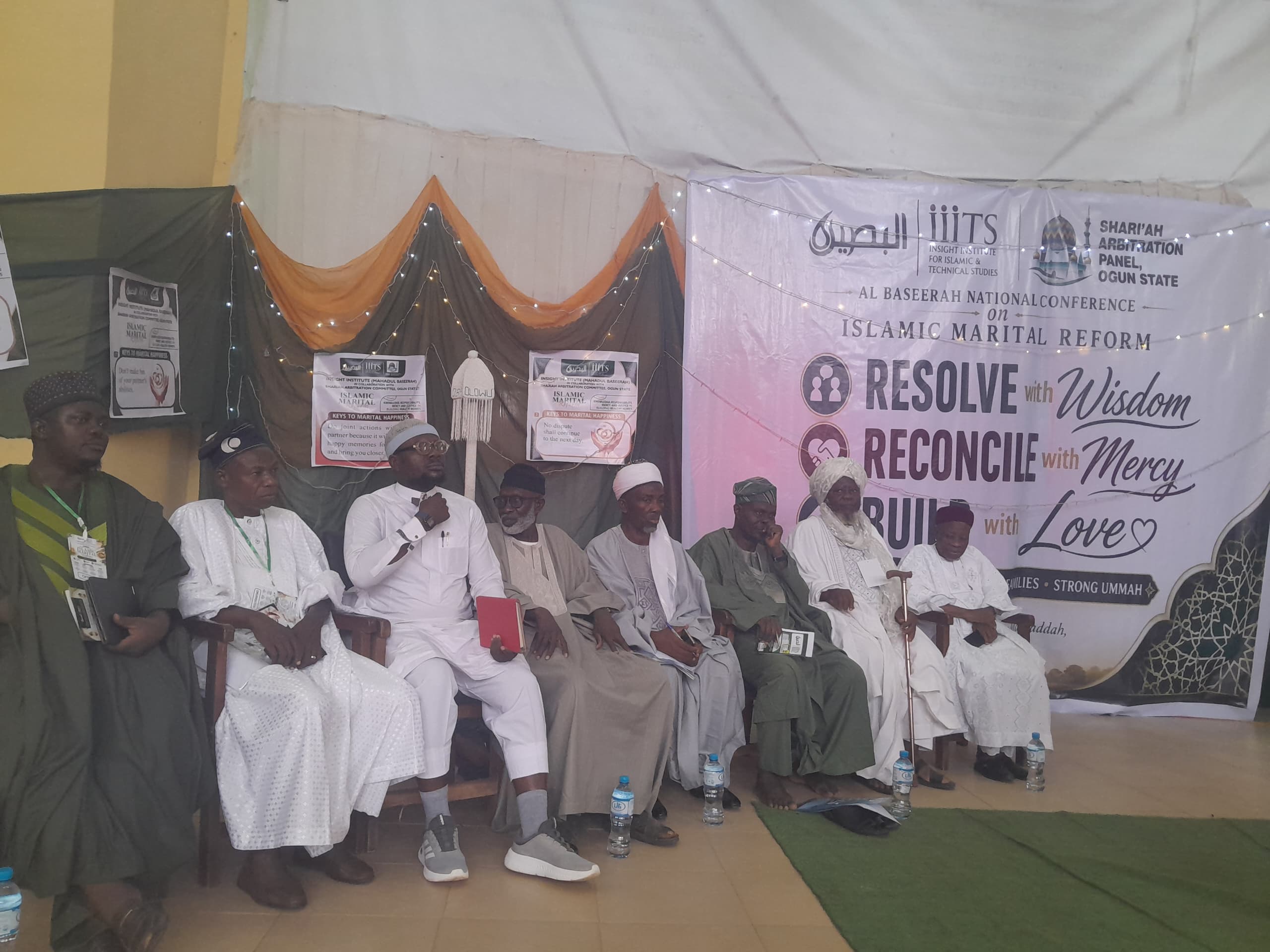
…Scholars identify poor communication, unrealistic expectations, marital illiteracy as drivers of divorce
…Conference launches eight-week Islamic pre-marital studies programme
Zainab Abioye
Islamic scholars, legal practitioners and marriage experts have called for a fundamental shift in the way Muslims approach marriage, urging couples to place greater emphasis on responsibility, compassion, accountability and mutual understanding rather than focusing primarily on marital rights.
The experts spoke at the National Conference on Islamic Marital Reform organised by Insight Institute, Mahdul Baseerah, in collaboration with the Shariah Arbitration Committee, Ogun State, at the Bola Ajibola Auditorium, Crescent University, Abeokuta.
The conference, which brought together Islamic scholars, lawyers, counsellors, government officials, marriage practitioners and couples from across Nigeria, was held under the theme, “Knowledge, Responsibility, Mercy and Justice in Building Healthy Homes.”
The speakers identified poor communication, unrealistic expectations, inadequate preparation for marriage, failure to fulfil responsibilities, misunderstanding of marital roles and inappropriate intervention by extended families as major factors contributing to marital conflicts and breakdown.
Speaking on “Reforming Marriages Through Rights, Responsibilities and Mutual Compassion,” a Fellow of the Institute of Arbitrators and Conciliators, Barrister Siddeeqah Tunde-Lawal, warned that approaching marriage solely from the perspective of rights could turn the home into an arena of entitlement, resentment and competition.
Tunde-Lawal, who has handled marital disputes as a mediator, argued that spouses should understand not only what they are entitled to receive but also what they are expected to contribute to the marriage.
She said Islamic marriage should not be viewed merely as a legal contract, but as a relationship founded on companionship, affection, mercy, responsibility and mutual care.
According to her, the growing tendency of couples to emphasise their rights while neglecting their obligations was creating avoidable tensions in many homes.
She identified misconceptions that needed to be addressed, including the belief that knowing one’s rights was sufficient for a successful marriage, that marital leadership amounted to dictatorship and that counselling was only necessary when a marriage was already on the verge of collapse.
Tunde-Lawal proposed a six-point approach to marital reform: re-educating couples, rebalancing rights and responsibilities, humanising marital relationships, equipping couples with practical skills, intervening early in disputes and reconnecting marriage with its spiritual foundation.
She also called for stronger systems of marital education, counselling, religious instruction, conflict resolution and community support to enable couples to address problems before they degenerate into separation or divorce.
Also speaking, Dr Sulaimon Ogunmuyiwa, Director of Quality Assurance, Lagos State Ministry of Education, represented by Imam Taofeek Buhari, described the inability of many couples to apply marital knowledge in practical situations as “marital illiteracy.”
Ogunmuyiwa said some people might have a good understanding of Islamic rules governing marriage but still lack essential skills such as effective communication, anger management, active listening, forgiveness, compromise and conflict resolution.
He said many couples entered marriage without adequately discussing critical issues such as finances, parenting, career choices, extended-family involvement and how disagreements would be handled.
The education expert urged intending couples to undergo proper pre-marital counselling and develop a clear understanding of their individual values and expectations before marriage.
He said two people could be individually good but still have fundamentally different value systems, warning that failure to identify and discuss such differences could become a source of persistent conflict.
Ogunmuyiwa also cautioned against equating marital leadership with domination, saying leadership should be rooted in responsibility, care, protection and fairness.
Presenting a paper titled “Marital Conflict, Divorce and Islamic Ethics: Reflections from Shariah Arbitration Practice,” Dr Afiz O. Musa said marital crises were often the result of problems that developed gradually rather than suddenly.
Musa, Director of Mahdul Baseerah and a member of the Shariah Arbitration Committee, said the committee had handled more than 200 cases since its establishment in March 2018, with marital disputes accounting for the majority.
He said his review of about 100 concluded cases showed recurring problems involving lack of mutual understanding, failure to fulfil responsibilities, inadequate accountability, misunderstanding of marital roles, injustice in polygynous marriages and inappropriate family intervention.
According to him, Islamic principles such as al-ta’aruf—mutual understanding—responsibility, accountability, qiwamah or responsible leadership tied to maintenance, justice and appropriate conflict intervention through tahkim were essential to healthy marriages.
Musa said the committee’s voluntary and conciliatory approach had helped resolve about 70 per cent of the cases presented in his analysis, while approximately 30 per cent remained difficult to resolve.
He stressed that not everyone was qualified to intervene in marital disputes, warning that unskilled intervention could worsen already fragile relationships.
He urged families and communities to seek the services of experienced and properly equipped mediators and counsellors when marital disputes arise.
The conference also examined the effect of marital instability on children.
Speaking on “Protecting Future Generations: Responsible Parenthood and Tarbiyah of Children in Times of Family Instability,” Imam Sanni Kay Yusuf, Director of Al-Faoz Counselling Home, Lagos, said parents had a major responsibility in shaping the moral and behavioural development of their children.
Yusuf urged parents to create healthy home environments and provide positive examples through their conduct, communication and religious practices.
He stressed that efforts to reform marriages should not focus only on couples but must also consider the wellbeing and future of children affected by family instability.
Eight-week marriage programme launched
A major highlight of the conference was the launch of the Certificate in Islamic Marriage and Pre-Marriage Studies, CIMPS, an eight-week online programme introduced by Insight Institute, Mahdul Baseerah, in collaboration with the Shariah Arbitration Committee, Ogun State.
The programme comprises 16 live sessions, held twice weekly for 90 minutes, and combines Islamic jurisprudence with psychological, counselling and financial perspectives.
The organisers said it was designed for singles preparing for marriage, engaged and newly married couples, marriage counsellors, Imams, community leaders and divorcees preparing for remarriage.
Declaring the conference open, Alhaji Kamaldeen Akintunde, who represented the Olowu of Owu Kingdom, Oba Prof. Saka Adelola Matemilola, commended the Ogun State Government for sustaining the Shariah arbitration system as a mechanism for promoting peace and resolving disputes among Muslim families.
The monarch urged participants to move beyond discussions and translate the recommendations of the conference into practical action.
He also assured the participants that the Ogun Muslim Council would collaborate with the League of Imams to promote the welfare and stability of Muslim families across the state.
Participants seek continuous marital education
Participants at the conference welcomed the emphasis on continuous education, saying marriage should not be treated as an institution that people stop learning about after their wedding.
An engineer, Abdulwasiu Popoola, who attended the conference with his wife, described the programme as both a spiritual refresher and an opportunity to gain practical knowledge about family responsibilities.
He said mutual understanding was one of his major takeaways from the conference.
Popoola said many people treated marriage as an institution they already understood and therefore failed to acquire additional knowledge after the wedding.
He urged couples to embrace continuous learning and participate in programmes capable of strengthening their homes.
An IT officer and married mother, Abika Robiat, said the conference changed her understanding of expectations within marriage.
Robiat said she learnt the importance of moderation in expectations and maintaining peace within the home.
She called for regular programmes for married couples, arguing that stronger families would ultimately contribute to a stronger society.
Another participant, Nofisat, said the conference drew her attention to the importance of self-awareness before attempting to understand another person.
She said marriage programmes could help couples challenge misconceptions, acquire relevant knowledge and “learn and unlearn” ideas about marital relationships.
Conference adopts five-stage reform model
At the end of the conference, delegates called for a broader community-based approach to Islamic marital reform built around five stages: education, prevention, early intervention, arbitration and post-divorce support.
They urged Imams to incorporate marriage counselling into mosque programmes for both intending and married couples.
The conference also called on Imams and Islamic scholars who join couples in matrimony to provide adequate sermons and guidance on wedding days and remain available to offer counselling and support after the marriage.
The delegates further recommended the integration of marital ethics into Islamic school curricula and the establishment of referral networks involving mental health professionals and other relevant specialists.
The organisers said the objective of marital reform should go beyond preventing divorce to equipping couples with the knowledge, character, skills and institutional support required to build stable homes.
Musa said sustainable marital reform must begin before couples encounter serious problems, rather than waiting until disagreements have escalated into separation or divorce.
He said the launch of CIMPS was part of a broader effort to move Muslim marriage practice from a largely crisis-response model to one based on structured preparation, continuous education and early intervention.

 '
' '
'Do you want to share a story with us? Do you want to advertise with us? Do you need publicity for a product, service, or event? Contact us on WhatsApp +2348183319097 Email: platformtimes@gmail.com
We are committed to impactful investigative journalism for human interest and social justice. Your donation will help us tell more stories. Kindly donate any amount HERE
