

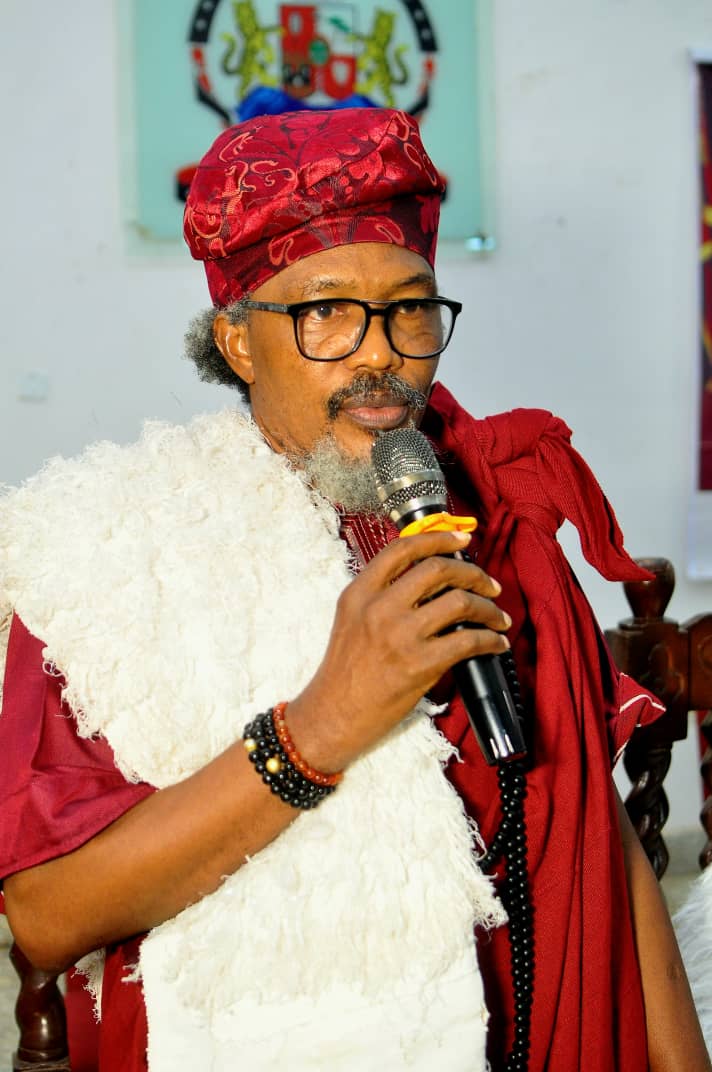
By Chief Abiodun Oladimeji Lasile
The theme, “Building a Better Egba Ogboni: Prospects and Challenges,” is particularly important at a time when our society is confronted by declining moral values, family disputes, communal conflicts, youth restiveness, distrust of institutions and an increasing disconnection between the younger generation and the ethical foundations of our culture.
The question before us is therefore not merely whether Ogboni remains relevant. The more important question is:
How can Ogboni members make their relevance more visible through service, justice, peace and responsible community leadership?
Tradition must not become a museum of symbols. Tradition must remain a living institution whose values positively influence society.
A traditional institution that cannot speak to the challenges of its people may preserve its ceremonies, but gradually lose its social purpose. Therefore, the future of Ogboni must be measured not only by the preservation of its customs, but by the quality of its contribution to the peace, morality and development of the communities in which its members live.
2. Understanding the Traditional Responsibility of Ogboni
Ogboni, within the Yoruba traditional system, has historically represented an important moral and institutional pillar of society. Its philosophy is closely associated with responsibility, accountability, truth, justice, order and respect for the community.
The traditional African society did not separate leadership completely from morality. A person entrusted with authority was expected to understand that power came with consequences.
In Yoruba thought, leadership is not merely about being honoured; it is about being answerable.
The elders understood that:
When justice disappears from the marketplace, peace will soon disappear from the community.
Ogboni members, therefore, should see themselves first and foremost as custodians of values.
The dignity of the institution must be reflected in the conduct of its members. Membership should produce men and women whose presence encourages peace, whose words reduce tension, whose actions promote fairness and whose lives inspire confidence.
If an Ogboni member cannot promote justice, cannot contribute to peace and cannot demonstrate responsible citizenship, society may rightly question the practical value of the institution.
3. THE ROLE OF OGBONI MEMBERS IN PROMOTING JUSTICE
3.1 Justice Must Begin with Personal Integrity
Justice does not begin in the courtroom. It begins in character.
An Ogboni member who demands fairness from others must first practise fairness within his own family, workplace, community and relationships.
We cannot condemn dishonesty in public while encouraging it in private. We cannot speak against corruption while benefiting from injustice. We cannot demand peace while constantly provoking conflict.
The first responsibility of every traditional leader is therefore self-discipline.
The Yoruba say: “Ìwà l’ẹwà.” Character is beauty.
The beauty of an institution is ultimately seen in the character of those who represent it.
Ogboni members must therefore become examples of truthfulness, moderation, confidentiality, fairness and accountability.
3.2 Promoting Fair and Impartial Conflict Resolution
Communities will always experience disagreements. Conflicts between families, neighbours, age groups, business partners and communities are natural realities of human society.
The challenge is not simply the existence of conflict; it is how conflict is managed.
Ogboni members can play constructive roles as mediators and peace-builders. However, mediation must never become an opportunity to protect friends, relatives or powerful interests.
Justice loses its meaning where favouritism begins.
An elder must be able to tell his friend the truth. He must also be able to defend the weak when the strong are wrong.
The Yoruba wisdom teaches us: “Bí òdodo bá kú, irọ́ ló máa jọba.” When justice dies, falsehood takes the throne.
A better Egba Ogboni must therefore encourage impartiality in resolving disputes.
3.3 Protecting the Weak and Vulnerable
The measure of justice in a society is often seen in how the vulnerable are treated.
Children, elderly persons, widows, persons with disabilities and economically disadvantaged members of society must not be ignored.
Traditional leadership should never become an exclusive gathering of influential people discussing only the interests of influential people.
Ogboni members should use their experience and social influence to advocate for fairness and dignity.
Where a child is denied education, where an elderly person is abandoned, where a widow is unjustly treated, where a young person is exploited, responsible traditional leaders should not pretend that such matters do not concern them.
Silence in the presence of injustice can sometimes become another form of injustice.
4. THE ROLE OF OGBONI MEMBERS IN PROMOTING PEACE
4.1 Peace Is More Than the Absence of Fighting
Peace is not merely the absence of violence.
A community may appear peaceful while resentment, poverty, discrimination, fear and injustice are quietly growing beneath the surface.
True peace is built on trust, fairness, communication and mutual respect.
Ogboni members should therefore become early-warning leaders within their communities.
They should identify tensions before they become crises and encourage dialogue before disagreements become hostility.
An elder should not wait until the house is burning before looking for water.
4.2 Acting as Bridges Between Generations
One major challenge confronting traditional institutions today is the growing distance between elders and young people.
Young people often believe that elders do not understand their realities, while elders sometimes believe that young people have abandoned discipline and respect.
Both sides must learn to listen.
Ogboni members can serve as bridges between generations.
The wisdom of the elderly and the energy of the youth should not be competitors. A community needs both.
The elder provides experience; the young person brings innovation.
A society that rejects its elders loses memory. A society that rejects its youth loses tomorrow.
Ogboni members must therefore create opportunities for intergenerational dialogue, mentorship and cultural education.
4.3 Promoting Dialogue Rather Than Escalation
Words can either heal or destroy.
Traditional leaders must be particularly careful in moments of disagreement. An elder should not use his position to inflame public anger, spread rumours or deepen divisions.
Before speaking publicly, we must ask:
Is this statement true?
Is it necessary?
Will it promote peace?
Have we listened to all sides?
What will be the consequences for the community?
Leadership requires emotional discipline.
Not every provocation deserves a reaction, and not every disagreement requires a public confrontation.
Sometimes, the greatest strength of an elder is calculated patience.
5. THE ROLE OF OGBONI MEMBERS IN COMMUNITY DEVELOPMENT
5.1 Development Must Become a Collective Responsibility
Government alone cannot solve every community problem.
Traditional institutions, professional bodies, religious organisations, businesses and citizens all have responsibilities.
Ogboni members are often people with experience, networks, influence and professional knowledge. These resources should be mobilised for community development.
A better Egba Ogboni should ask practical questions:
What problems exist in our communities?
What can we collectively do about them?
How can our members contribute their expertise?
How can we mobilise resources without compromising integrity?
What legacy are we leaving for future generations?
Development should not be limited to buildings and ceremonies.
A community develops when its people become better educated, healthier, more peaceful, economically productive and morally responsible.
5.2 Education and Youth Development
One of the greatest investments Ogboni members can make is in young people.
Scholarships, mentoring, reading initiatives, vocational training, entrepreneurship support and leadership education can create lasting impact.
We must move from asking only:
“What will the younger generation inherit?”
to asking:
“What are we deliberately preparing them to become?”
Every Ogboni group should consider adopting practical youth-development programmes within its area of influence.
A society that does not prepare its young people will eventually spend more resources managing the consequences of their neglect.
5.3 Community Service as a Culture
The strength of an institution is demonstrated through service.
Ogboni groups can organise and support initiatives relating to:
Community sanitation and environmental protection;
Education and literacy;
Youth mentorship;
Care for elderly citizens;
Peace education;
Support for vulnerable families;
Cultural preservation and documentation;
Skills acquisition;
Drug-abuse awareness and prevention;
Community security dialogue;
Health education and social welfare.
The important thing is not to do everything. It is to identify genuine community needs and respond consistently.
A small project that is sustained can be more valuable than a large project announced only for publicity.
6. PROSPECTS FOR BUILDING A BETTER EGBA OGBONI
The prospects are significant.
6.1 Moral Reawakening
There is a growing need for institutions capable of promoting ethical leadership.
Ogboni can contribute to rebuilding public confidence by demonstrating that honour, responsibility and integrity are still meaningful values.
6.2 Cultural Preservation
Egba culture possesses a rich historical and philosophical heritage.
Ogboni members can support the documentation of oral traditions, customs, historical events, indigenous knowledge and ethical principles.
What is not documented can easily be distorted, forgotten or claimed by others.
We must therefore document our history for those yet unborn.
6.3 Stronger Community Partnerships
Ogboni institutions can build constructive relationships with:
Traditional councils;
Community development associations;
Educational institutions;
Professional organisations;
Youth groups;
Civil society organisations;
Religious institutions;
Government agencies.
Partnership does not mean surrendering traditional identity. It means applying traditional values to contemporary realities.
6.4 Repositioning Tradition for the Modern Generation
The younger generation should not encounter tradition only through secrecy, ceremony or restriction.
They should also understand its ethical and social values.
A modern society still needs:
Integrity;
Accountability;
Respect for elders;
Respect for human dignity;
Community responsibility;
Peaceful conflict resolution;
Environmental consciousness;
Commitment to justice.
These values are not outdated.
The challenge is to communicate them in ways that are understandable and meaningful to today’s generation.
7. CHALLENGES FACING THE OGBONI INSTITUTION
7.1 Public Misunderstanding and Negative Perceptions
Many traditional institutions suffer from misconceptions, rumours and sensational representations.
The answer should not always be silence.
Where appropriate, institutions should educate the public about their positive values and contributions while respecting legitimate traditional boundaries.
A vacuum of information is often filled with speculation.
7.2 Internal Division and Personal Interests
No institution can effectively promote peace outside when it is deeply divided within.
Personal ambition, rivalry, ego, factionalism and struggles for influence can weaken even the most respected institution.
Members must understand that the institution is greater than individual interests.
A person who destroys the ladder because he cannot climb it forgets that his children may need the same ladder.
Internal disagreements must therefore be handled with maturity, dialogue and respect for established processes.
7.3 The Challenge of Maintaining Integrity
The greatest threat to traditional institutions is not always external criticism.
Sometimes, it is the conduct of those within.
If titles become instruments of intimidation, personal enrichment or unnecessary display, public confidence will decline.
The credibility of Ogboni must be protected through transparent conduct and moral discipline.
7.4 Disconnection from Younger Generations
An institution that does not prepare successors is preparing for decline.
Elders must find responsible ways of transferring knowledge and values to younger people.
Succession should involve more than titles. It should involve the transfer of wisdom, ethics and responsibility.
8. A PRACTICAL AGENDA FOR A BETTER EGBA OGBONI
I respectfully propose the following agenda:
1. Establish a Justice and Peace Committee
A structured body of respected members who can support mediation, dialogue and peaceful conflict resolution.
2. Develop a Code of Ethical Conduct
Members should have clear expectations concerning integrity, respect, confidentiality, abuse of influence and responsible public conduct.
3. Create a Youth Mentorship Programme
Professionals and experienced members should mentor young people in leadership, entrepreneurship, education and civic responsibility.
4. Organise Community Development Projects
Each Ogboni group should adopt at least one sustainable community project annually.
5. Promote Historical Documentation
The history, philosophy and contributions of Egba Ogboni should be properly documented for future generations.
6. Encourage Periodic Peace Dialogues
Bring together traditional leaders, youth representatives, community leaders and other stakeholders to discuss emerging issues before they become crises.
7. Build the Capacity of Members
Workshops and seminars should address contemporary issues such as mediation, leadership ethics, communication, community development and conflict management.
8. Promote Responsible Public Engagement
Members should understand that their individual behaviour, both offline and online, affects the reputation of the institution.
9. CONCLUSION
Distinguished participants,
The future of Ogboni cannot depend only on the strength of its history. It must also depend on the quality of its present conduct and the value it offers the future.
To build a better Egba Ogboni, we must build better Ogboni members.
A better institution will not emerge merely from more elaborate ceremonies or greater titles. It will emerge from members who are more committed to truth, more disciplined in character, more courageous in defending justice and more active in serving their communities.
Let us remember:
Tradition does not belong to those who merely wear its symbols; it belongs to those who faithfully carry its responsibilities.
If Ogboni members become genuine ambassadors of justice, mediators of peace and servants of community development, the institution will not merely survive—it will become more relevant.
Our challenge is therefore clear:
Let us preserve the dignity of our past, confront the realities of our present and deliberately build a future in which the Egba Ogboni institution remains a respected force for justice, peace, moral leadership and community development.
The Yoruba elder does not plant a tree merely because he desires its shade. He plants it because he understands that those coming behind him must also find shelter.
That is the responsibility before us.
OGBONI DISTINCTION
Rev. Venerable Archdeacon Thomas Adesina Jacob Ogunbiyi (T.A.J. Ogunbiyi) is widely identified as the founder of the Reformed Ogboni Fraternity (ROF).
The important historical distinction is that Ogunbiyi did not originate the indigenous Yoruba Ogboni institution. Rather, he established the Reformed Ogboni Fraternity, drawing on the name and some conceptual elements of the older Ogboni institution while creating a new organisation within the context of Christianity and colonial-era Lagos. The ROF itself states that Ogunbiyi and several co-founders established it on 14 December 1914, while other historical accounts give 18 December 1914 as the launch/founding date.
For this traditional-leadership seminar, I would make this distinction very clear:
The indigenous Ogboni is an ancient Yoruba traditional institution associated with traditional governance, elders, justice, consultation and community affairs. The Reformed Ogboni Fraternity, founded by Rev. T.A.J. Ogunbiyi in 1914, is a later organisation that adopted the Ogboni name and adapted elements of its symbolism and philosophy within a reformed, initially Christian framework.
This distinction is particularly important for this paper because “Ogboni members” can otherwise be interpreted as referring to the ROF rather than the traditional Ogboni institution.
This seminar is specifically about traditional leadership, I would structure the historical section around royal Traditional Ogboni → Colonial disruption → Emergence of Reformed Ogboni → Contemporary traditional leadership, rather than treating the two as one institution.
The different types or categories of Ogboni institutions traditionally found among the Yoruba, the commonly referenced ones include:
Ogboni Ìlú (Traditional/Community Ogboni) – the indigenous Ogboni institution associated with traditional Yoruba community governance, elders, justice, dispute resolution and social order. This is the royal traditional Ogboni.
Ogboni Aborigine – a historical/traditional form of the Ogboni institution, often discussed in relation to the older indigenous institution and its spiritual and political dimensions.
Reformed Ogboni Fraternity (ROF) – a modern organisation established in the early 20th century, distinct from the indigenous traditional Ogboni institution. It has its own organisational structure, symbols, rituals and membership system.
Ogboni of the traditional chieftaincy structure – in some Yoruba communities, Ogboni roles or councils may exist as part of the broader traditional political arrangement, with local variations in title, structure and functions.
Local/community variants – different Yoruba towns and kingdoms may have their own forms or branches of traditional Ogboni institutions, with differences in names, offices, responsibilities and customs.
Important distinction
It is useful at a traditional leaders’ seminar to distinguish between the indigenous Ogboni institution and modern fraternities that use the Ogboni name. They are not automatically the same institution, and their origins, purposes, structures and practices can differ.
===================={==============
WORKSHOP PAPER ON CAPACITY BUILDING FOR EGBA OGBONI TITLED THE ROLE OF OGBONI MEMBERS IN PROMOTING JUSTICE, PEACE AND COMMUNITY DEVELOPMENT BY CHIEF ABIODUN LASILE (Orunto Baalufe Owu Kingdom Abeokuta)
SUMMARY TEXT
The Ogboni institution has historically occupied an important position in Yoruba traditional governance, particularly in promoting wisdom, justice, consultation, accountability, social order and communal responsibility. In contemporary society, its relevance should extend beyond traditional ceremonies to active participation in building peaceful, just and developed communities.
Ogboni members, as respected elders and custodians of traditional values, can contribute to justice by encouraging fairness, truth, impartiality and mediation. They can help resolve family, land, chieftaincy and community disputes before they escalate, while respecting the authority of constitutional courts and modern legal institutions.
In promoting peace, Ogboni members can serve as trusted mediators and early-warning agents. Their knowledge of community relationships and historical grievances places them in a strong position to prevent conflicts and facilitate reconciliation. However, sustainable peace must be founded on truth and justice rather than the suppression of grievances.
Their role in community development is equally important. Ogboni members can mobilise human, financial and professional resources for education, healthcare, youth empowerment, entrepreneurship, infrastructure and cultural preservation. They can support scholarships, libraries, vocational training, mentorship and programmes that prepare young people for responsible leadership.
The institution also has a responsibility to preserve cultural and moral values while adapting responsibly to contemporary realities. Values such as integrity, respect, communal responsibility, honesty, accountability and service remain relevant. At the same time, tradition should not be used to justify practices inconsistent with human dignity or modern law.
Ogboni members should also work with government, traditional rulers, religious organisations, civil society and security agencies to address contemporary challenges such as drug abuse, cultism, youth violence, human trafficking, internet fraud, environmental degradation and political thuggery.
Ultimately, the future relevance of the Ogboni institution depends on its ability to transform traditional authority into responsible community leadership. Ogboni members should see themselves as custodians of wisdom, guardians of justice, mediators of conflict, mobilisers of development, preservers of culture and mentors of younger generations.
The central message is simple:
Justice provides the foundation for peace; peace creates the environment for development; and responsible traditional leadership gives direction to all three.
The greatest legacy of an Ogboni member should therefore not be the title held, but the lives improved, conflicts prevented, justice promoted and communities strengthened through his or her service.
Chief Abiodun Oladimeji Lasile, DL, MnbR, Orunto Baalufe, Owu Kingdom Abeokuta, Social, Entrepreneur, Mediator, Author, Publisher and Cultural Advocate.At the Adire Hall, Aafin Ake Abeokuta on September 10, 2026
 '
' '
'Do you want to share a story with us? Do you want to advertise with us? Do you need publicity for a product, service, or event? Contact us on WhatsApp +2348183319097 Email: platformtimes@gmail.com
We are committed to impactful investigative journalism for human interest and social justice. Your donation will help us tell more stories. Kindly donate any amount HERE
