

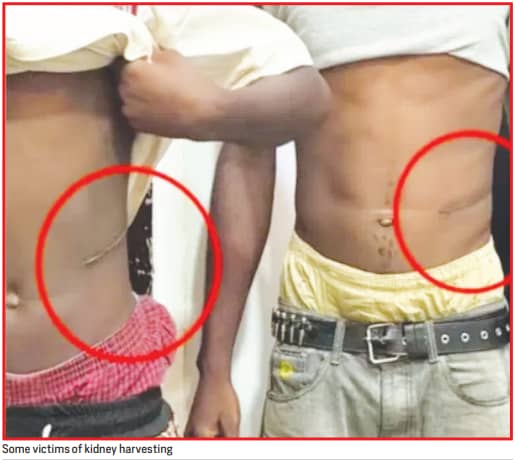
…Police probe alleged syndicate targeting vulnerable youths as Kogi monarch raises fresh alarm
Daud Olatunji
For 22-year-old Samuel Ezekiel, the promise sounded like a way out of poverty.
A message offering quick money and describing the procedure as a simple medical exercise allegedly set in motion a chain of events that ended with Ezekiel undergoing an operation in Abuja.
According to the Nigeria Police Force, Ezekiel was allegedly lured from Nasarawa State to Abuja on April 24, 2026, where one of his kidneys was allegedly removed.
Police said he was allegedly paid $1,250, equivalent to about N1.7m at the exchange rate cited by the Force.
But Ezekiel’s case is no longer being treated as an isolated allegation.
Four suspects, including two nephrologists, have been arrested by the police over an alleged organ-harvesting and human-trafficking syndicate operating between Nasarawa State and Abuja.
The development has also raised a disturbing question: How many Nigerians may have been victims of illegal organ removal without their cases ever being officially recorded?
The answer remains unclear.
Nigeria has no publicly available, comprehensive national database showing the number of people whose organs have allegedly been illegally removed for transplantation or trafficking.
Recent police investigations, however, suggest that vulnerable young people may be targeted by recruiters who exploit their financial difficulties.
Four arrested
The Nigeria Police Force said its Special Tactical Squad arrested four suspects during a sting operation in Auta Balifi, Karu Local Government Area of Nasarawa State, on August 19, 2026.
The suspects were identified as Emmanuel Ode, 23; Dr Benjamin Oyime, 48, a nephrologist; Dr Daniel Otukpa, 53, also a nephrologist; and David Idoko, 25.
According to the police, Ode allegedly admitted recruiting victims under false pretences.
The Force alleged that he lured Ezekiel to Wellington Hospital, Life Camp, Abuja, where his kidney was allegedly harvested.
Police further alleged that the suspects and their accomplices targeted vulnerable and poorly educated young people in Nasarawa State and neighbouring areas, exploiting their financial desperation.
The police also alleged that official documents, including National Identification Numbers, birth certificates, age declarations, affidavits and consent letters, were falsified to facilitate the procedures.
The suspects have not been convicted of any offence and remain entitled to due process.
Second alleged victim emerges
The police investigation has also produced the account of another alleged victim.
According to the Force, the second person told investigators that the same alleged recruiter lured him to a hospital in 2022, where his kidney was allegedly removed.
He reportedly claimed that he received N7m.
The two accounts raise questions about whether the recent investigation has uncovered only a small part of a potentially wider network or whether the cases represent isolated incidents.
At present, there is insufficient verified data to establish the scale of the alleged operation.
The missing numbers
That uncertainty is one of the most troubling aspects of Nigeria’s organ-trafficking problem.
Available Nigerian data on illegal organ harvesting remain limited.
A News Agency of Nigeria report noted that precise statistics on organ harvesting linked to trafficking are scarce because of the clandestine nature of the crime.
NAN also reported that NAPTIP recorded only one case of recruitment for organ harvesting in 2021.
That figure should not be interpreted to mean that only one person was victimised. Rather, it demonstrates how few cases may enter official statistics.
The difficulty is that victims may not report, medical records may not identify trafficking, recruiters may operate through intermediaries and victims may not initially understand that they have been deceived.
Consequently, official case numbers may represent detected cases rather than the actual prevalence of the crime.
Kogi monarch raises fresh alarm
Against that background, concerns have now surfaced in Kogi State.
The Onu Egume/Okura District Head of Dekina Local Government Area, HRH Ochimana Simon Anu, has raised an alarm over allegations that some youths in his domain may be selling their kidneys to raise money for motorcycles and other material possessions.
The monarch reportedly became concerned about young people suddenly acquiring motorcycles valued at between N1m and N2m without obvious sources of income.
He subsequently ordered the formation of a security committee to investigate unexplained displays of wealth among youths and underage persons in the community.
The committee is expected to examine the sources of funds used to purchase expensive motorcycles and determine whether any criminal or exploitative activity is involved.
But there is an important distinction.
The Kogi allegation has not established that any identified youth actually sold a kidney to buy a motorcycle.
No victim has been publicly identified and no police investigation confirming such a transaction in Egume has been disclosed.
The monarch’s intervention therefore represents an alarm and a call for investigation, rather than proof that a kidney-for-motorcycle market exists in the community.
From a WhatsApp message to an alleged missing kidney
The Nasarawa case provides a more concrete picture of how alleged recruitment can occur.
According to the police account, Ezekiel was reportedly approached through a promise of quick financial relief.
He was subsequently introduced to people who allegedly presented the procedure as an opportunity to make money.
The police said he was taken to a hospital, where he allegedly signed documents before undergoing the operation.
He reportedly later discovered that one of his kidneys had been removed.
The case has generated public concern partly because of the alleged vulnerability of the victim.
The police specifically said the network targeted young people experiencing financial difficulties.
That raises another question for investigators: Are poverty and unemployment creating a pool of potential victims for organ-trafficking recruiters?
There is currently insufficient national data to quantify that relationship.
Hospital denies wrongdoing
The hospital named in the police investigation, Wellington Clinics in Abuja, has denied involvement in illegal organ trafficking.
The facility said it did not participate in or benefit from any financial transaction involving the alleged donor or recipient.
It also suspended renal transplant-related services pending the outcome of the investigation.
The hospital said its records showed that the donor was admitted under another identity and was discharged four days after the April 24 operation.
The discrepancy between the police account and the hospital’s records has consequently become an important part of the ongoing investigation.
VeryDarkMan’s alarm
The case gained wider public attention after activist Martins Otse, popularly known as VeryDarkMan, raised an alarm over a young man who allegedly approached his organisation with medical evidence showing that his left kidney was missing.
The allegations prompted further public discussion about possible organ trafficking around Nasarawa and parts of the Federal Capital Territory.
However, claims circulating on social media that large numbers of young people in communities such as Nyanya, Mararaba and Karu had sold their kidneys have not been established.
The FCT Police Command has previously cautioned against unverified claims capable of causing panic, stressing that members of the public should provide credible information to law enforcement.
Medical risks
Beyond the criminal investigation lies a potentially lifelong medical burden for victims.
Physician Gabriel Omonaiye said removing a kidney without informed consent could expose a person to serious physical and psychological consequences.
He identified possible complications of kidney-removal surgery, including bleeding, infection, damage to nearby organs, anaesthetic complications, blood clots, incisional hernia and hypertension.
He also warned that a person whose remaining kidney has impaired function could face serious renal complications.
The psychological consequences, he added, could include anxiety, depression, a sense of betrayal and loss of confidence in the healthcare system.
The bigger investigation
The emerging cases leave investigators with several unanswered questions.
How many alleged victims have undergone kidney removal after being recruited through promises of money?
How many recruiters are operating across Nasarawa, Abuja and neighbouring states?
Were the alleged victims properly informed about the procedures?
…Who authorised the operations?
Were the identities and consent documents of alleged donors properly verified?
How many medical facilities have handled questionable transplant procedures?
And perhaps most importantly, how many victims have never reported what happened to them?
For now, the documented police investigation involves four arrested suspects and allegations concerning at least two victims, while broader claims remain unverified.
What the available evidence does establish is that Nigeria is facing a serious challenge in detecting and documenting organ-trafficking cases.
But until investigations produce identifiable victims, medical evidence and corroborated records, claims of a widespread kidney-for-motorcycle trade should remain allegations—not established facts.
 '
' '
'Do you want to share a story with us? Do you want to advertise with us? Do you need publicity for a product, service, or event? Contact us on WhatsApp +2348183319097 Email: platformtimes@gmail.com
We are committed to impactful investigative journalism for human interest and social justice. Your donation will help us tell more stories. Kindly donate any amount HERE
