

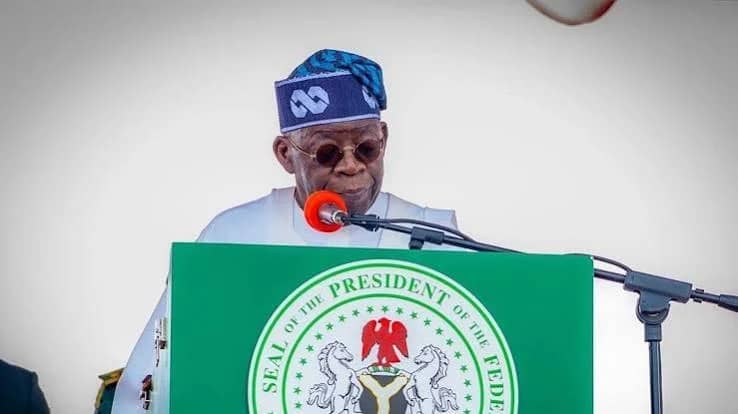
President Bola Ahmed Tinubu has defended the economic policies of his administration, declaring that the reforms implemented since he assumed office did not create Nigeria’s economic weaknesses but were designed to confront problems that had accumulated over decades.
Tinubu made the declaration on Thursday in his Independence Day broadcast to Nigerians, where he described the country as having passed through the most difficult phase of his economic adjustment programme and entering what he called an “age of prosperity.”
The President, who marked Nigeria’s 66th Independence anniversary with an address themed “From Reform to Prosperity,” likened the pre-reform economy to a cancer patient who must choose between painful treatment and temporary relief.
According to him, previous administrations had for years relied on measures that merely eased the symptoms of economic problems without addressing their underlying causes.
“Nigeria was like a sick patient who receives the terrible news that he has cancer,” Tinubu said.
“His doctor explains that the treatment will be difficult and painful, but that it offers a strong prospect of recovery. The patient has a choice. He can begin treatment, endure its discomfort and fight the disease. Or he can ask only for morphine, dull the pain and leave the cancer to spread.”
The President said Nigeria’s leaders had for too long avoided difficult economic decisions while the country accumulated structural problems.
“For too long, Nigeria’s leaders chose morphine while praying for a miracle that never came. They focused on symptoms while allowing the disease to take hold deep within the fabric of our society,” he said.
Tinubu said his administration consequently chose to confront the problems, including what he described as inefficient economic arrangements that had become unsustainable.
“Our reforms did not create the weaknesses in our economy. They confronted them,” he declared.
Tinubu warns against subsidy return
The President also warned against calls for a return to petrol subsidy arrangements, describing such proposals as a retreat from the reforms his administration had undertaken.
He urged Nigerians to reject what he called the “siren song” of returning to what he described as “addictive subsidies.”
“Now, as certain influential but regressive voices would have us abandon the treatment and return ourselves to the abuse of addictive subsidies, we must resist their siren song,” Tinubu said.
The issue of petrol subsidy has emerged as a major point of political debate ahead of the 2027 general elections, with opposition figures, including former Vice-President Atiku Abubakar, advocating variations of targeted subsidy support.
Tinubu, however, insisted that the country must remain on the reform path.
‘Economy grows by over 4%’
Three and a half years into his administration, the President said indicators available to his government showed that the economy had begun to stabilise.
He said Nigeria’s economy had grown by more than four per cent in 2026, with both the oil and non-oil sectors contributing to the growth.
Tinubu also claimed that oil theft had declined, inflation had fallen substantially, foreign reserves had been rebuilt and the foreign exchange market had stabilised.
He further stated that Nigeria generated more than $6bn in non-oil export revenue in 2025, describing it as the highest level recorded in the country’s history.
“Our reforms have strengthened Nigeria’s economic stability and resilience,” he said.
The President also claimed that foreign direct investment continued to rise, arguing that the private sector had responded positively to the reforms.
‘Emergency treatment is over’
Tinubu declared that the period of “emergency treatment” for the Nigerian economy was over, saying the focus of his administration had shifted from economic correction to delivering broader prosperity.
“The emergency treatment is over. The foundation has been repaired,” he said.
“For three years, our overriding purpose was to correct our nation’s course. Now, our purpose is simple: shared and widespread prosperity.”
He said the success of the reforms should ultimately be measured by their impact on ordinary Nigerians rather than solely by macroeconomic indicators.
According to him, the desired outcome is an economy where farmers can cultivate safely and earn better returns, factories have reliable electricity, businesses can access credit and young Nigerians can secure productive employment.
Tinubu targets food, transport costs
Addressing the persistent cost-of-living concerns confronting households, the President said his administration would focus on reducing the cost of production and transportation.
He listed mechanised irrigation, dry-season farming, improved access to seeds and fertiliser, agricultural mechanisation, storage and transportation among the areas receiving attention.
He also said roads, railways and ports linking farms, factories and markets were being constructed or completed to reduce the cost of moving goods across the country.
“Our logic is simple. When a farmer produces more cheaply, when fewer crops are lost between the farm and the market, when a manufacturer spends less on electricity, when a truck reaches its destination faster, and when the business environment fosters fair competition, all those savings will ultimately find their way into the price of goods in the market,” he said.
President promises jobs, industrial expansion
Tinubu said employment creation, enterprise development and industrial growth would become central to the next phase of his administration.
He pledged to promote the use of domestic gas to power industries, revive factories in industrial centres, expand digital connectivity to underserved communities and develop skills demanded by employers.
“I want to see more Nigerians making things. I want to see more Nigerian farms feeding our cities and supplying our factories,” he said.
“I want to see Nigerian businesses selling Nigerian goods to the whole world. I want young Nigerians building unicorns and creating opportunities for others here at home.”
‘Millions still struggling’
Despite his positive assessment of the economy, Tinubu acknowledged that many Nigerian families were still struggling to afford food, education, healthcare and transportation.
He said the hardship confronting many households predated his administration and was the cumulative result of years of low productivity, inadequate infrastructure and limited economic opportunities.
“Some Nigerian families still struggle today for the next meal, the next school fee, the next medical bill, or simply enough money to get to work,” he acknowledged.
“Their circumstances did not begin with the reforms of the last three years. Their struggle is the accumulated consequence of decades of low productivity, inadequate infrastructure, insufficient opportunity and institutions that too often failed those who needed them most.”
He said his government could not reverse in four years problems that had accumulated over generations but could change the direction of the economy.
NELFUND, CREDICORP, social register
The President said his administration was expanding social intervention programmes to cushion vulnerable Nigerians while pursuing longer-term economic reforms.
He cited efforts to strengthen direct support for poor households and improve the National Social Register to ensure that assistance reaches intended beneficiaries.
He also highlighted the Nigerian Education Loan Fund, which he said was helping students from low-income households access higher education, as well as CREDICORP, which provides consumer credit for assets including vehicles, solar systems and digital devices.
Tinubu said the government would also continue working with state and local governments to strengthen primary healthcare, basic education and essential public services.
“These programmes are not substitutes for prosperity. They are a bridge,” he said.
“Our objective is not to manage poverty more efficiently. We will defeat it.”
‘No looking back’
The President concluded his Independence Day message with a call for Nigerians to remain committed to the reform trajectory.
“We have travelled through difficult years together. We have made hard decisions together. And now, still together, we must build the country those decisions have made possible,” he said.
“Our destination is in sight. Our foundations are strong. Our direction is clear. So let us go forward. No looking back.”
 '
' '
'Do you want to share a story with us? Do you want to advertise with us? Do you need publicity for a product, service, or event? Contact us on WhatsApp +2348183319097 Email: platformtimes@gmail.com
We are committed to impactful investigative journalism for human interest and social justice. Your donation will help us tell more stories. Kindly donate any amount HERE
