

…Varsity Unveils Research Breakthrough, Bioxin Biopesticide Patented, Distributes 200 Bottles To Market Women
…Nursing, Medical Laboratory Science, Three Other Programmes Score Above 85% In NUC Assessment
Six First-Class Graduates Secure Automatic Employment Placement
Daud Olatunji
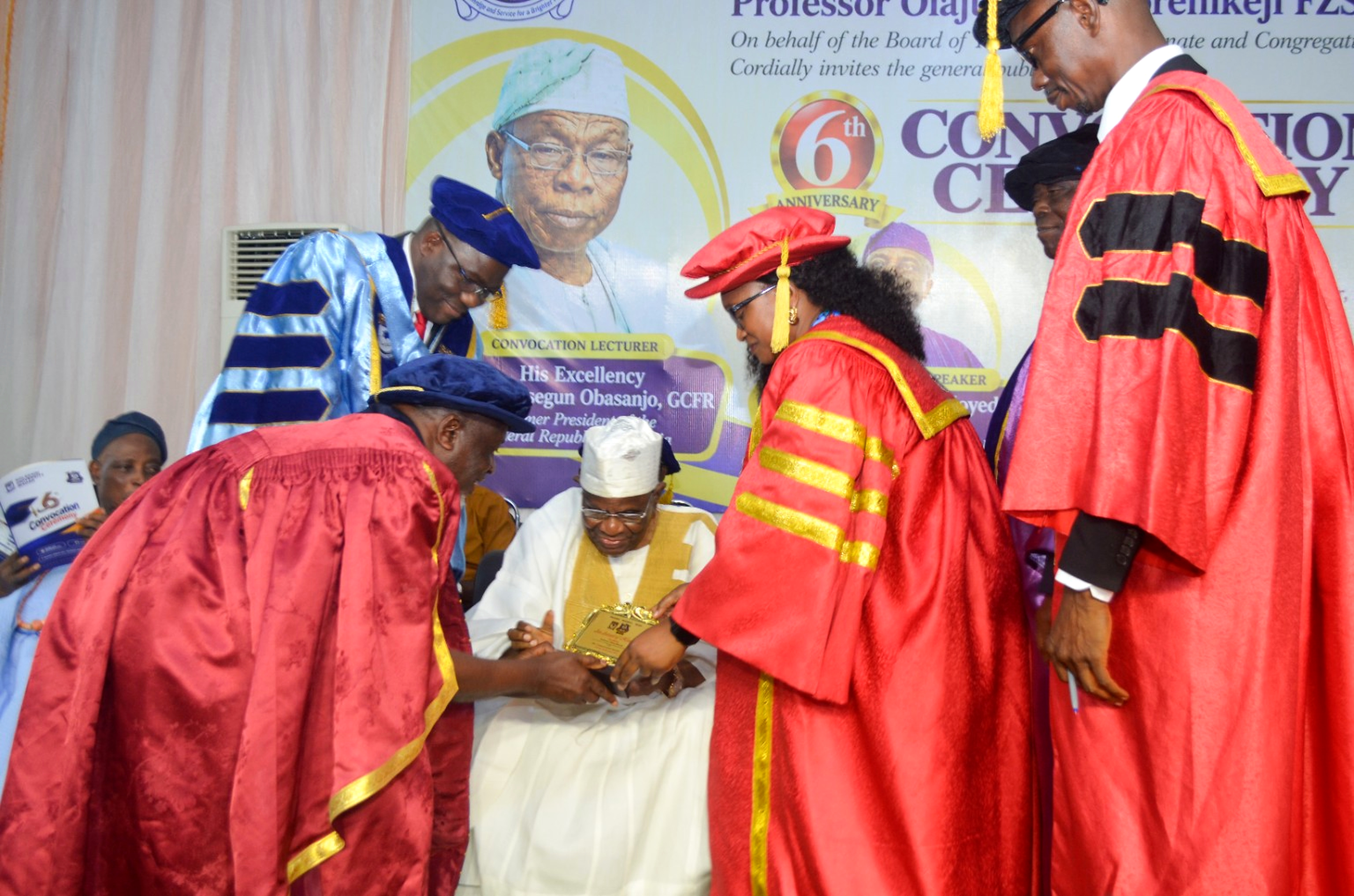
KolaDaisi University, Ibadan, Oyo State, has graduated 224 students, with 24 earning First Class honours, as the institution celebrated its 10th anniversary alongside its sixth convocation ceremony.
The ceremony, held on Thursday, November 5, 2026, also featured the announcement of significant achievements in academic development, research and innovation, international collaborations, graduate employability and infrastructure expansion.
In her address, the Vice-Chancellor, Professor Olajumoke Morenikeji, disclosed that 22 academic programmes of the university had secured full accreditation from the National Universities Commission, while one programme had interim accreditation.
She also highlighted the institution’s research breakthrough in the development of Bioxin, a patented plant-based biopesticide designed to tackle weevil infestation in stored food crops, as part of efforts to translate university research into practical solutions for society.
The Vice-Chancellor said the university had distributed 200 bottles of the product free of charge to market women during its convocation medical outreach.
The graduating class comprised 80 students from the Faculty of Applied Sciences, 80 from the Faculty of Arts, Management and Social Sciences, and 64 from the Faculty of Law.
Giving a breakdown of the academic performance, Morenikeji said 24 graduands obtained First Class honours, 91 finished with Second Class Upper Division, 80 earned Second Class Lower Division, while 29 graduated with Third Class honours.
The 24 First Class graduates represented approximately 10.7 per cent of the graduating class.
She described the convocation as a celebration of individual achievement and an opportunity for the university to assess its progress, account for its stewardship and renew its commitment to knowledge, innovation and public service.
According to her, the institution’s growth over the past decade reflected the collective efforts of its founder, governing bodies, management, staff, students, families, partners and other stakeholders.
Morenikeji said the university had grown from its initial two faculties — Applied Sciences and Arts, Management and Social Sciences — to include the Faculties of Law and Basic Medical Sciences, as well as the School of Postgraduate Studies.
Its academic programmes now cover humanities, management, computing, law, Nursing Science, Medical Laboratory Science, Public Health and related disciplines.
She noted that the number of graduating students had increased steadily from 52 in 2021 to 92 in 2022, 123 in 2023, 155 in 2024, 203 in 2025 and 224 in 2026.
The Vice-Chancellor said the progression reflected the university’s growing capacity to provide higher education and contribute to the development of skilled human resources.
On academic accreditation, she disclosed that all five programmes in the Faculty of Basic Medical Sciences obtained full accreditation during the NUC exercise conducted in October and November 2025.
The programmes recorded the following scores: Human Physiology, 96.6 per cent; Nursing Science, 89.9 per cent; Medical Laboratory Science, 87.4 per cent; Human Anatomy, 85.7 per cent; and Public Health, 85.6 per cent.
She said the accreditation maturity dates for the five programmes extended to 2030.
However, she explained that the Nursing and Midwifery Council of Nigeria conducted a separate professional accreditation exercise for the Nursing Science programme between August 30 and September 3, 2026, adding that the university was awaiting the council’s formal outcome.
Preparations, she added, were also ongoing for the professional accreditation exercise for Medical Laboratory Science.
The Vice-Chancellor further disclosed that the Council of Legal Education accredited the university’s Law programme in 2024, enabling pioneer graduates of the faculty to proceed to the Nigerian Law School in March 2026.
On research and innovation, Morenikeji described the development of Bioxin by Dr Mojisola Karigidi as one of the institution’s notable achievements.
She said the plant-based biopesticide, developed from lemongrass and orange-peel extracts, was designed to tackle weevil infestation in stored beans, maize and rice.
According to her, the product was patented on March 5, 2024, under Patent No. F/PT/NC/2024/11274, while its efficacy was verified by the Nigerian Stored Products Research Institute.
She added that documentation relating to its ingredients and safety and toxicity assessment had been prepared by a NAFDAC-recognised independent assessor, with relevant certificates issued.
The university, she said, had also prepared prototype samples, branding and packaging for the product, which were displayed at its Convocation Research and Entrepreneurship Exhibition.
Morenikeji said the distribution of 200 bottles to market women during the anniversary medical outreach demonstrated how research findings could be connected to community needs.
She stressed that the university was taking deliberate steps to strengthen its research culture, improve research governance and expand opportunities for scholarly collaboration.
The Vice-Chancellor disclosed that the institution had established a Centre for Open Science Research in Robotics, Computing and Artificial Intelligence through a Physics with Electronics research team led by Dr Mumin O. Oladipo, with international funding.
She said the centre was developing collaborations with national and international institutions and industry partners, including research activities involving prototyping and patent development.
She also highlighted the international recognition received by some members of the academic staff.
According to her, Dr John Akanni of the Department of Computing and Mathematical Sciences undertook research visits to the Institut des Hautes Études Scientifiques in France and the University of Oxford, where he worked on mathematical modelling of disease transmission, including Mpox and onchocerciasis.
Akanni was also awarded the Stellenbosch Institute for Advanced Study Iso Lomso Fellowship for 2027–2029 for a research project examining endemic diseases and mathematical modelling in African contexts.
Morenikeji further disclosed that Dr Anne Adeyanju completed a four-month research fellowship at the University of Alicante, Spain, between November 2025 and March 2026, while Dr Temitope Y. Bello received a travel grant to present research on forced displacement and indigenous farming practices at a conference in Senegal.
She said the university’s 2026 International Symposium, held on October 20, attracted more than 400 registered participants from Nigeria, Ghana, Zimbabwe, South Africa, Germany and India.
The symposium focused on enhancing research visibility and academic competitiveness in the Global South through artificial intelligence and international collaboration.
The Vice-Chancellor also highlighted the university’s efforts to improve graduate employability through partnerships with employers and professional institutions.
She disclosed that six First Class graduates of the institution were offered automatic placement in the Management Training Programme of Chams Corp Plc, Lagos, in November 2025.
Two Accounting students, Fatimo Oluwabukunmi Aderoju and Samuel Olaoluwa Olatunji, also became the first undergraduates of the university to pass the Institute of Chartered Accountants of Nigeria provisional qualifying examination while still pursuing their degree programmes.
She said the two students had secured internship placements with KPMG and PricewaterhouseCoopers through the intervention of the Pro-Chancellor and Chairman of the Governing Council, Mr Remi Babalola, and were expected to commence the programmes after graduation.
The institution, she added, had also maintained an annual internship arrangement with the Nigerian Institute of International Affairs for five outstanding students from its History and Diplomatic Studies and International Relations departments.
Morenikeji said the university’s inaugural Career Fair, held in June 2026 under the theme, “Forging Futures: Connecting Talent with Opportunity”, attracted more than 20 companies from different sectors.
She said the event provided opportunities for students to interact with prospective employers, industry practitioners and other stakeholders.
As part of efforts to strengthen student development, she announced that Babalola had instituted the Remi Babalola Initiative Academic and Excellence Prize, valued at N5m, for the best overall undergraduate students from 100 to 400 level, beginning from the 2026/2027 academic session.
The Vice-Chancellor also disclosed that Odu’a Investment Company Limited donated 500 books to the university following its participation in the Career Fair, while Professor Oladapo Afolabi donated N40m towards furnishing the new Senate Chamber and offices of principal officers.
On digital skills and entrepreneurship, Morenikeji said the university had partnered with Mobile Screens and Sound Limited through the MSS EventTech Academy to provide professional training in sound engineering, LED and multimedia installation, lighting and stage design, videography, creative production and event management.
She clarified that the academy was a technical and professional skills initiative, with certificates jointly issued by the university and MSS, and did not replace NUC-regulated academic programmes.
She also cited the Campus Tech Queens Initiative, organised in collaboration with the Nigerian Women in Information Technology, Oyo State Chapter, which equipped female students with practical skills in prompt engineering, artificial intelligence-driven design, digital content creation, and website and application development.
On infrastructure, the Vice-Chancellor said additional halls of residence had been provided, while a hostel project designed to accommodate approximately 500 students was under construction.
She added that work was progressing on the Faculty of Nursing and Faculty of Medical Laboratory Science complexes, while the Governing Council had approved the construction of a 600-capacity lecture theatre.
Other projects, according to her, included plans for a befitting university library, dedicated virtual resource rooms, upgrading the university health centre into a Primary Healthcare Centre and renovating the sports complex.
She said the university had also employed a professional sports coach to strengthen sporting and recreational activities.
On campus security, Morenikeji said the management had engaged additional personnel, deployed more CCTV cameras and communication equipment, and strengthened collaboration with the Nigerian Army, Nigeria Police Force and Amotekun Corps.
She appreciated the Oyo State Government for facilitating the presence of Amotekun personnel within the university environment.
The Vice-Chancellor added that the university had continued to engage neighbouring communities through health outreaches, borehole donations and other community development initiatives.
She said healthcare services were also provided to residents of surrounding communities and traders at Alata Market as part of the 10th-anniversary activities.
Earlier, the Chairman of the Board of Trustees, Professor Adeniyi Osuntogun, described the university’s 10th anniversary as a significant milestone, expressing satisfaction with its growth and institutional development.
Osuntogun said the university had recorded full NUC accreditation for its academic programmes, including Nursing Science and Medical Laboratory Science.
His statement on accreditation was broader than the specific breakdown later provided by the Vice-Chancellor, who said 22 programmes had full accreditation while one held interim accreditation.
The Board chairman also disclosed that the university had completed a multi-million-naira hostel complex comprising Olatunbosun, SRL and Bolanle Halls of Residence.
He said construction was ongoing on two additional hostel blocks, each designed to accommodate 280 students, to improve residential facilities and student welfare.
Osuntogun further said the university was investing in an Entrepreneurship Hub, sporting facilities, healthcare services, a modern student cafeteria and solar-powered energy solutions in student residential areas.
He said the institution’s alumni were making contributions across different sectors, while some had secured admission for postgraduate studies at institutions in Nigeria, Canada, the United States and the United Kingdom.
Addressing the graduands, the chairman urged them to embrace lifelong learning, innovation, entrepreneurship, independent thinking and ethical leadership.
He said artificial intelligence, climate change and digital transformation were reshaping the global labour market, stressing that universities must prepare graduates with the skills and adaptability required to remain relevant.
He challenged the graduands to become value creators rather than merely job seekers, adding that their success should be measured by the problems they solve and the positive changes they bring to society.
In his remarks, the Pro-Chancellor and Chairman of the Governing Council, Mr Remi Babalola, described higher education as a strategic investment in national development, economic prosperity and global competitiveness.
Babalola said tertiary education remained critical to producing the skilled workforce needed to drive innovation, improve productivity, strengthen institutions and address poverty.
Citing the World Bank, he said graduates of tertiary institutions enjoyed an estimated 17 per cent increase in earnings compared with individuals with lower levels of education.
He also noted that global tertiary education enrolment had risen from approximately 100 million students in 2000 to about 269 million in 2024, underscoring the growing importance of human capital development.
The Pro-Chancellor urged universities to respond to changing labour-market realities by equipping students with critical thinking, creativity, problem-solving abilities and entrepreneurial skills.
He said KolaDaisi University would remain committed to innovation, digital readiness, ethical leadership, global engagement and strategic partnerships with industries.
Babalola also cautioned that artificial intelligence should remain a tool for human development rather than a replacement for human dignity, creativity and ethical responsibility.
Meanwhile, the Chancellor and Founder of the university, Chief Kola Daisi, CON, said the institution was established a decade ago on the conviction that universities must do more than impart academic knowledge.
Daisi, who is also the Bashorun of Ibadanland, said his vision was to build an institution capable of shaping character, developing human potential and producing graduates who would contribute meaningfully to society.
He said the university’s first decade had been characterised by growth, resilience, institutional development and the transformation of students’ lives.
According to him, the true measure of a university should not be restricted to its buildings, academic programmes or years of existence, but should be determined by the quality of its graduates, the strength of its values and its contributions to society.
He urged the graduating students to become worthy ambassadors of the institution by using their knowledge to solve societal problems, empower others and create opportunities for future generations.
Daisi reaffirmed the university’s commitment to investing in critical infrastructure, academic excellence and global relevance, adding that its next decade would focus on greater institutional impact and contributions to Nigeria’s development.
The ceremony featured former President Olusegun Obasanjo as the convocation lecturer, while Professor Is’haq Oloyede, immediate past Registrar of the Joint Admissions and Matriculation Board, served as the commencement speaker.
The event was attended by Oyo State Governor, Engineer Seyi Makinde; the Olubadan of Ibadanland, Oba Rashidi Adewolu Ladoja; traditional rulers; government officials; university administrators; parents and other prominent personalities.
As the institution entered its second decade, Morenikeji said its priorities would include strengthening academic quality, expanding appropriate postgraduate programmes, improving research and innovation, developing infrastructure, advancing digital learning, supporting staff development, enhancing student welfare and building strategic partnerships.
She urged the graduands to uphold integrity, remain lifelong learners, create opportunities, serve humanity and respect diversity, while maintaining the values of excellence, innovation, entrepreneurship and service to society.
 '
 '
Do you want to share a story with us? Do you want to advertise with us? Do you need publicity for a product, service, or event? Contact us on WhatsApp +2348183319097 Email: platformtimes@gmail.com
We are committed to impactful investigative journalism for human interest and social justice. Your donation will help us tell more stories. Kindly donate any amount HERE
 '
