

Daud Olatunji
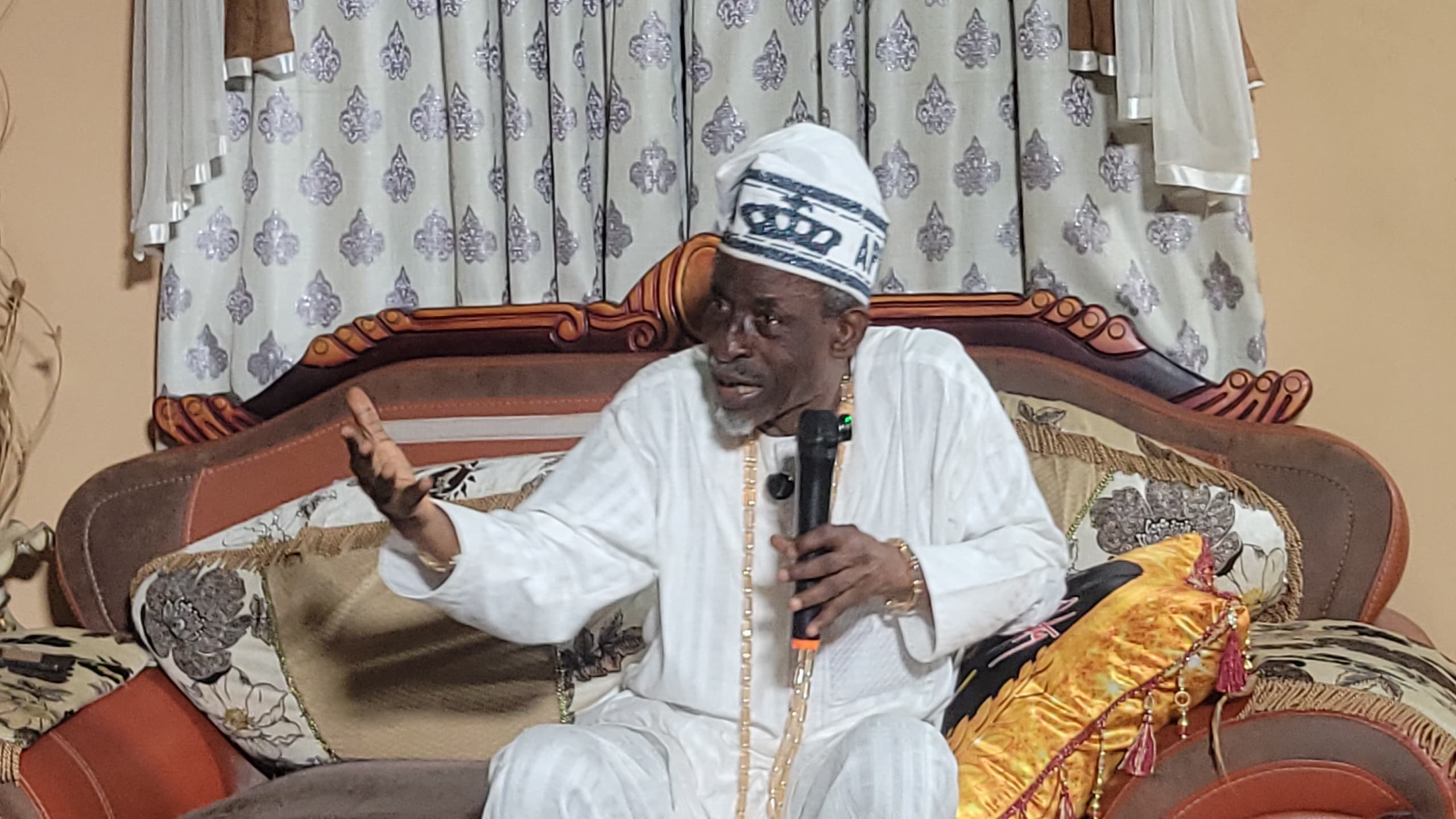
The Apena of Egbaland and Oluwo of Iporo-Ake, Chief Suarau Olayiwola Alani Bankole, has attributed many of Nigeria’s political and socioeconomic challenges to what he described as a defective system, arguing that changing political leaders alone may not solve the country’s problems.
Bankole, who spoke during a media chat to mark his 85th birthday, said the structure of governance, political appointments and the country’s approach to developing human capacity had contributed significantly to the difficulties confronting Nigeria.
The businessman and former national chairman of the defunct All Nigeria Peoples Party also argued that the country’s political system often makes it difficult for elected leaders to constitute teams strictly on the basis of competence.
He said, “The system is responsible for our present-day calamity.”
Bankole, the father of former Speaker of the House of Representatives, Dimeji Bankole, said his decades of involvement in business and politics had given him an opportunity to observe the country’s governance system from different perspectives.
He said Nigeria’s challenges should not always be blamed exclusively on the President, governors or individual political office holders.
According to him, a President operates within constitutional, political and institutional constraints, including the requirement to ensure broad representation in government.
He said, “To be President, you must work with a team. How do you get a good team in Nigeria when the Constitution says you must take at least a minister from each of the states?”
Bankole argued that such arrangements could make it difficult for a leader to select members of government exclusively on the basis of competence.
He said the same challenge applied to political appointments at different levels of government, stressing that the problem was broader than the personality of any particular office holder.
‘Leadership alone not enough’
The octogenarian businessman said even replacing political leaders would not automatically transform the country if the underlying institutions and political arrangements remained unchanged.
He said, “You can only give what you have.”
Bankole, who has spent decades in business and public affairs, said the country needed to examine the foundations of its political and administrative system instead of focusing solely on individual politicians.
He also linked Nigeria’s current situation to the historical legacy of colonial administration, arguing that some structures introduced during the colonial era had continued to influence governance after independence.
He questioned whether Nigerians had sufficiently adapted those inherited structures to meet the country’s own circumstances.
The Apena also used the occasion to speak about unemployment, poverty and the attitude of some young Nigerians towards work.
He argued that parents had an important responsibility to prepare their children for self-reliance by exposing them to productive activities and teaching them the value of hard work.
Recalling his childhood, Bankole said young people of his generation were expected to combine education with practical work.
He recalled returning from school and going directly to the farm, saying such experiences helped young people develop discipline and a sense of responsibility.
He contrasted that experience with what he described as the tendency of some contemporary parents to make life too easy for their children.
Bankole said young Nigerians should not depend exclusively on salaried employment but should also acquire entrepreneurial skills.
“Teach people how to make money; don’t give them money,” he said.
He argued that creating wealth and developing productive skills could provide young people with greater economic independence.
Bankole also recounted the difficult circumstances surrounding his early years.
He said his education was temporarily interrupted after elementary school because he could not immediately secure admission into secondary school.
He subsequently began working at a petrol station through a family connection.
Rather than abandon his education, he said an arrangement was eventually reached between the two families allowing him to attend school and continue working at the petrol station after classes.
According to him, the experience exposed him to business management at an early age.
He recalled that by the age of about 18, he had progressed from being a petrol attendant to managing two filling stations.
He said his responsibilities included travelling to Lagos to place orders, receiving petroleum products and supervising operations.
The experience, he said, laid the foundation for his subsequent career in business.
Bankole later moved to Lagos, where he secured employment opportunities, including work with the Federal Office of Statistics and subsequently in banking.
He said his work in the banking sector, particularly in the foreign exchange department, exposed him to international business and further strengthened his interest in entrepreneurship.
He eventually resigned from banking after he was asked to relocate to Port Harcourt during the Nigerian Civil War.
According to him, he declined the transfer because of the security situation and his responsibility as the eldest son of the family.
Looking back at his journey, Bankole attributed his achievements largely to divine grace.
“Whatever I am today and whatever I have been able to do is by the special grace of God,” he said.
Bankole also reflected on his long involvement in Nigerian politics.
He said he became interested in politics at about 35 and subsequently participated in political activities during the transition to the present democratic era.
He was a prominent member of the defunct All Nigeria Peoples Party and served as its national chairman.
He also recalled his interactions with political leaders and his involvement in legislative and governmental affairs.
According to him, his political experience reinforced his belief that Nigeria’s challenges were structural and could not be resolved simply by changing individuals in political office.
He said he had reached a point in his life where political office itself was no longer his primary concern.
Rather, he said his interest was in how Nigeria could build institutions capable of delivering better outcomes for citizens.
The 85-year-old traditional chief also spoke about his family and the importance of education and enterprise.
Bankole is the father of former Speaker of the House of Representatives, Dimeji Bankole, who presided over the House between 2007 and 2011.
He spoke with pride about the achievements of his children and said he had always encouraged them to acquire education, develop professional skills and contribute to society.
For him, family success should not be measured only by wealth but also by the ability of one’s children to make meaningful contributions to their communities.
Reflecting on his 85 years, Bankole said he wanted to be remembered as a person whose position on issues was clear, even when others disagreed with him.
“You may not agree with your friend or colleague on many issues, on many occasions or in many instances, but you should always know where he stands,” he said.
He described this as one of the qualities about which he was most proud.
 '
' '
'Do you want to share a story with us? Do you want to advertise with us? Do you need publicity for a product, service, or event? Contact us on WhatsApp +2348183319097 Email: platformtimes@gmail.com
We are committed to impactful investigative journalism for human interest and social justice. Your donation will help us tell more stories. Kindly donate any amount HERE
 '
'