

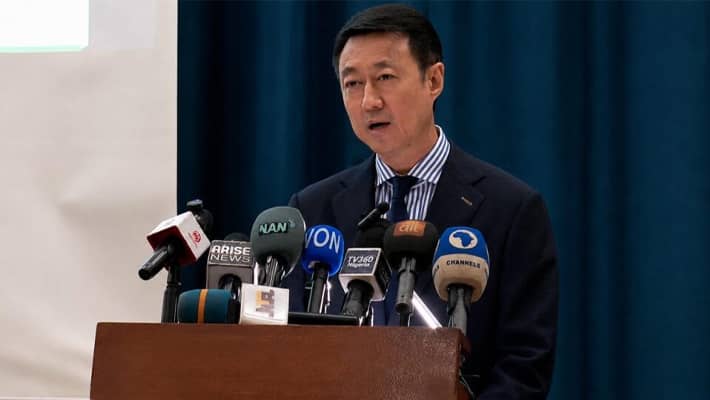
China imported goods worth about $2.3bn from Nigeria in the first half of 2026, representing an 80 per cent increase, the Chinese Ambassador to Nigeria, Yu Dunhai, has said.
Dunhai disclosed this on Friday in Abuja at an international seminar on “China’s Zero-Tariff Measures and Africa’s Economic Structural Transformation,” organised by the Centre for China Studies.
The ambassador attributed the surge to China’s zero-tariff policy for African countries, which took effect on May 1 and covers 53 African countries with which Beijing maintains diplomatic relations.
He said Nigeria-China bilateral trade also rose to $18bn during the first half of the year, representing a 35 per cent increase compared with the corresponding period in 2025.
“Chinese imports from Nigeria surged 80 per cent to $2.3bn, with monthly growth exceeding 40 per cent in both May and June,” Dunhai said.
The envoy said the policy had already contributed to an estimated six per cent increase in Africa’s overall exports to China, with China-Africa trade reaching a record $207bn in the first six months of 2026.
He said Chinese imports from Africa rose to $29bn in May and June alone, representing a 24 per cent year-on-year increase.
Dunhai said the tariff-free arrangement had lowered the cost of exporting Nigerian commodities to China, with savings already recorded on products including sesame, cattle bone granules and liquefied propane.
According to him, every 100 tonnes of sesame exported from Nigeria saves about $11,000 in costs, while the country’s annual export of 7,000 tonnes of cattle bone granules translates to nearly $450,000 in savings.
He added that a single shipment of 23,000 tonnes of Nigerian liquefied propane attracted about $300,000 in tax savings under the new arrangement.
However, the ambassador warned that tariff-free access alone would not transform Nigeria’s economy.
He said Nigerian businesses must improve product quality, establish reliable supply chains and invest heavily in local processing if the country is to sustain its access to the Chinese market.
Dunhai urged Nigerian exporters to move beyond the shipment of raw commodities and invest in value addition to take advantage of China’s market of about 1.4 billion consumers.
He also called for stronger cooperation in industrial parks, technology transfer and technical training, assuring that China was prepared to support Nigeria’s efforts to process its raw materials locally.
He said China was also working towards faster negotiations on trade facilitation, investment protection and quarantine standards to provide a more predictable environment for investors.
The envoy encouraged Nigerian exporters and small businesses to use platforms such as the China International Import Expo, Canton Fair and China-Africa Economic and Trade Expo to establish direct links with Chinese buyers.
The Minister of Foreign Affairs, Bianca Ojukwu, described the policy as an opportunity for Nigeria to move from dependence on raw-material exports to the production of value-added goods.
Ojukwu, represented by the Permanent Secretary of the ministry, Dunoma Ahmed, said the priority should be to ensure that more of the wealth generated from Africa’s natural resources remained on the continent.
“The objective should be to ensure that a greater proportion of the value generated from Africa’s resources remain within Africa,” she said.
The Minister of State for Agriculture and Food Security, Aliyu Abdullahi, similarly challenged Nigeria to focus not merely on increasing its exports but on improving what it exports.
“The question before us is not, can Nigeria export more? The question should be, can Nigeria export better?” he said.
Abdullahi identified processed cassava, premium rice, spices, hibiscus, cashew products, soybean products, fruits and vegetables as areas where Nigeria could significantly expand its presence in the Chinese market.
He said tariff-free access would only yield lasting benefits if backed by modern processing industries, efficient logistics, quality assurance, traceability systems, adequate storage facilities and internationally recognised export certification.
The Director of the Centre for China Studies, Charles Onunaiju, said the seminar was aimed at moving discussions about China’s zero-tariff policy beyond announcements to practical strategies capable of delivering economic benefits.
Onunaiju said the policy offered African countries an opportunity to confront longstanding structural weaknesses in their economies but warned that market access would mean little without deliberate industrial policies.
He said the African Continental Free Trade Area could complement the policy by harmonising standards, strengthening regional value chains and creating economies of scale for African producers.
He urged African governments and businesses to regard the zero-tariff arrangement as a starting point for industrialisation rather than an end in itself.
The seminar attracted government officials, farmers, manufacturers, exporters, traders and other stakeholders who examined ways of overcoming barriers that could prevent African businesses from fully exploiting the Chinese market.
 '
' '
'Do you want to share a story with us? Do you want to advertise with us? Do you need publicity for a product, service, or event? Contact us on WhatsApp +2348183319097 Email: platformtimes@gmail.com
We are committed to impactful investigative journalism for human interest and social justice. Your donation will help us tell more stories. Kindly donate any amount HERE
 '
'