

Toyyibat Qasim
Africa’s richest industrialist, Aliko Dangote, has unveiled an ambitious plan to establish a continent-wide petroleum distribution network, disclosing that his conglomerate has acquired a 25 per cent stake in Kenya’s petroleum products pipeline network as part of efforts to expand its footprint across African energy markets.
Dangote also revealed plans for petroleum storage terminals, tank farms and distribution corridors linking Djibouti, Ethiopia, Cameroon and Namibia, with further expansion envisaged into Botswana, South Africa, Zimbabwe and Zambia.
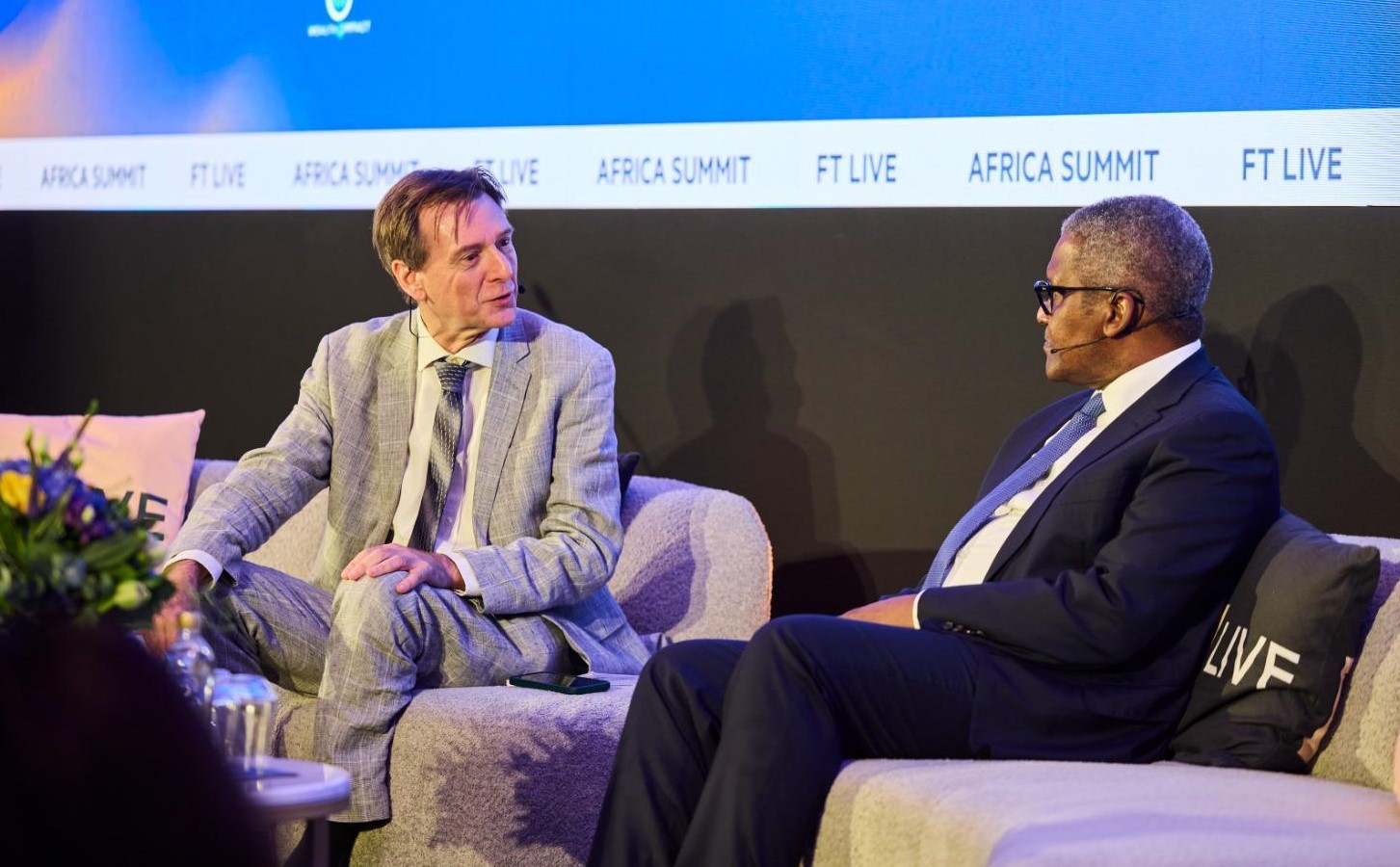
The President and Chief Executive of Dangote Industries Limited disclosed the plans during an interview with Financial Times Africa Editor, David Pilling, at the FT Africa Summit in London.
The proposed network is expected to strengthen the movement of refined petroleum products from major refining centres to markets grappling with supply constraints and fragmented distribution infrastructure.
Dangote said the Group was pursuing the expansion aggressively, describing energy distribution infrastructure as critical to improving Africa’s energy security and accelerating industrial development.
“Just let me tell you, yesterday, with the support from the President of Kenya, we bought 25 per cent of the pipeline network for the distribution of petroleum products,” he said.
The acquisition represents a significant step in the conglomerate’s strategy to expand beyond refining into the transportation, storage and distribution of petroleum products across the continent.
Dangote explained that the Group was developing a major distribution corridor connecting Djibouti with Addis Ababa, Ethiopia, supported by storage terminals and tank farms to facilitate the efficient movement of refined products.
He added that another strategic project in Cameroon was nearing completion, while Namibia had emerged as a potential gateway for expanding into Southern African markets.
According to him, Namibia’s geographical position makes it attractive for the distribution of petroleum products from the Dangote Petroleum Refinery in Lagos.
“From our refinery to Namibia is just about four days of steaming,” he said.
Dangote explained that products shipped from Lagos could be distributed through Namibia to neighbouring markets, including Botswana and South Africa, with Zimbabwe and Zambia also featuring in the Group’s broader expansion plans.
The proposed network is designed to connect refining capacity with strategic storage and transportation facilities, potentially improving supply efficiency across markets that have traditionally relied heavily on imported petroleum products.
Plans 700,000-Barrel Refinery In Kenya
Beyond distribution infrastructure, Dangote disclosed plans to establish another refinery in Lamu, Kenya, with a proposed capacity of approximately 700,000 barrels per day.
He said East Africa’s expanding economies, growing mining industry and rising demand for energy made the region attractive for large-scale refining investments.
According to him, technical assessments identified Lamu as the preferred location because of its deep-water access, marine infrastructure and the availability of resources required for a major refinery.
Dangote said the proposed facility would source crude oil from multiple markets rather than depend exclusively on supplies from Kenya or Uganda.
He added that the investment decision was concluded within four months, alleging that commercial interests had attempted to delay the project through legal proceedings shortly before its public announcement.
The proposed refinery, if implemented at the stated capacity, would represent a major addition to the continent’s refining infrastructure and further extend the Group’s presence in East Africa.
However, the project’s development timeline, financing arrangements and implementation details were not provided in the statement.
‘Importing Poverty Into Africa’
While outlining the expansion strategy, Dangote called on African governments to adopt stronger industrial policies that protect domestic manufacturers against unfair competition and encourage local production.
He argued that excessive dependence on imported goods undermines domestic industries, weakens job creation and limits the continent’s ability to retain economic value from its resources.
“Allowing imports to displace local production means we are exporting our jobs out of the continent and importing poverty into the continent,” he said.
The industrialist questioned why African countries should hesitate to protect their domestic industries when major global economies were increasingly adopting measures to strengthen local manufacturing.
“If America is now saying, no, we are going to protect our industries, who are we in Africa not to protect our own industries?” he asked.
Dangote maintained that industrialisation would remain difficult to achieve without deliberate government policies that support local manufacturers, preserve productive capacity and create sustainable employment.
His position comes amid persistent debates across African economies over the balance between protecting emerging industries and maintaining competition, affordable prices and access to imported goods.
He argued that governments must create an environment in which African businesses can compete, expand production and develop the capacity to meet growing domestic and regional demand.
Earmarks $50bn For Investments
Dangote also disclosed that his Group had earmarked approximately $50bn for investments between 2026 and 2030.
He said the investment programme was part of a broader ambition to demonstrate that African businesses could execute large-scale industrial projects capable of transforming the continent’s economic fortunes.
“The legacy we are trying to set up is how do we industrialise our continent?” he said.
According to him, the proposed investments would extend the Group’s industrial footprint while encouraging other African entrepreneurs and investors to pursue ambitious projects in manufacturing, energy and infrastructure.
Dangote identified inadequate electricity supply, weak financial systems and underdeveloped industrial policies as major obstacles to Africa’s economic transformation.
He stressed that reliable electricity was indispensable for manufacturing, mining and mineral processing, particularly as African countries seek to move beyond exporting raw materials to producing higher-value goods.
The industrialist also highlighted the continent’s electricity access deficit, arguing that the shortage of reliable power continues to constrain business growth, productivity and employment opportunities.
He maintained that Africa possessed abundant natural resources, extensive agricultural land and a large youthful population but had yet to fully translate these advantages into widespread prosperity.
Dangote expressed optimism that sustained investment in energy infrastructure, industrial production and regional trade could help reverse the trend.
“The journey has started,” he said. “But now we’re awake, and we will make it happen.”
 '
 '
Do you want to share a story with us? Do you want to advertise with us? Do you need publicity for a product, service, or event? Contact us on WhatsApp +2348183319097 Email: platformtimes@gmail.com
We are committed to impactful investigative journalism for human interest and social justice. Your donation will help us tell more stories. Kindly donate any amount HERE
 '
