

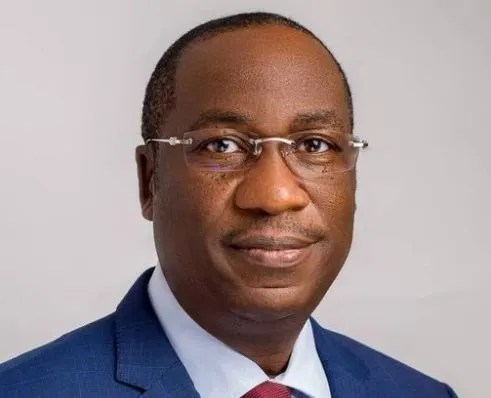
Firdaus Obiremi
Lagos State Deputy Governor and All Progressives Congress governorship candidate, Obafemi Hamzat, has defended the state government’s handling of the aftermath of the October 20, 2020 Lekki tollgate shooting, insisting that several recommendations of the judicial panel set up to investigate the incident were implemented.
Hamzat, who was deputy governor when soldiers were deployed to the tollgate during the #EndSARS protests, acknowledged his involvement in the administration at the time, describing the incident as one of the saddest moments in Lagos State’s history.
He spoke on Sunday during the Lagos Governorship Debate organised by the Nigeria Debate Consortium, a coalition comprising peer media organisations.
Responding to a question about what he personally knew concerning the security decisions taken on October 20, 2020, Hamzat said he would not distance himself from the government in which he served.
“October 20, 2020, is a very sad day in Lagos. Very sad. I will not stand here to say I’m not the deputy governor. I was in the room,” he said.
The APC governorship candidate acknowledged the pain suffered by victims and their families, as well as the damage the incident caused to public confidence in government.
He, however, argued that the Lagos State Government subsequently took steps to investigate the incident through an independent judicial commission, which submitted recommendations for implementation.
“Remember, Lagos set up a judicial commission, funded and independent, to find the truth. They did their report. Lagos also did a white paper, implementing a lot of those decisions,” Hamzat said.
He also reiterated the government’s position that citizens have the constitutional right to protest, declaring, “We believe people have the right to protest.”
However, the deputy governor’s defence comes amid lingering controversy over the extent to which the recommendations of the judicial panel were implemented, particularly its findings on the shooting, compensation for victims and demands for accountability.
The #EndSARS protests erupted in October 2020 following widespread allegations of police brutality, extortion, harassment and extrajudicial killings, particularly by operatives of the disbanded Special Anti-Robbery Squad.
The protests spread across several Nigerian states, with the Lekki tollgate in Lagos becoming one of the major centres of demonstrations.
On October 20, 2020, soldiers were deployed to the tollgate, where protesters had gathered. The shooting that followed triggered nationwide and international outrage, with activists and affected families demanding justice and accountability.
In response, the Lagos State Government inaugurated a nine-member Judicial Panel of Inquiry, chaired by retired Justice Doris Okuwobi, to investigate allegations of police brutality and human rights violations, including the Lekki tollgate incident.
After 131 sittings, the panel concluded its proceedings in October 2021 and submitted its reports to the state government on November 15, 2021.
The panel awarded N410m in compensation to 70 victims of police brutality and other human rights violations.
In its report on the Lekki incident, the panel found that soldiers fired at unarmed protesters, resulting in deaths and injuries. It described the incident as a massacre within the context of its findings and raised concerns about the subsequent handling of the scene.
The panel made 32 recommendations, including compensation for victims, prosecution of security personnel implicated in the incident, improved police accountability, a public apology and the establishment of a memorial at the tollgate.
However, the Lagos State Government’s White Paper, released on November 30, 2021, accepted only 11 recommendations, accepted six with modifications, rejected one and referred 14 to the Federal Government, arguing that they fell outside its jurisdiction.
The government also rejected the panel’s finding that nine people were killed by gunfire at the tollgate, maintaining that the conclusion was not supported by sufficient evidence and contained inconsistencies.
The disagreement over the panel’s findings and the extent of the government’s response has continued to fuel public debate, with human rights advocates and families of victims insisting on full accountability.
The controversy resurfaced on October 20, 2022, when police fired tear gas to disperse protesters who converged on the Lekki tollgate to commemorate the second anniversary of the demonstrations.
The procession, attended by entertainer Folarin Falana, popularly known as Falz, and comedian Adebowale Adedayo, popularly known as Mr Macaroni, featured participants carrying placards and symbolic coffins in remembrance of those who died during the protests.
The police subsequently defended the action, claiming that the protesters had disrupted traffic by stopping at the tollgate.
Despite the passage of six years, the Lekki shooting remains a sensitive issue in Nigeria’s political and human rights discourse, with questions surrounding responsibility, accountability and the implementation of the judicial panel’s recommendations continuing to shape public conversations..
 '
 '
Do you want to share a story with us? Do you want to advertise with us? Do you need publicity for a product, service, or event? Contact us on WhatsApp +2348183319097 Email: platformtimes@gmail.com
We are committed to impactful investigative journalism for human interest and social justice. Your donation will help us tell more stories. Kindly donate any amount HERE
 '
