
…Ogun Ranks Fourth Most Indebted With ₦538.92bn Debt Stock
…Lagos Tops Debt Chart With ₦2.9tn, Osun Gulps ₦100.17bn On Debt Servicing
…Oyo’s Expenditure Soars 118.7%, Enugu Records 125.9% IGR Growth
…Ebonyi Battles ₦43.32bn Contractor Arrears As States Struggle Despite FAAC Windfall
Daud Olatunji
State governments across Nigeria are facing mounting fiscal pressure as their combined debt stock climbed to ₦11.67tn in 2025, raising fresh concerns about their capacity to meet development obligations despite increased revenue inflows from the Federation Account.
The alarming figures are contained in the 2026 State of States Report released by BudgIT, which assessed the 2025 fiscal performance of 35 states, excluding Rivers State over inadequate financial documentation.
The report disclosed that the combined debt of the 35 states increased by 10.41 per cent from ₦10.57tn recorded in 2024 to ₦11.67tn in 2025, exposing the growing financial burden confronting subnational governments.

The rising debt stock, coupled with outstanding payments to contractors, pensioners and retirees, has intensified questions about the quality of public spending, borrowing decisions and the ability of state governments to translate increased revenue into improved living conditions.
Lagos State emerged as the most indebted, with a debt stock of approximately ₦2.9tn, while Ogun State ranked fourth among the most indebted states with liabilities of ₦538.92bn.
The report also identified significant debt-servicing pressures across the federation, with states collectively spending about ₦1.99tn on servicing debts in 2025.
Although the aggregate debt-servicing expenditure declined from ₦2.12tn in 2024, the figures revealed that several states continued to devote substantial portions of their revenues to meeting debt obligations, leaving fewer resources for other public services.
Osun State recorded one of the most troubling situations, spending ₦100.17bn on debt servicing, representing 28.6 per cent of its total revenue.
Lagos also spent ₦479.13bn on debt servicing, the highest among the assessed states, while Oyo paid ₦182.96bn, representing a sharp increase from ₦45.02bn in the preceding year.
Other states with substantial debt-servicing payments included Plateau, which spent ₦107.65bn, Benue with ₦104.57bn and Ogun with ₦87.41bn.
The report’s findings suggest that the debt challenge extends beyond the size of outstanding loans, as the cost of servicing existing obligations continues to place pressure on state finances.
Revenue Growth, Expenditure Explosion
While some states recorded impressive increases in internally generated revenue (IGR), BudgIT raised concerns about whether the growth in government income was translating into responsible spending and measurable development outcomes.
Enugu State recorded the highest IGR growth among the highlighted states, with revenue rising by 125.91 per cent from ₦180.5bn in 2024 to ₦407.76bn in 2025.
However, the report cautioned that non-tax receipts accounted for 90.79 per cent of the absolute increase in the state’s IGR, raising questions about the sustainability of the revenue expansion.
Oyo also recorded a 112.79 per cent increase in internally generated revenue to ₦138.93bn.
Despite the improved revenue figures, the state witnessed a massive expansion in public expenditure, which rose by 118.71 per cent to ₦978.64bn in 2025.
Its operating expenses increased by 88.85 per cent to ₦372.68bn, while capital expenditure rose to ₦423bn.
The figures have raised questions about the capacity of state governments to control recurrent spending and ensure that expanding budgets deliver corresponding improvements in infrastructure and social services.
Lagos, which retained its position as the country’s strongest-performing state in the fiscal sustainability assessment, generated ₦1.71tn in IGR in 2025, representing a 35.67 per cent increase over the previous year.
Its total revenue rose to ₦2.68tn, while expenditure increased by 33.24 per cent to ₦3.16tn.
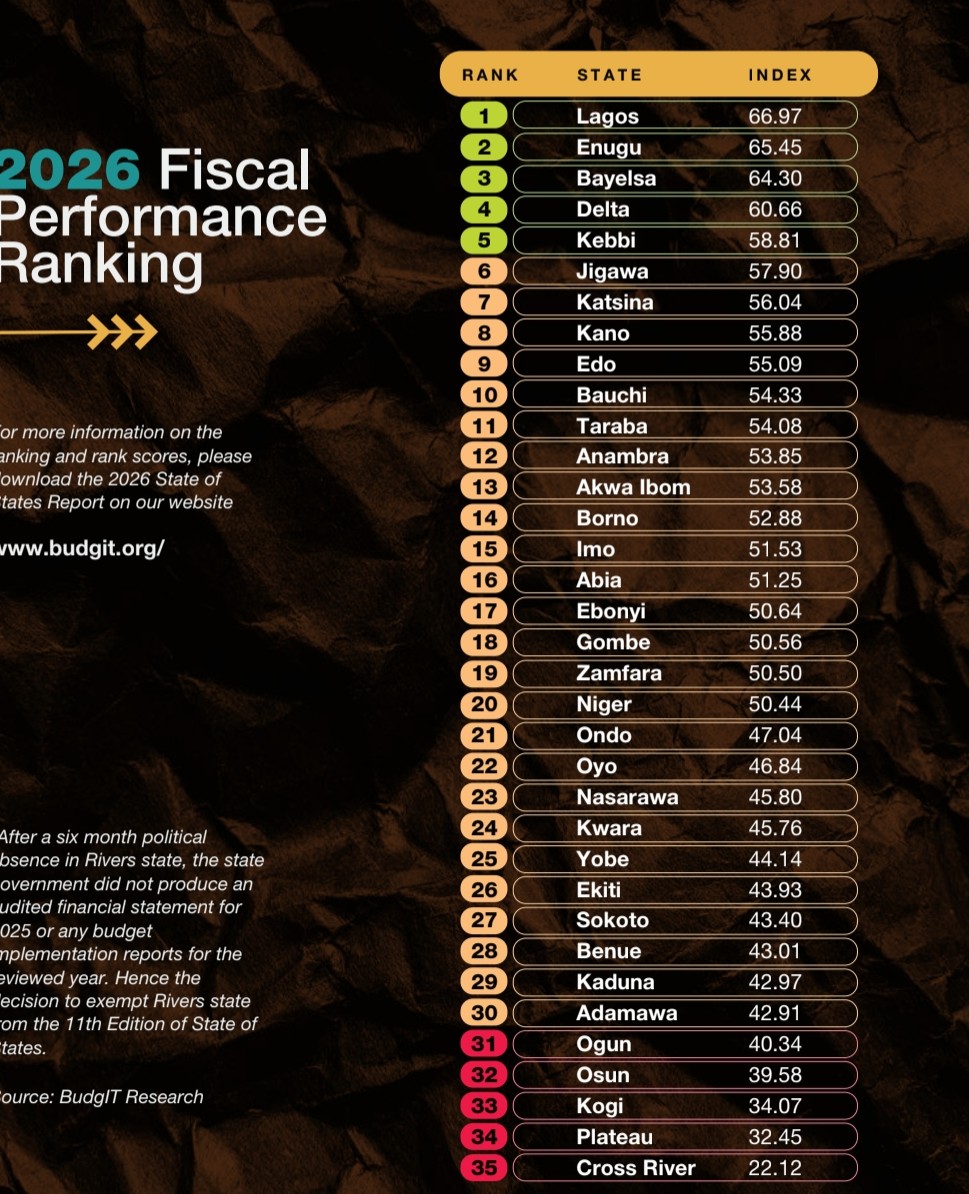
Enugu ranked second in the overall fiscal performance assessment, followed by Bayelsa, Delta and Kebbi, while Cross River occupied the bottom position.
Ogun, despite ranking fourth in debt stock, placed 31st in the overall fiscal performance ranking, underscoring the distinction between a state’s debt burden and its broader fiscal performance.
Contractor, Pension Arrears Deepen Crisis
Beyond conventional debt, the report identified billions of naira in outstanding obligations to contractors, pensioners and retirees, further exposing the financial pressures confronting state governments.
Ebonyi State reported ₦43.32bn in outstanding contractor arrears, while Delta recorded the highest contractor obligations at ₦121.69bn.
Ogun also reported ₦97.91bn in contractor arrears, followed by Kaduna with ₦72.95bn and Enugu with ₦64.97bn.
The report further identified significant pension and gratuity obligations, with Kaduna owing ₦100.29bn, Benue ₦71.02bn and Ogun ₦69.95bn.
Kwara recorded ₦23.87bn in pension and gratuity arrears, alongside ₦15.96bn owed to contractors.
Such liabilities, according to the report, represent claims on future public resources and can impose financial costs on retirees, workers and businesses even before they are formally settled.
The growing burden has also raised concerns about the ability of state governments to pay contractors promptly, clear pension obligations and sustain essential services without accumulating further liabilities.
BudgIT Warns Against Fiscal Illusion
BudgIT warned that increased government revenue should not automatically be interpreted as improved fiscal health, particularly where rising allocations are accompanied by weak budget implementation, high operating costs and mounting debt obligations.
The organisation argued that the developmental impact of public spending, rather than the nominal growth of government receipts, should determine whether states are managing their finances responsibly.
It urged state governments to strengthen domestic revenue mobilisation, reduce financial leakages, improve budget transparency and adopt credible medium-term debt management strategies.
The organisation also called for borrowing to be linked to productive investments capable of expanding the future capacity of states to generate revenue and deliver public services.
The report’s concerns were reinforced by economist and lecturer at Amadeus University, Abia State, Dr Iboro Nelson, who argued that rising government revenues had failed to adequately translate into relief for households struggling with economic hardship.
Nelson described the situation as “fiscal illusion”, blaming weak budget implementation, unrealistic expenditure projections, overlapping projects and excessive recurrent costs for limiting the developmental impact of increased revenue.
She disclosed that state governments collectively budgeted ₦1.32tn for healthcare in 2024 but spent ₦816.64bn, while education expenditure stood at ₦1.61tn against ₦2.41tn budgeted.
A Programme Manager at the Ford Foundation’s West Africa Office, Joy Ehinor-Esezobor, also urged state governments to measure fiscal performance by improvements in citizens’ welfare rather than revenue growth or rankings.
She maintained that the ultimate measure of government performance should be better public services and improved living conditions..
 '
 '
Do you want to share a story with us? Do you want to advertise with us? Do you need publicity for a product, service, or event? Contact us on WhatsApp +2348183319097 Email: platformtimes@gmail.com
We are committed to impactful investigative journalism for human interest and social justice. Your donation will help us tell more stories. Kindly donate any amount HERE
 '
