

….Expenditure Soars 43.7% To ₦852.5bn As Revenue Declines
…₦341.62bn Deficit Exposes Deepening Fiscal Challenges
…Contractor, Pension Arrears, Other Liabilities Hit ₦176.17bn
Daud Olatunji
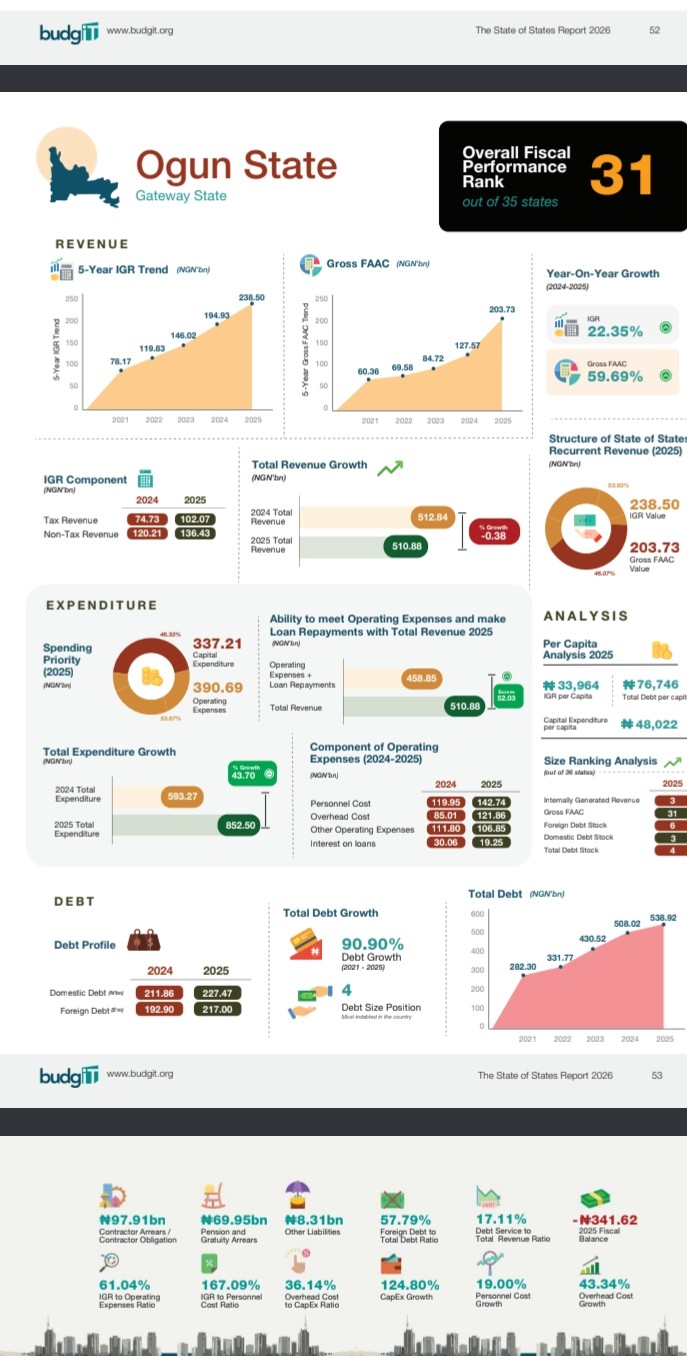
Ogun State has emerged among Nigeria’s poorly performing states in fiscal management, ranking 31st in overall fiscal performance despite generating ₦238.5bn internally, as its debt stock climbed to approximately ₦538.9bn, with a staggering fiscal deficit of ₦341.62bn.
The latest BudgIT State of States Report 2026, which examined the fiscal records of Nigerian states for 2025, exposed the widening gap between Ogun’s revenue-generating capacity and its ability to manage public finances sustainably.
The report further showed that the state’s total expenditure surged by 43.70 per cent, from ₦593.27bn in 2024 to ₦852.50bn in 2025, despite a marginal decline in total revenue.
Ogun also emerged as the fourth most indebted state in the country, with its debt stock increasing by approximately 90.9 per cent between 2021 and 2025.
The findings have raised fresh questions about the state’s financial priorities, expenditure management, borrowing strategy and capacity to translate its growing revenue into meaningful development for residents.
Particularly troubling is the revelation that Ogun’s outstanding contractor obligations, pension and gratuity arrears, and other liabilities amounted to ₦176.17bn, comprising ₦97.91bn in contractor obligations, ₦69.95bn in pension and gratuity arrears and ₦8.31bn in other liabilities.
The development presents a troubling picture for a state strategically positioned as one of Nigeria’s major industrial and commercial destinations.
Popularly known as the Gateway State, Ogun shares boundaries with Lagos, Oyo, Osun and Ondo states, as well as the Republic of Benin, giving it significant economic advantages in manufacturing, agriculture, international trade and regional integration.
Despite these advantages, the BudgIT assessment placed the state 31st in overall fiscal performance, exposing serious concerns about the management of its financial resources.
Revenue Declines Despite ₦238.5bn IGR
A breakdown of Ogun’s revenue profile showed that its total revenue declined from ₦512.84bn in 2024 to ₦510.88bn in 2025, representing a 0.38 per cent decrease.
The decline occurred despite significant increases in both internally generated revenue and federal allocations.
The state’s IGR increased by 22.35 per cent, rising from approximately ₦194.93bn in 2024 to ₦238.50bn in 2025.
Similarly, gross allocations from the Federation Account Allocation Committee increased by 59.69 per cent, from ₦127.57bn to ₦203.73bn within the same period.
The report showed that tax revenue rose from ₦74.73bn in 2024 to ₦102.07bn in 2025, representing a 36.59 per cent increase.
Non-tax revenue also increased by 13.49 per cent, from ₦120.21bn to ₦136.43bn.
With an IGR per capita of ₦33,964, Ogun ranked third nationally in internally generated revenue, demonstrating its capacity to generate substantial funds independently.
However, its strong revenue performance failed to translate into improved overall fiscal standing.
The state also ranked 31st in gross FAAC allocation size, while its overall fiscal performance remained considerably weak.
The figures raise questions about why increased revenue generation and federal inflows could not produce corresponding growth in total revenue and a stronger fiscal position.
Expenditure Jumps By 43.7% As Revenue Stagnates
One of the most striking revelations in the report is the widening gap between Ogun’s revenue and expenditure.
While the state recorded total revenue of ₦510.88bn in 2025, its expenditure increased to ₦852.50bn, leaving a fiscal deficit of ₦341.62bn.
This means that Ogun spent approximately ₦1.67 for every ₦1 generated in revenue during the period.
The state’s operating expenses increased from ₦346.82bn in 2024 to ₦390.69bn in 2025, representing a 12.64 per cent rise.
Personnel expenditure also increased by 19 per cent, from ₦119.95bn to ₦142.74bn.
Similarly, overhead costs rose sharply by 43.35 per cent, increasing from ₦85.01bn to ₦121.86bn.
Other operating expenses, however, declined from ₦111.80bn to ₦106.85bn, while interest payments on loans dropped from ₦30.06bn to ₦19.25bn.
The rising personnel and overhead costs suggest increasing pressure on the state’s recurrent expenditure, particularly against the background of stagnant revenue.
BudgIT further indicated that operating expenses and loan repayments amounted to ₦458.85bn in 2025, leaving a balance of just ₦52.03bn from total revenue after meeting those obligations.
The figures suggest that a substantial portion of the state’s revenue was committed to government operations and loan repayments, leaving limited fiscal room for other competing development needs.
Capital Spending Rises By 124.8%
Despite the worrying fiscal indicators, Ogun recorded a significant increase in capital expenditure in 2025.
The report showed that capital spending rose from ₦150bn in 2024 to ₦337.21bn in 2025, representing approximately 124.8 per cent growth.
The increase of ₦187.21bn accounted for a substantial expansion in the state’s capital expenditure.
Capital spending represented 46.33 per cent of total expenditure, while operating expenses accounted for 53.67 per cent.
The state’s capital expenditure per capita stood at approximately ₦48,022, according to the BudgIT infographic.
However, the increase in capital expenditure raises questions about the actual projects executed, their completion status, locations and measurable benefits to residents.
The size of capital expenditure alone does not establish whether public infrastructure projects have been completed or whether the funds have delivered corresponding value.
The government is therefore expected to provide detailed explanations of how the ₦337.21bn was deployed, particularly in critical sectors such as roads, healthcare, education, water supply and environmental infrastructure.
Ogun Fourth Most Indebted State As Debt Grows 90.9%
The state’s debt profile presents another major concern.
BudgIT’s five-year debt analysis showed that Ogun’s total debt increased from ₦282.30bn in 2021 to ₦331.77bn in 2022, ₦430.52bn in 2023, ₦508.02bn in 2024 and ₦538.92bn in 2025.
The increase represents approximately 90.9 per cent growth within five years, placing Ogun fourth among Nigeria’s most indebted states.
The report’s debt profile showed that domestic debt increased from ₦211.86bn in 2024 to ₦227.47bn in 2025.
Foreign debt also increased from $192.90m in 2024 to $217m in 2025, according to the accompanying narrative.
BudgIT’s indicators put foreign debt at approximately 57.79 per cent of total debt, while the state’s debt service-to-total revenue ratio stood at 17.11 per cent.
Ogun also ranked 32nd in BudgIT’s debt sustainability assessment, an indication of its weak position in the index.
The state’s total debt per capita was estimated at ₦76,746, compared with its IGR per capita of ₦33,964.
The comparison highlights the significant debt burden relative to the state’s internally generated revenue capacity.
The growing exposure to foreign debt also presents potential exchange-rate risks, particularly because the state’s revenue is largely generated in naira while foreign-currency obligations are affected by movements in exchange rates.
₦176.17bn Contractor, Pension Arrears, Other Liabilities
Beyond the debt stock, Ogun is also confronted with substantial outstanding financial obligations.
BudgIT identified ₦97.91bn in contractor arrears and obligations, ₦69.95bn in pension and gratuity arrears, and ₦8.31bn in other liabilities.
The combined amount stands at ₦176.17bn.
The contractor obligations represent a significant financial commitment to businesses and individuals who have executed or are owed payments for government projects.
Similarly, the ₦69.95bn pension and gratuity arrears raise concerns about the financial welfare of retired public servants who depend on their entitlements after years of service.
The figures also raise questions about the government’s capacity to settle outstanding obligations while managing its growing debt burden and expenditure commitments.
The liabilities should, however, be distinguished from the reported debt stock, as their accounting treatment and possible overlaps would need to be established before combining them with the state’s total debt.
IGR Strength Contrasts With Poor Fiscal Ranking
Perhaps the most revealing aspect of Ogun’s fiscal profile is the contradiction between its impressive revenue generation and poor overall fiscal performance.
Despite ranking third nationally in IGR, the state placed 31st in overall fiscal performance.
It also ranked third in domestic debt stock, sixth in foreign debt stock and fourth in total debt stock.
The report further put Ogun’s IGR-to-operating-expenses ratio at 61.04 per cent, indicating that internally generated revenue alone was insufficient to cover its operating expenses.
However, its IGR-to-personnel-cost ratio stood at 167.09 per cent, suggesting that internally generated revenue was sufficient to cover personnel expenditure.
Another worrying indicator was the foreign-debt-to-total-debt ratio of 57.79 per cent, highlighting the substantial foreign-currency component of its debt obligations.
Although the accompanying narrative of the 2026 State of States Fiscal Sustainability Index placed Ogun 26th nationally and fifth in the South-West, the separate overall fiscal performance assessment ranked it 31st.
The two rankings measure different aspects of state finances and should not be confused.
Nevertheless, the findings underline the need for improved fiscal discipline, more efficient expenditure management and a sustainable borrowing strategy.
Questions Over Public Service Delivery
Beyond the figures, the critical issue is whether the huge financial resources recorded by the state have translated into improved living conditions for residents.
The state’s ₦238.50bn IGR, ₦203.73bn gross FAAC receipts and ₦337.21bn capital expenditure represent substantial public resources.
Residents would reasonably expect these resources to translate into accessible healthcare, functional public schools, quality roads, reliable water supply, effective environmental management and improved economic opportunities.
The government must therefore demonstrate the actual impact of its expenditure, particularly in communities where residents continue to demand improved infrastructure and essential public services.
The ₦341.62bn fiscal deficit also raises questions about how the shortfall was financed and the implications for future government spending.
With debt increasing by approximately 90.9 per cent in five years, the state faces the challenge of balancing infrastructure investment with responsible borrowing and the protection of future public finances.
Questions Ogun Government Must Answer
The BudgIT findings have raised several questions that require explanations from the Ogun State Government.
Why did total expenditure rise by 43.70 per cent while total revenue declined by 0.38 per cent?
What projects accounted for the ₦337.21bn capital expenditure, and how many were completed and made available for public use?
What is the government’s strategy for managing the approximately ₦538.9bn debt stock?
Why are contractor obligations and pension and gratuity arrears standing at ₦97.91bn and ₦69.95bn, respectively?
How does the government intend to improve its 31st-place overall fiscal performance ranking and 32nd-place debt sustainability ranking?
What concrete measures are being implemented to ensure that increased revenue translates into improved public services and reduced financial liabilities?
For a state that prides itself on being Nigeria’s Gateway to industrial and commercial opportunities, the challenge goes beyond generating revenue.
 '
 '
Do you want to share a story with us? Do you want to advertise with us? Do you need publicity for a product, service, or event? Contact us on WhatsApp +2348183319097 Email: platformtimes@gmail.com
We are committed to impactful investigative journalism for human interest and social justice. Your donation will help us tell more stories. Kindly donate any amount HERE
 '
