

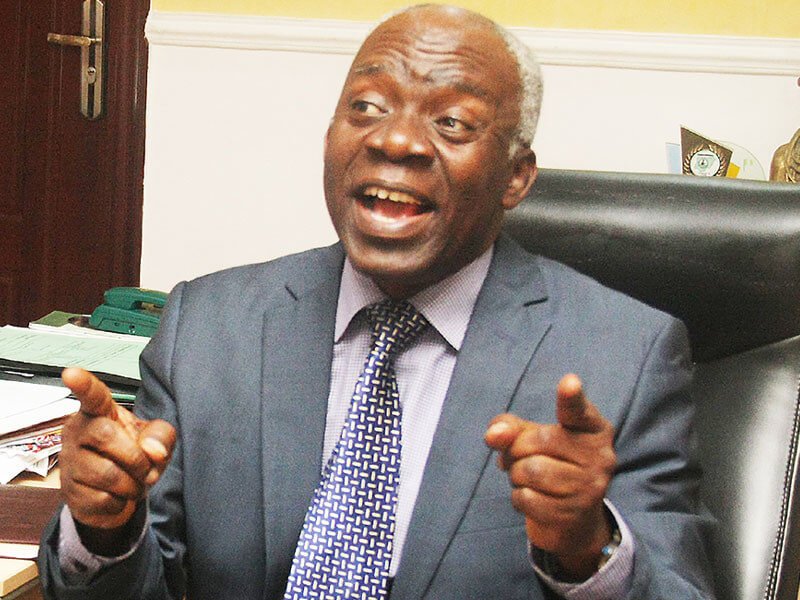
Human rights lawyer and Senior Advocate of Nigeria, Femi Falana, has called on the Federal Government to reopen the investigation into the death of the winner of the June 12, 1993 presidential election, Chief Moshood Abiola, insisting that the circumstances surrounding his death in military custody remain unresolved.
Falana argued that fresh investigation was necessary to establish what happened to Abiola, who died on July 7, 1998, while in the custody of the military government headed by General Abdulsalami Abubakar.
He made the demand while reviewing Abubakar’s recent account of the incident in his autobiography, Call of Duty, in which the former Head of State reportedly rejected allegations that Abiola was poisoned and maintained that foreign pathologists attributed his death to natural causes.
Falana, however, faulted the claim, saying it failed to address critical evidence presented before the Oputa Panel, which investigated human rights abuses committed under successive military regimes.
According to him, the panel had concluded that Abiola’s death occurred in suspicious circumstances and recommended a thorough investigation to determine the actual cause.
He said, “In view of the denial of Abubakar and the members of the American delegation of any involvement in the suspicious death of Abiola, the Federal Government should, without any further delay, reopen investigation into the case.”
Abiola had been detained after declaring himself President on June 12, 1994, a year after the presidential election widely believed to have been won by him.
Falana said the businessman-turned-politician spent about four years in detention after the military annulment of the election, during which he was allegedly denied adequate medical attention despite his deteriorating health.
He recalled that Archbishop Desmond Tutu, who visited Abiola in April 1998 at the instance of former South African President Nelson Mandela, reportedly raised concerns about the detainee’s worsening health and called for his immediate release.
The lawyer said the appeal was ignored.
According to Falana, Abiola was also denied access to his personal physician, Dr Ore Falomo, while the Abubakar administration allegedly subjected him to pressure to abandon his claim to the presidency.
He said the former military government subsequently brought international figures, including former United Nations Secretary-General Kofi Annan and Commonwealth Secretary-General Emeka Anyaoku, to persuade Abiola to renounce his mandate in exchange for his release.
Falana said Abiola rejected the proposal, describing such a condition as a capitulation.
He also questioned the circumstances surrounding the visit by an American delegation to Abiola on July 7, 1998, the day he died.
According to him, the delegation was allowed to bring a flask of tea into the detention facility and one of its members, Susan Rice, served the beverage to Abiola without tasting it in the presence of security officials, contrary to the procedure he said applied to visitors bringing food or drinks to detainees.
Falana cited testimony before the Oputa Panel by a police officer, ACP Zadok, who had guarded Abiola between 1996 and 1998.
The officer reportedly told the panel that he routinely tasted food, water or tea prepared for Abiola before it was served to him.
Falana said Zadok was removed from his duty post when the American delegation arrived.
He further cited the testimony of Major A.S. Aliyu, then Chief Security Officer to the Head of State, who reportedly confirmed that Rice did not taste the tea before serving it to Abiola.
Falana said the circumstances surrounding the tea and the security arrangements during the visit raised questions that had not been satisfactorily answered.
He also challenged the argument that an autopsy had conclusively established that Abiola died of natural causes, noting that evidence before the Oputa Panel had raised questions about whether every form of poisoning could necessarily be detected through an autopsy.
However, the lawyer’s account comes against the position attributed to Abubakar and the foreign pathologists that Abiola died from a heart-related condition.
Falana also noted that Kofi Annan, in his memoir, Interventions: A Life in War and Peace, reportedly acknowledged that Abiola had been denied adequate medical care during his incarceration, even though Annan said the foreign pathologists found no evidence of foul play.
The Oputa Panel, according to Falana, reached a broader conclusion after examining the evidence.
The panel reportedly held that the government of the time knew more about the circumstances surrounding Abiola’s death than it had disclosed.
It further concluded that Abiola’s death was linked to his prolonged incarceration and denial of adequate medical attention, while describing his death as occurring in suspicious circumstances.
The panel consequently recommended a comprehensive investigation to determine what killed Abiola.
Falana said the recommendation remained relevant nearly three decades after Abiola’s death.
He argued that reopening the investigation would not only address lingering questions surrounding the death of the June 12 presidential candidate but would also provide Nigerians with a definitive account of one of the most controversial episodes in the country’s democratic history.
“The fresh investigation will, as opined by the Oputa Panel, ‘throw light to and inform the Nigerian people on what killed Chief Moshood Abiola’ in the custody of the Abubakar military junta,” Falana said.
 '
' '
'Do you want to share a story with us? Do you want to advertise with us? Do you need publicity for a product, service, or event? Contact us on WhatsApp +2348183319097 Email: platformtimes@gmail.com
We are committed to impactful investigative journalism for human interest and social justice. Your donation will help us tell more stories. Kindly donate any amount HERE
 '
'