

Toyyibat Qasim
The Onisaga of Saga, Oba Joseph Oladele Olusoji Tella, has called on sons and daughters of Isaga, both at home and in the diaspora, to unite, strengthen their ancestral bonds and mobilise their resources towards the development of their community.
The monarch also urged traditional rulers, community leaders, professionals, youths and other stakeholders to set aside personal differences and work towards a common development agenda capable of transforming Isaga and its settlements.
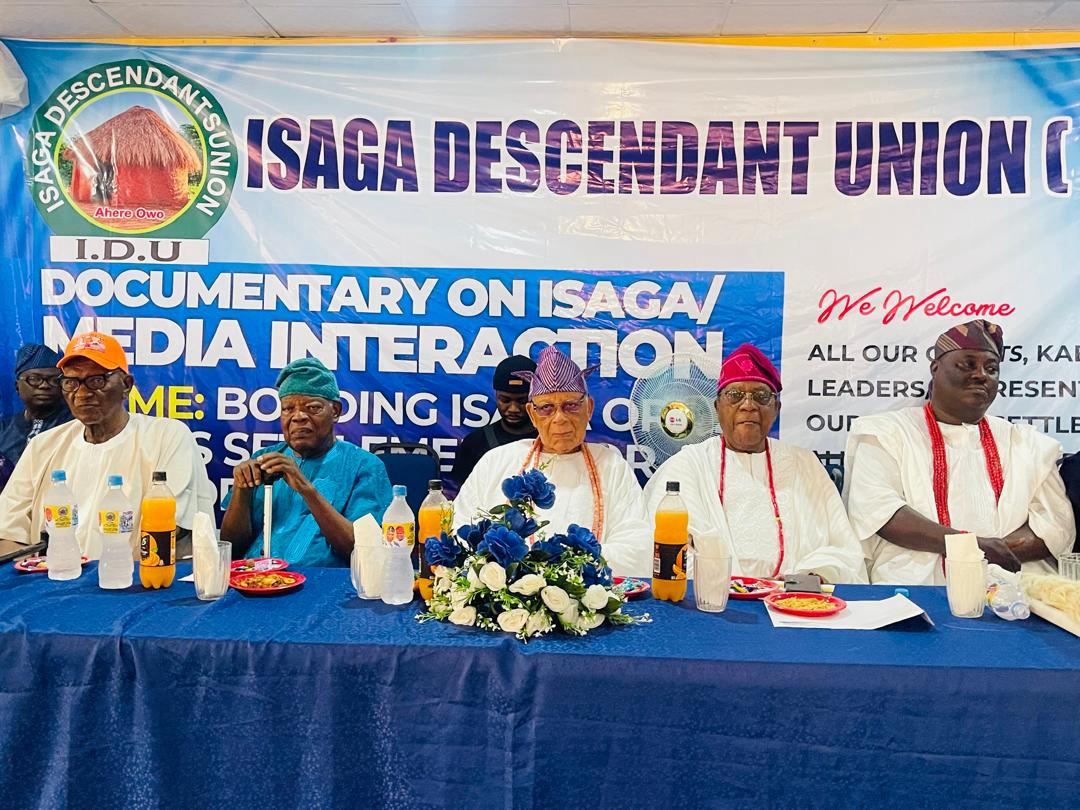
Oba Tella made the call in a speech delivered on his behalf by the Balogun of Isaga, Chief Lawrence Osayemi, at a gathering of the Isaga Descendants Union held at Isaga Orile, in Abeokuta North Local Government Area of Ogun State, on Saturday.
The gathering, themed, ‘Bonding Isaga Orile and Its Settlements for Development’, brought together traditional rulers, prominent indigenes and descendants of the ancient community from different parts of Nigeria and abroad for a reunion, media interaction and documentation of Isaga’s history.
The monarch, who regretted his inability to attend the event physically, commended the organisers for creating a platform for descendants scattered across different settlements and geographical locations to reconnect with their common ancestry.
He described the reunion as an opportunity to preserve the community’s cultural heritage, strengthen relationships and renew collective commitment to the development of their ancestral homeland.
Oba Tella maintained that Isaga’s strength should not be measured only by its historical heritage or geographical spread but also by the unity, cooperation and determination of its people.
He said, “Our geographical separation should not become a barrier to our unity or make us lose sight of the fact that we share a common origin. We must recognise that wherever we find ourselves, Isaga remains our ancestral home.”
The traditional ruler stressed that community development should not be left in the hands of traditional institutions or a few wealthy individuals, insisting that every indigene had a responsibility to contribute, irrespective of social status, occupation or location.
He urged academics, entrepreneurs, political leaders, artisans, youths and elderly people to deploy their knowledge, experience, resources and influence towards advancing the community.
The monarch also called for stronger political mobilisation among Isaga descendants, urging eligible voters to participate actively in the electoral process and support peaceful, lawful and democratic political engagement.
He warned that divisions arising from political affiliations, religious differences and geographical separation could weaken the community’s collective influence.
Meanwhile, a Professor of International Boundaries, Chief Anthony Asiwaju, has traced the dispersal of Isaga descendants across different Yoruba settlements to the devastating wars and insecurity that characterised 19th-century Yorubaland.
He said the emergence and growth of several major settlements in Yorubaland were closely connected to the movement of people fleeing conflicts and searching for security.
Using Ibadan as an example, the professor explained that what began as a war camp eventually developed into one of Africa’s largest cities, following the movement of people from different parts of Yorubaland, including Egba communities.
According to him, hunters and other people familiar with the forests and surrounding territories played significant roles in guiding displaced families to safer locations.
He said, “Historically, the Yoruba people experienced considerable movements and migrations from one settlement to another, largely as a result of wars and insecurity.
“These wars scattered communities, displaced families and forced people to establish new settlements.”
Asiwaju further identified the historical connections among Yoruba communities in present-day Nigeria and the Republic of Benin, particularly Ketu, Sabe and Oyo, explaining that their cultural and traditional relationships predated modern national boundaries.
He, however, said the conflicts involving the Dahomey Kingdom had devastating consequences for several border communities, leading to killings, destruction of settlements, displacement and enslavement.
The professor specifically referenced conflicts between 1882 and 1886, which affected Meko and Ketu, among other settlements, noting that insecurity extended across territories between Ogun State and Parakou in present-day Republic of Benin.
He said the historical dispersal of Isaga descendants could only be properly understood against the background of these conflicts and the subsequent search for safety.
Asiwaju added that many displaced families established new settlements, while others integrated into existing communities, explaining why descendants of the same ancestral stock could be found in different locations today
Turning to the political future of Ogun State, the professor expressed confidence in the 2027 governorship ambition of Senator Solomon Olamilekan Adeola, popularly known as Yayi.
He declared that Adeola’s ancestral connection to Isaga, through Pahayi in Ilaro, strengthened the community’s interest in the senator’s political aspiration.
Asiwaju lamented what he described as the marginalisation of Yewa communities in the political development of Ogun State since its creation 50 years ago.
He insisted that the area deserved an opportunity to produce the state’s governor, declaring that Adeola could only be prevented from becoming governor if Isaga ceased to be part of Ogun State.
He said, “As long as Isaga .
He said, “As long as Isaga remains part of Ogun State, Yayi can become governor of Ogun State. Except they remove Isaga from Ogun State, Yayi cannot be Ogun State governor.
“We have been part of this state since its creation, and there is no reason why our people should continue to feel excluded from the opportunity to produce its governor.”
Also speaking, the Bada of Isaga Orile, Prince Mukaila Oniyide, urged descendants of the community living in different parts of Nigeria and abroad to reconnect with their ancestral roots and contribute to the development of their homeland.
Oniyide disclosed that Isaga was founded in 1750 but suffered an invasion in 1863, forcing many of its original inhabitants to flee and establish settlements in other locations.
He identified Iju-Isaga, Isaga Agbado, Mushin-Isaga and Isaga Isolo in Lagos State, as well as communities in the Republic of Benin and Brazil, as locations where descendants of the ancient settlement could be found.
Other settlements linked to Isaga ancestry, according to him, include Isaga Ipaja, Agoshaga Ilaro and Agoshaga Ota.
The traditional titleholder disclosed that his own family relocated to Ipaja following the invasion, adding that the gathering was organised partly to correct misconceptions about Isaga’s history and establish a clearer understanding of the ancestral relationships among its scattered descendants.
He said the union was determined to bring all Isaga indigenes together and remind them that Isaga Orile remained their ancestral home.
Similarly, the Onisaga of Isaga Abosude, Oba Mudashiru Billiaminu Atanda, traced the ancestry of some Isaga settlements to four brothers who reportedly migrated from Ishaga Orile.
He explained that their forefather was a hunter who also traded in agricultural produce and travelled through Lagos and Abeokuta before subsequent generations established themselves in different locations.
Oba Atanda identified Abiona as one of the four brothers, saying he later moved to Badagry in Lagos State, where one of his descendants, Ayo, became his great-grandfather.
According to the monarch, the family subsequently migrated from Badagry to Isaga Ayobo, around the Alagbado axis in Ifo Local Government Area of Ogun State.
He listed Isaga Ayobo, Isaga Abosude, Isaga Owodeyi and Isaga Akintoye among the settlements and family branches connected to the common Isaga ancestry.
The monarch stressed that geographical separation should not erase the shared heritage of the different branches, urging descendants to sustain relationships and recognise their common origin.
He also highlighted the political relevance of Isaga, citing the emergence of Honourable Folorunso Fatai Salami as a member of the Ogun State House of Assembly.
In his remarks, the Osi of Egbaland, Chief Bode Mustapha, openly declared support for Adeola’s 2027 governorship ambition, describing the senator as an experienced politician with the capacity to provide effective leadership for Ogun State.
Mustapha acknowledged Adeola’s ancestral connection to Isaga and commended his contributions to public service and national development.
The Egbaland chief, who described himself as a proud son of Yewa in Egbaland, said his endorsement was based on his personal assessment of the senator’s political experience, public service record and leadership capacity.
He said Ogun State, with its human resources, economic opportunities, historical heritage and geographical advantages, required purposeful leadership to maximise its potential.
Mustapha said, “May I, at this juncture, make my personal position very clear: I fully support Senator Adeola’s aspiration to serve Ogun State as governor in 2027.
“I make this statement in my personal capacity, informed by my relationship with him, my assessment of his record of public service and my confidence in his capacity to provide the effective leadership needed for Ogun State. I stand by him 100 per cent, come rain, come shine.
He, however, urged Isaga descendants to look beyond political affiliations and remain committed to preserving their cultural identity, promoting enterprise and supporting initiatives that would improve the living conditions of the people.
Earlier, the convener of the gathering, Ven. Ladipo Ajayi, said the meeting was organised to strengthen relationships among Isaga settlements and their indigenes, irrespective of their locations.
Ajayi clarified that the Isaga Development Union was neither a political nor religious organisation but an inclusive platform open to all descendants of the community.
He urged indigenes to obtain their Permanent Voter Cards, describing them as important instruments for ensuring effective participation in the electoral process and strengthening the political representation of the community ahead of the 2027 general elections.
He said the ultimate objective was to unite Isaga descendants, preserve their history and build a common platform for the development of their ancestral homeland.
 '
 '
Do you want to share a story with us? Do you want to advertise with us? Do you need publicity for a product, service, or event? Contact us on WhatsApp +2348183319097 Email: platformtimes@gmail.com
We are committed to impactful investigative journalism for human interest and social justice. Your donation will help us tell more stories. Kindly donate any amount HERE
 '
