

Daud Olatunji
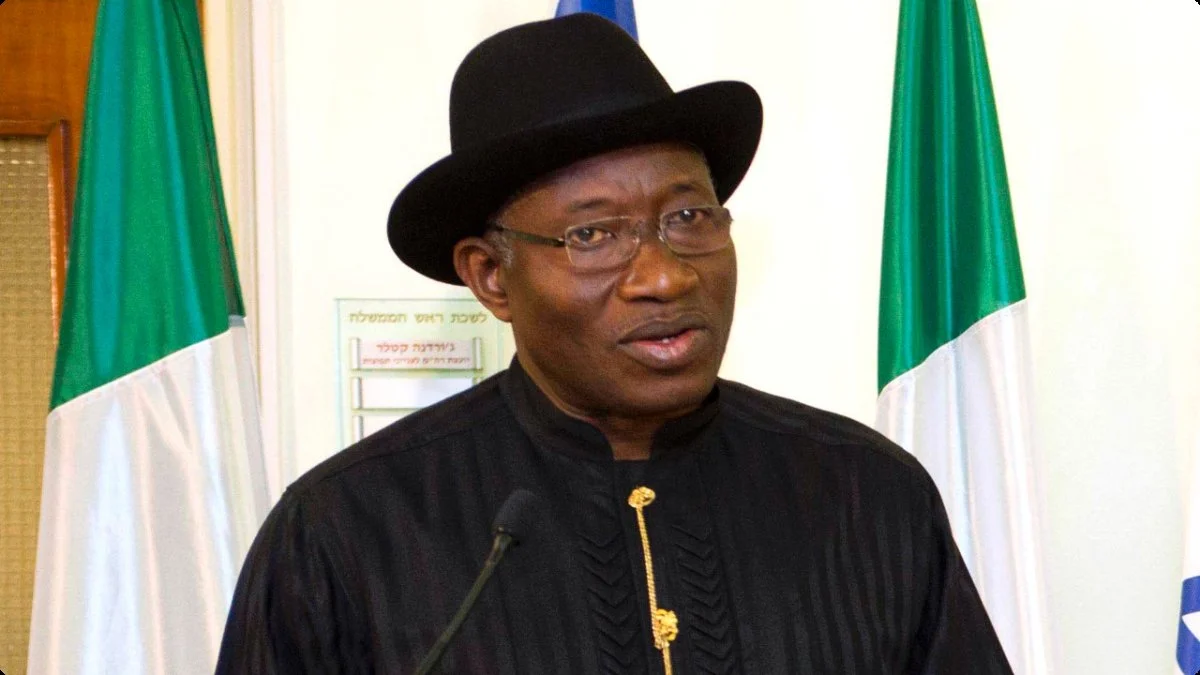
Former President Goodluck Jonathan has called for comprehensive reforms of Nigeria’s democratic system, warning that the country may struggle to achieve meaningful development unless its political and institutional structures are fundamentally strengthened.
Jonathan made the call on Saturday while delivering his address as Chairman of the Occasion at the Herbert Macaulay Memorial Colloquium in Lagos, where he described Nigeria’s current democratic practice as opaque and lacking the institutional clarity required to drive sustainable national development.
The former President said Nigeria must review its democratic system to reflect core principles such as popular participation, the rule of law, separation of powers, respect for human rights, judicial independence and accountability.
He stressed the need to build a democracy anchored on strong institutions and supported by vibrant civil society organisations.
“We must review our opaque and amorphous democratic system and align it with the fundamental pillars of democracy.
“These include popular participation, the rule of law, separation of powers, respect for human rights, judicial independence, accountability, prudence and democratic governance,” he said.
Jonathan expressed concern that Nigeria’s democratic practice had failed to develop a clear institutional character, warning that the situation could undermine the country’s aspirations for progress.
“What we are practising today, as political scientists here may agree, is difficult to define and understand. It is an amorphous democracy that lacks clear institutional character.
“Until we move away from this opaque and amorphous democratic practice, we may find it difficult to make the progress we desire,” he added.
The former President also identified Nigeria’s political recruitment process as a major obstacle to national development, lamenting that leadership selection remained heavily influenced by religion, ethnicity, language and other considerations rather than competence and character.
He said the problem had persisted since the pre-independence era, limiting the emergence of capable leaders who could effectively address the country’s development challenges.
“Our political recruitment process has been problematic, even from the pre-independence era.
“We are still suffering from a system in which political leaders are often selected based on religion, language, ethnicity and other considerations rather than competence, character and capacity,” he said.
Jonathan illustrated the challenge with an example from a southern Nigerian state, where he said ethnic considerations could prevent qualified individuals from emerging as governor despite their competence.
He consequently urged Nigerians to abandon what he described as a primitive approach to political leadership recruitment and embrace a system that prioritises merit, capacity and integrity.
On education, Jonathan called for greater investment in functional educational institutions capable of driving technological advancement, innovation and knowledge creation.
He maintained that Nigeria could not achieve meaningful development without strengthening its educational system and equipping young people with the skills required to compete in an increasingly technology-driven world.
The former President clarified that his position was not a condemnation of Nigerian universities, noting that he obtained all his academic qualifications in the country.
“I did not have the opportunity of schooling abroad. I obtained all my degrees in Nigeria.
“Therefore, I am not suggesting that Nigerian universities are bad. That is not the issue,” he said.
He, however, stressed the need for deliberate policies to improve the effectiveness of educational institutions and prepare future generations for emerging development challenges.
Jonathan also urged political leaders to establish a clear national development agenda as Nigeria approaches 100 years of independence in 2060.
He warned that without deliberate planning and measurable targets, another generation of Nigerians could inherit the same challenges confronting the country today.
“By 2060, Nigeria will celebrate 100 years of independence. That is about 34 years from now.
“A child born today will be about 34 years old when Nigeria marks its centenary of independence. These same questions will inevitably arise again.
“The question is: What kind of country will we be celebrating in 2060?” he queried.
He called for a national development framework with clearly defined objectives, measurable targets, timelines and responsibilities, insisting that nation-building should move beyond academic discussions to practical implementation.
According to him, political leaders must provide direction, public institutions must deliver efficiently, businesses must invest in productive capacity, while educational institutions must prepare Nigerians for the demands of the future.
Jonathan identified leadership failures, institutional weaknesses, corruption, policy inconsistency, inadequate infrastructure, insecurity and overdependence on raw material exports as some of the major factors hindering Nigeria’s development.
Comparing Nigeria’s development trajectory with those of South Korea, India and Singapore, he observed that the countries had recorded significant progress in industrialisation, technology, education, healthcare and human development.
He said Nigeria must urgently convert its abundant human and natural resources into sustainable development and economic emancipation.
The former President also emphasised the importance of preserving Nigeria’s history and recognising the contributions of its founding nationalists, warning that a country that neglects its history risks losing its identity and direction.
He described Herbert Macaulay as a man of exceptional intellect, courage and conviction who distinguished himself as an engineer, surveyor, journalist, political activist and public intellectual.
Jonathan noted that Macaulay was among the earliest Nigerian nationalists to challenge colonial injustice and demand greater political participation and self-determination for Nigerians.
He said the aspirations of Macaulay and other founding nationalists extended beyond the transfer of political power from colonial authorities to indigenous leaders.
According to him, their vision was to establish a sovereign nation where Nigerians would determine their own destiny, control their resources and deploy them towards national development and the welfare of citizens.
He added that the founding nationalists envisaged a united country where citizens, irrespective of ethnicity, religion or background, would enjoy equal rights, dignity and opportunities.
Jonathan said the greatest tribute Nigeria could pay to its founding fathers was to build a country that reflected the ideals for which they struggled.
He urged younger Nigerians to sustain the nationalist vision through innovation, enterprise, civic participation, responsible citizenship and accountability.
The former President commended Macaulay’s descendants for organising the colloquium, describing it as an important platform for reflecting on Nigeria’s political history and the collective responsibilities involved in nation-building.
Earlier, former Deputy National Chairman of the Peoples Democratic Party, Chief Olabode George, appealed to President Bola Tinubu to return the property housing the General Post Office in Lagos to the Macaulay family for the establishment of a permanent memorial in honour of the nationalist.
George, who is a cousin of Macaulay, said the family was prepared to construct a permanent memorial hall on the property to preserve the nationalist’s legacy and educate younger generations about his contributions to Nigeria.
He explained that the house where Macaulay lived was demolished after his death in 1946, while the General Post Office was subsequently built on the site.
Macaulay, born on November 14, 1864, died in 1946, 14 years before Nigeria gained independence in 1960.
According to him, political leaders must provide direction, public institutions must deliver efficiently, businesses must invest in productive capacity, while educational institutions must prepare Nigerians for the demands of the future.
Jonathan identified leadership failures, institutional weaknesses, corruption, policy inconsistency, inadequate infrastructure, insecurity and overdependence on raw material exports as some of the major factors hindering Nigeria’s development.
Comparing Nigeria’s development trajectory with those of South Korea, India and Singapore, he observed that the countries had recorded significant progress in industrialisation, technology, education, healthcare and human development.


Do you want to share a story with us? Do you want to advertise with us? Do you need publicity for a product, service, or event? Contact us on WhatsApp +2348183319097 Email: platformtimes@gmail.com
We are committed to impactful investigative journalism for human interest and social justice. Your donation will help us tell more stories. Kindly donate any amount HERE

