

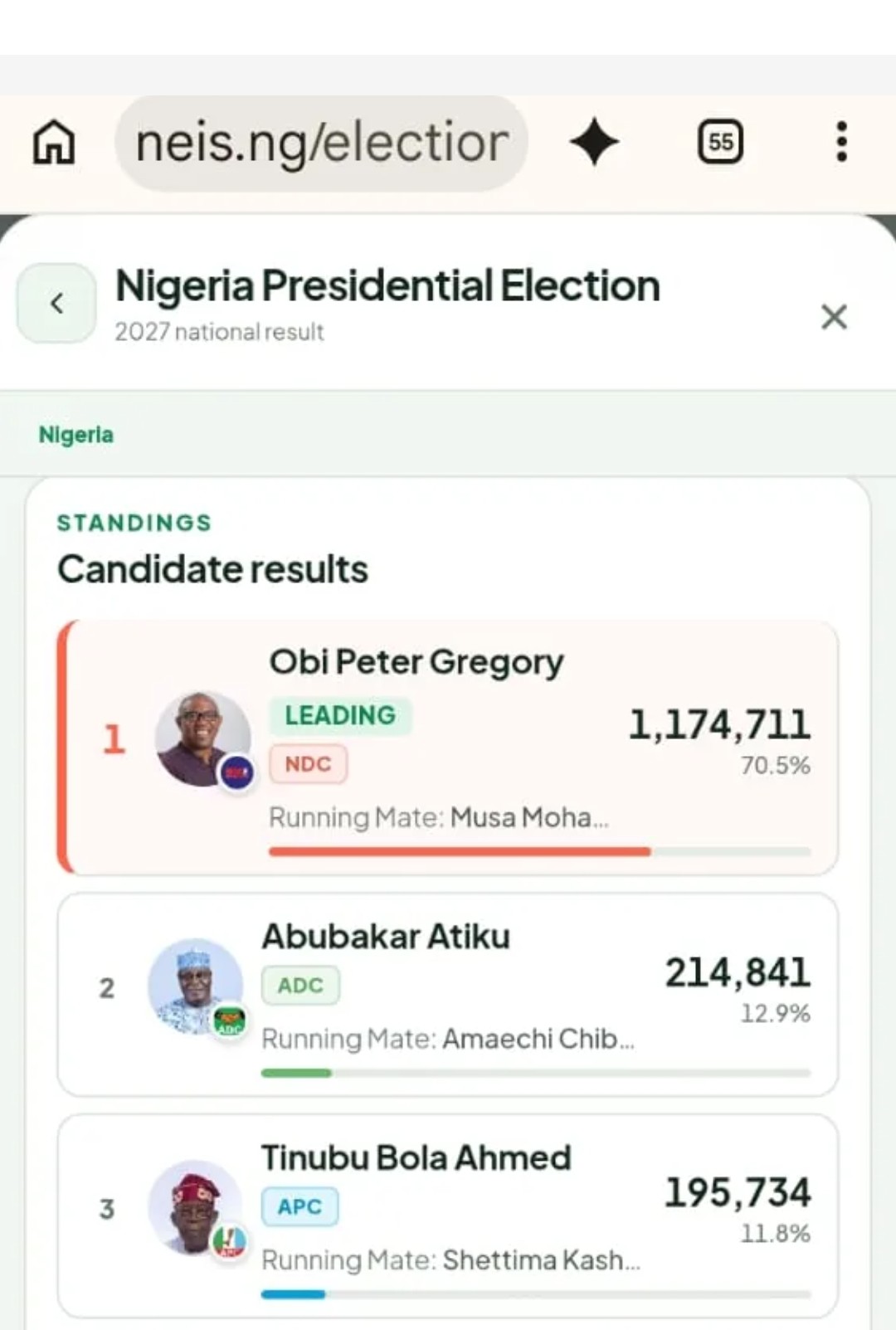
…Tinubu, Atiku Trail In Controversial Online Simulation Published By NEIS
…APC Describes Figures As Fictitious, Accuses Opposition of Manipulating Public Opinion
…Electoral Commission Warns Nigerians Against Treating Simulated Figures As Actual
Results
Daud Olatunji
Controversy has erupted over purported presidential rankings published by the Nigeria Election Intelligence System following the Independent National Electoral Commission’s mock accreditation and election exercise, with the commission and the All Progressives Congress dismissing the figures as fictitious.
The online platform had published simulated figures showing Peter Obi, presidential candidate of the Nigeria Democratic Congress, leading with 5.7 million votes, while President Bola Tinubu came second with 5.6 million votes and African Democratic Congress presidential candidate, Atiku Abubakar, placed third with 5.4 million votes.
The publication has generated political reactions, with the INEC distancing itself from the figures and insisting that its November 28 mock exercise did not feature real political parties or presidential candidates.

The controversy also took a new dimension on Sunday when the APC Presidential Campaign Council accused opposition elements of attempting to manipulate public opinion through what it described as fabricated election figures.
In a statement issued by its spokesperson, Dele Alake, the APC campaign council described the more than five million votes purportedly credited to Obi as “fictitious, fraudulent and intended to mislead Nigerians”.
Alake questioned how NEIS arrived at the figures when the ballot papers used during the mock exercise did not contain the names or logos of registered political parties.
He also challenged the platform to explain how it generated more than 17 million votes from an exercise that covered only about 10 per cent of the country’s polling units.
INEC had conducted the mock exercise in two polling units in each ward nationwide as part of its preparations for the 2027 general election.
With 8,809 wards and 176,846 polling units across the country, the exercise reportedly covered 17,618 polling units.
The commission had explained that the exercise was designed to test the effectiveness of its Bimodal Voter Accreditation System, as well as its technological processes and logistical arrangements ahead of the next general election.
The ballot papers reportedly carried dummy options, including AQUA, BLUE, COAL, CYAN and GOLD, rather than the names and logos of political parties or their candidates.
Reacting to the controversy, INEC disowned the purported results published by NEIS, describing the figures as false and misleading.
In a statement issued on Sunday by Adedayo Oketola, Chief Press Secretary to the INEC Chairman, Joash Amupitan, the commission said the website was neither affiliated with nor authorised by it.
“The Commission wishes to state categorically that the website is not affiliated with, authorised by or connected to INEC in any way, and that the figures it displays are false and misleading,” the statement read.
INEC maintained that the mock exercise did not feature actual political parties or candidates, explaining that pseudo names were generated solely for the dummy ballot papers used during the exercise.
It said the exercise was not intended to produce results for any presidential candidate or political party but to assess the commission’s technology, operational processes and logistics.
“Any claim that a candidate or party won, led or trailed in the mock exercise is therefore baseless, and any website or platform presenting such figures as mock election results is deceiving the public,” the commission said.
INEC urged Nigerians to disregard the figures published on neis.ng and similar platforms, warning against interpreting the purported rankings as an indication of the political strength or electoral prospects of any candidate ahead of 2027.
The commission added that it was reviewing the matter and reserved the right to take appropriate action against those responsible for spreading what it described as false election information.
The APC also questioned the authority under which NEIS presented the figures, arguing that INEC had not announced any results at polling-unit, ward, local government, state or national levels.
Alake said the commission remained the legally recognised authority responsible for announcing official election results, insisting that figures generated by a third-party platform could not be presented as actual electoral outcomes.
He further described the publication as an online political game designed to attract attention, engagement and traffic rather than provide a credible assessment of voters’ preferences.
The APC spokesperson also accused opposition elements of using fake news and artificial intelligence-generated images to manipulate public opinion, discredit the electoral process and undermine confidence in INEC.
Meanwhile, the controversy over the purported presidential rankings has coincided with fresh questions from the African Democratic Congress Presidential Campaign Council about the integrity and verifiability of result sheets uploaded during the commission’s mock exercise.
In a separate statement issued by its Director of Strategic Communication, Phrank Shaibu, the ADC said its Digital Situation Room had analysed 37,712 mock result sheets on INEC’s Election Result Viewing portal as of 11am on Sunday, November 29.
The council claimed that the images examined had no visible camera, timestamp or GPS metadata, raising concerns about how the commission could establish when and where the result sheets were captured and whether the published images could be independently authenticated.
Shaibu said the findings were based on an examination of the uploaded documents and demanded that INEC explain where the original images were stored and how their authenticity could be established.
“INEC must tell Nigerians where the original images are, what records establish when and where each was captured, and who can independently verify that a published image has not been replaced,” he said.
However, the ADC acknowledged that the absence of metadata from publicly accessible copies did not, by itself, establish that the original files had been altered or that the commission had deliberately removed the information.
The campaign council nevertheless argued that INEC should demonstrate how the original images and their audit trails were preserved and made available for independent verification.
It illustrated its concerns with a hypothetical scenario in which a polling unit originally recorded 113 accredited voters and 108 ballots cast, but both figures were subsequently changed to 740 accredited voters and 735 ballots cast.
According to the ADC, although the altered figures would still satisfy the basic arithmetic requirement that ballots cast must not exceed accredited voters, the adjustment would conceal an additional 627 votes that were absent from the original record.
The council stressed that the illustration was hypothetical and not an allegation that such manipulation occurred during the mock exercise.
“Checking one figure against another is useless if both can be changed. Every accreditation count and result sheet must be tied to an original record that no official or contractor can secretly replace,” Shaibu said.
The ADC subsequently demanded an independent technical audit before the 2027 general election, urging INEC to demonstrate the complete chain of evidence linking original BVAS accreditation records, signed result sheets, image capture and upload records, and polling-unit results to ward-level totals.
It also called for secure access for political parties and accredited auditors to verify the records and requested that the commission demonstrate how its systems respond when unauthorised changes are attempted.
The competing reactions have placed renewed attention on the credibility of INEC’s technological preparations for the 2027 general election, particularly the security, preservation and independent verification of electoral records.
While the commission has dismissed the NEIS figures as fictitious, the ADC’s separate questions about missing metadata have raised another dimension of the debate over electoral transparency.
The two issues, however, remain distinct: the NEIS publication was not an official INEC result, while the ADC’s concerns about metadata and audit trails are demands for technical explanations and independent verification, not proof that electoral records were manipulated.
With political parties and voters expected to rely increasingly on technology for accreditation, result transmission and public verification, the commission faces the challenge of demonstrating that its systems are not only functional but also secure, transparent and resistant to unauthorised alterations.


Do you want to share a story with us? Do you want to advertise with us? Do you need publicity for a product, service, or event? Contact us on WhatsApp +2348183319097 Email: platformtimes@gmail.com
We are committed to impactful investigative journalism for human interest and social justice. Your donation will help us tell more stories. Kindly donate any amount HERE