

…Nigeria Spends Just About ₦234 per Disabled person, panellists calculate
…Specialists accuse Govt Agencies Of Poor implementation, Opaque Spending, Procurement Irregularities
…BudgIT Demands Disclosure Of Beneficiaries, Contractors, Project Costs, Fund Releases
…Experts Fault Exclusion Of PWDs From Budget Decisions, Demand Accountability Ahead Of 2027 Elections
Daud Olatunji
Disability inclusion specialists, journalists and public finance experts have raised concerns over what they described as grossly inadequate funding for persons with disabilities in Nigeria, revealing that the N8.2bn allocated for disability-related interventions in the 2026 national budget translates to approximately N234 per person when shared among an estimated 35 million people living with disabilities.
The experts also warned that inadequate budgetary allocations, poor implementation, alleged procurement irregularities and the exclusion of persons with disabilities from decision-making processes were undermining government efforts to improve their welfare and access to essential services.
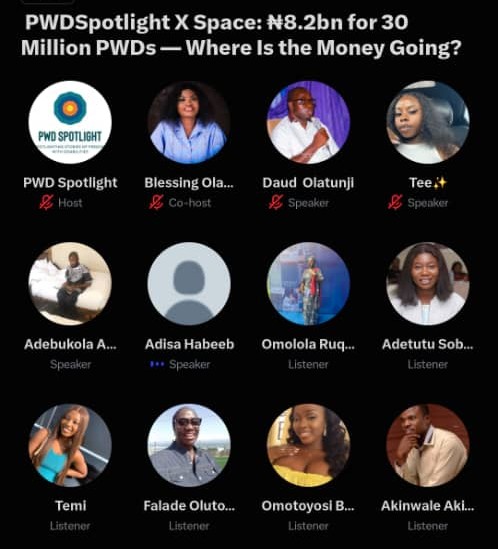
They expressed their concerns during a monthly X Space discussion organised by PWDSpotlight in collaboration with BOFIM and BO News on Saturday, October 31, 2026.
The discussion, which examined disability-related allocations in the 2026 Appropriation Act, featured the Project Manager of PWDSpotlight, Habeeb Adisa; journalist with BOFIM and BO News, Blessing Oladunjoye; disability-inclusive development specialist and Founder of Inclusive Development Consults Ltd, Dr Adebukola Adebayo; and Oluwatimilehin Olugbemi of BudgIT’s Open Government and Institutional Partnership unit.
The panellists questioned the adequacy of the N8.2bn allocation, arguing that disability inclusion required considerably more than token financial provisions, particularly when the funding was expected to address education, healthcare, transportation, assistive devices, skills acquisition, accessibility infrastructure and social protection.
Introducing the discussion, Adisa disclosed that PWDSpotlight’s examination of the 2026 Appropriation Act revealed that the Federal Government had provided N8.2bn for disability-related interventions.
He said the analysis was necessary as Nigeria approached another election cycle in 2027, stressing the need to determine whether government commitments to persons with disabilities were translating into measurable improvements.
Oladunjoye, who described the allocation as grossly inadequate, said disability-related expenditure should not be treated as a charitable gesture but as an essential component of national development.
She explained that the additional costs associated with disability, including transportation, mobility assistance and access to public facilities, made adequate funding imperative.
According to her, a wheelchair user might have to pay for a taxi or ride-hailing service to cover a distance that a person without mobility challenges could easily walk.
She said, “In addressing issues around disability, providing funds should not be addressed from a tokenism point of view. We are all humans. Being persons with disabilities or not, we are all humans.”
Oladunjoye argued that the responsibility for disability inclusion should not be restricted to the National Commission for Persons with Disabilities or other specialised agencies, insisting that every government ministry and department had a role to play.
She maintained that road construction, education, healthcare, transportation and other public services should incorporate accessibility requirements from the planning stage rather than waiting for separate interventions after projects had been completed.
She said, “Disability is a cross-cutting issue. When building roads, are you ensuring that there is a walkway that people can seamlessly pass through? A blind person should be able to navigate that path with his or her guide cane.”
The journalist added that government agencies should mainstream disability considerations into their respective programmes instead of assuming that the responsibility rested exclusively with disability-focused institutions.
Adebayo also described disability inclusion as one of Nigeria’s most underfunded development concerns, noting that the country had made considerable progress in establishing legal and institutional frameworks without matching them with adequate financial commitments.
He said Nigeria had a national disability law, while nearly 30 of the 36 states had also enacted disability legislation, with several establishing agencies to coordinate disability-related programmes.
However, he argued that the existence of laws without adequate funding had created a significant gap between government policy and actual implementation.
He said, “We’ve left the policy gap behind. We now have a disability act at country level, and almost 30 of the 36 states also now have a disability law at sub-national levels.
“But beyond having policies, the challenge has always been moving from policy to action. The only vehicle to do that is the budget.”
The disability specialist maintained that the N8.2bn allocation was inadequate considering the estimated population of 35 million persons with disabilities and the numerous challenges confronting them.
He stressed that government must accept primary responsibility for disability inclusion, while the private sector, development partners and civil society organisations should complement its efforts.
Adebayo also warned that the problem extended beyond the amounts approved in annual budgets, saying some disability agencies struggled to access even a fraction of their allocations.
He disclosed that some agencies received annual allocations below N1bn but were unable to draw down up to 10, 20 or 30 per cent of the approved amounts.
He said, “You allocate maybe N500m to a disability agency in a state where you have almost one million persons with disabilities who need education, health, assistive devices and other support services. Yet, even out of that small amount, you are unable to release up to 20 or 30 per cent.”
He added that budgetary commitments must be backed by actual cash releases to enable agencies to deliver meaningful services.
The specialist further questioned the effectiveness of disability interventions in the education sector, citing figures he attributed to studies and UNICEF.
According to him, only about three per cent of children with disabilities are able to access schooling, while adult literacy among persons with disabilities stands at approximately five per cent.
He argued that such figures demonstrated the consequences of inadequate funding and poor implementation of existing policies.
“Government must take responsibility. It’s not the lack of policies, but the lack of budget,” he said.
Providing further insight into the composition of the 2026 allocation, Adisa disclosed that PWDSpotlight’s analysis identified N2.004bn for awareness campaigns, programmes and policy development, representing the largest category among the allocations examined.
He also identified N1.413bn for skills empowerment and acquisition, while approximately N1.86bn was earmarked for construction-related interventions.
The figures prompted questions about whether the spending priorities adequately addressed the immediate and practical needs of persons with disabilities.
The panellists argued that government should demonstrate how such allocations would translate into accessible infrastructure, educational opportunities, assistive devices and improved living conditions.
Olugbemi of BudgIT said public financial transparency should go beyond announcing the amounts approved for projects, insisting that Nigerians must be able to establish how much was released, how the money was spent and whether the intended beneficiaries received the promised support.
She identified unclear budget descriptions, inadequate project details and difficulties tracking allocations across government documents as major obstacles to public accountability.
Citing examples from the 2026 Appropriation Act, she disclosed that N250m was allocated for vulnerable persons, widows, persons with disabilities and elderly people across Osun State senatorial districts.
However, she said the budget description failed to indicate how much was specifically intended for persons with disabilities.
She also cited a N100m allocation for women, youths and persons with disabilities in Oluyole, questioning how citizens could determine the actual amount committed to disability inclusion when several beneficiary groups were lumped together.
Olugbemi called on government institutions to publish detailed breakdowns of such allocations, including the selection criteria, the number of beneficiaries expected to benefit and the geographical distribution of interventions.
She also cited N140m allocated for relief materials in Ikeja Federal Constituency, saying government should disclose the specific materials to be purchased, their quantities and the number of beneficiaries expected to receive them.
Similarly, she referenced N105m allocated for a skills acquisition programme in Abakaliki, Ebonyi State, insisting that the government should identify the skills to be taught, training duration, service providers and post-training support for participants.
She also questioned the N175m allocation for renovation of an ECN building, saying the government should disclose the scope of work, accessibility features, technical standards and expected completion date.
Olugbemi said, “You can’t put vague projects without giving people the ability to track what has been published. Vague projects mislead people.”
She maintained that the government must publish actual fund releases, expenditure records and outstanding balances, with each transaction linked to its original budget line.
The BudgIT representative also called for accessible budget documents with identifiable project codes, noting that citizens and journalists should not be compelled to search through hundreds of pages to locate specific interventions.
She further emphasised the importance of procurement records, including tender notices, contract awards, contractors’ identities, contract values and project timelines.
According to her, such information would enable citizens to establish whether government obtained value for money in the procurement of assistive devices and construction of accessible facilities.
She said, “A budget is a commitment made with public resources, so Nigerians should be able to see the results for those commitments and hold the relevant institutions accountable.”
Beyond inadequate funding and poor transparency, Adebayo raised concerns over alleged corruption and procurement irregularities within disability-related government interventions.
He warned that some contractors awarded contracts to supply assistive devices and other equipment lacked the necessary technical knowledge to understand the actual needs of persons with disabilities.
The specialist, who disclosed that he served on the board of the Lagos State Office for Disability Affairs between 2016 and 2019, recalled an incident in which a contractor supplied a fairly used vehicle under a contract for the provision of equipment and vehicles.
According to him, the vehicle was rejected after officials detected that it did not meet the required specifications, while the matter was reported to the state government.
He said similar incidents had been observed in other states and at the national level, warning that substandard equipment could worsen the living conditions of intended beneficiaries.
He said, “We’ve seen situations where disability commissions go and procure fairly used materials.
“A particular supplier went and brought a fairly used vehicle, not even tokunbo. We detected it and we rejected it and reported the case to the state government.”
Adebayo urged journalists to investigate not only the number of wheelchairs, guide canes, eyeglasses and other assistive devices distributed by government agencies but also their quality and compliance with established technical standards.
He argued that the procurement of disability-related equipment required specialised knowledge, warning that devices that failed to meet users’ needs could become a source of further hardship.
The specialist also questioned the accessibility of public infrastructure, including the compressed natural gas buses being procured across the country.
He asked whether the authorities responsible for purchasing the buses had considered the needs of wheelchair users and other persons with disabilities.
According to him, accessibility requirements should be incorporated into the procurement and construction of public facilities, including ramps, elevators, vehicles and other infrastructure.
He further insisted that persons with disabilities should not be treated merely as beneficiaries of government contracts but should also participate as contractors, suppliers, consultants and decision-makers.
“We are not just beneficiaries; we are partakers. We are in the decision-making process. We are also suppliers and contractors,” he said.
The panellists also challenged journalists to move beyond reporting government announcements and investigate whether disability-related budgetary provisions were being implemented.
Oladunjoye said reporters should examine previous budget allocations, implementation reports, actual releases and the results achieved before accepting fresh government spending commitments.
She urged journalists to investigate whether the number of beneficiaries announced by government agencies corresponded with the actual number of people reached.
Citing the distribution of assistive devices as an example, she said journalists should verify claims by government agencies that thousands of people had received support instead of relying solely on official statements and publicity photographs.
She also raised concerns that political considerations could influence the selection of beneficiaries, potentially excluding persons who genuinely needed assistance.
She said, “We want to check: How were beneficiaries selected? Are beneficiaries getting it?”
Oladunjoye urged newsrooms to develop the capacity to analyse budgets, procurement records and implementation reports, noting that the ability to interpret financial data would strengthen investigative reporting on disability inclusion.
Adebayo, however, cautioned journalists against reporting disability issues through the traditional charity narrative, urging them to adopt human rights and development perspectives.
He said portraying persons with disabilities as helpless beneficiaries who should be grateful for government assistance undermined their rights and contributions to society.
He also warned against the tendency to portray them either as helpless victims or extraordinary heroes, arguing that such narratives could compromise objective reporting.
He said, “You must understand disability from the human rights and development perspectives, so that you can see disability as a development issue, as a human rights issue.”
The discussion also exposed concerns over inadequate consultation between government disability agencies and Organisations of Persons with Disabilities (OPDs).
Adebayo said there was a significant disconnect between disability commissions and the organisations representing persons with disabilities, despite the latter having played important roles in advocating for the establishment of such institutions.
He warned that the absence of effective consultations could result in budgets containing projects that failed to address the actual needs of intended beneficiaries.
According to him, some disability-related budgets were prepared by officials without adequate input from the people expected to benefit from them.
He urged disability agencies and OPDs to strengthen collaboration, particularly during budget consultations, to ensure that the needs of persons with disabilities were properly reflected in government spending plans.
He said, “How will disability commissions and agencies take into cognisance the actual needs of persons with disabilities, let alone put it in their budget and implement the budget?”
The specialist called for more consultations between government institutions and disability organisations at both national and state levels, stressing that meaningful participation must continue beyond the enactment of disability laws.
An audience participant also called for sustained advocacy, better public perception of persons with disabilities and regular engagement with government officials.
The participant suggested that PWDSpotlight’s monthly discussions should continue beyond the 2027 election cycle and provide opportunities for senators, members of the House of Representatives, local government chairmen and other public office holders to explain their disability-related commitments.
The participant also questioned the implementation of the five per cent employment provision for persons with disabilities, calling for closer monitoring of existing laws and policies.
Responding, Adisa disclosed that PWDSpotlight had invited government representatives to participate in the discussion but received no responses from some of the officials contacted.
He said the platform would continue to provide opportunities for stakeholders to discuss issues affecting persons with disabilities.
Contributing to the discussion, the Editor of PLATFORM TIMES, Daud Olatunji, called for stronger collaboration among disability organisations, government stakeholders and journalists to ensure that concerns raised during advocacy engagements translated into concrete action.
Olatunji said the challenges confronting persons with disabilities reflected broader leadership and accountability problems in Nigeria, stressing that disability organisations needed to work together to demand improved governance.
He urged disability-focused organisations to bring more stakeholders together, develop common positions and ensure that their demands reached the appropriate authorities.
He also called on journalists to sustain their commitment to reporting disability-related issues and pushing for accountability.
He said, “We are ready to push whatever we see here out, but there’s need for us to also follow the talk.”
Olatunji added that the alleged diversion or mismanagement of resources meant for vulnerable groups was not isolated to disability-related interventions but reflected wider governance challenges requiring sustained public scrutiny.
The panellists agreed that disability inclusion should become a central component of government planning and public expenditure, particularly as political parties and candidates prepare for the 2027 general elections.
They urged Nigerians, civil society organisations, disability groups and journalists to monitor budget implementation, scrutinise procurement processes and demand evidence of results rather than accepting allocations on paper as proof of government performance.
 '
 '
Do you want to share a story with us? Do you want to advertise with us? Do you need publicity for a product, service, or event? Contact us on WhatsApp +2348183319097 Email: platformtimes@gmail.com
We are committed to impactful investigative journalism for human interest and social justice. Your donation will help us tell more stories. Kindly donate any amount HERE
 '
