
..Healthcare Budget Performance Drops From 44.95% To 40.48% in One Year.
…Poor Funding Execution Threatens Primary Healthcare, Maternal Services, Access To Essential Medicine
….Out-Of-Pocket Payments Deepen Hardship As Poor Nigerians Struggle To Access Treatment.
Daud Olatunji
A fresh assessment of healthcare expenditure across Nigerian states has exposed a worrying disconnect between increasing budgetary allocations and actual spending, raising concerns about the commitment of subnational governments to improving access to affordable and quality healthcare.
Despite approving a combined N3.07tn for the health sector in 2026, Nigerian states covered in a new report by BudgIT collectively spent N621.34bn in the first half of the year, representing a 31.61 per cent nominal increase over the N472.09bn recorded during the corresponding period of 2025.

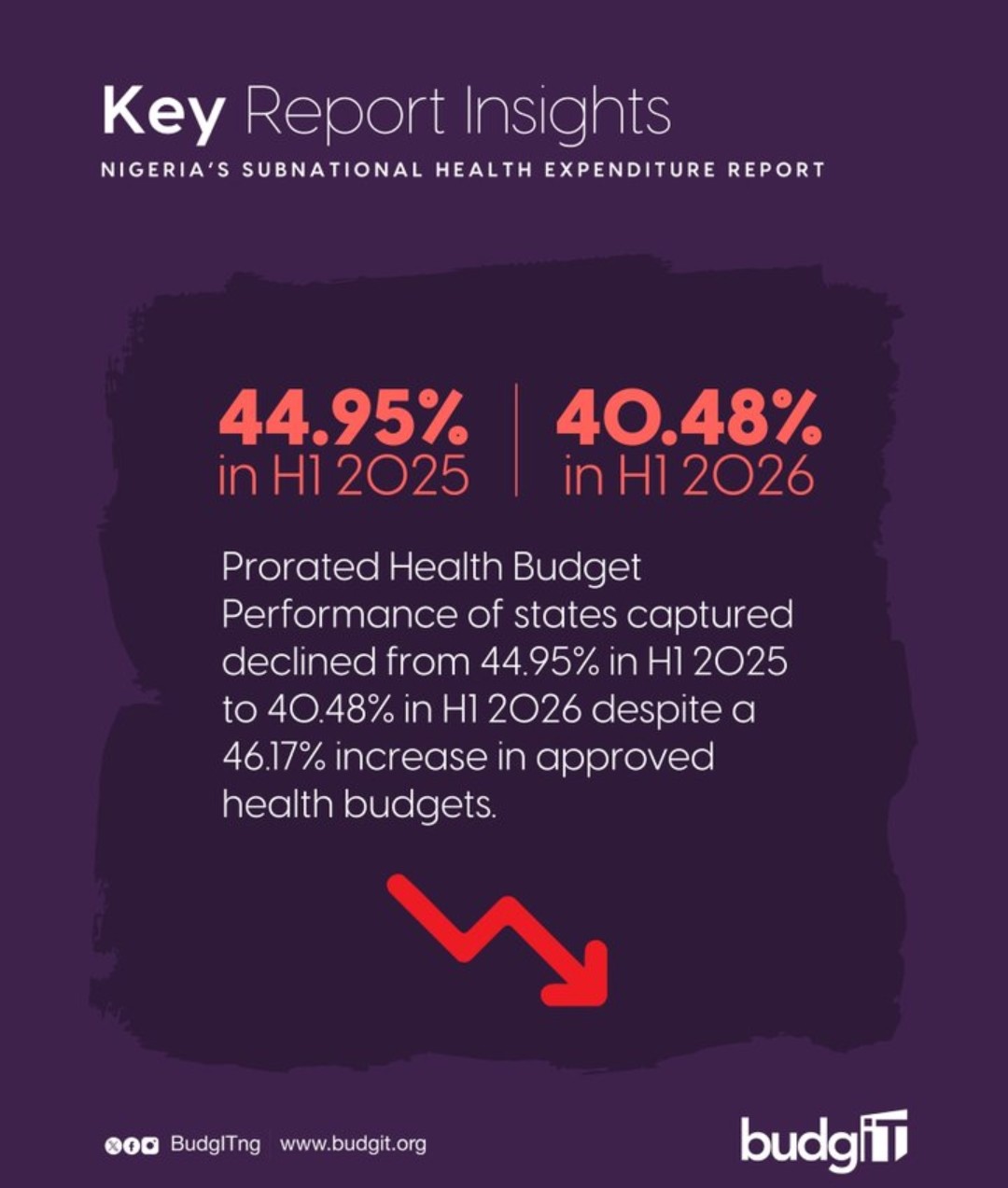
However, the increase in actual expenditure has failed to match the growth in approved health budgets, with budget performance declining from 44.95 per cent in the first half of 2025 to 40.48 per cent in the corresponding period of 2026.
The development means that, although state governments approved 46.17 per cent more money for healthcare, their performance in translating the allocations into actual expenditure deteriorated by 4.47 percentage points.
The findings, contained in BudgIT’s Nigeria’s Subnational Health Expenditure Report, H1 2026, provide fresh evidence of the challenges confronting Nigeria’s healthcare system, where millions of citizens continue to struggle with inadequate medical facilities, rising treatment costs, shortages of healthcare professionals and limited access to essential services.
A closer examination of the figures also raises questions about the ability of state governments to convert increased fiscal resources into improved healthcare delivery.
Rising Budgets, Declining Performanc
The report’s figures reveal that Nigeria’s subnational governments are yet to demonstrate the level of budget execution required to address the country’s longstanding healthcare challenges.
Although the combined approved health budgets increased by 46.17 per cent, expenditure performance declined within the same period.
The 40.48 per cent performance recorded in H1 2026 represents expenditure against the prorated budget expected to have been implemented by the end of June.
In practical terms, this means that states achieved only about 40 kobo of every N1 expected to have been spent on healthcare by the halfway point of the year.
Consequently, approximately 59.52 per cent of the expected half-year expenditure had not been executed by the end of June.
While the N621.34bn spent represents a significant nominal increase over the previous year’s expenditure, the declining execution rate suggests that increasing budgetary provisions alone may not translate into improved healthcare services without effective implementation.
For citizens who depend on government-owned hospitals and primary healthcare centres, the critical question is not how much governments approve for healthcare but how much is actually released, spent and converted into functioning medical services.
Kano leads, Akwa Ibom records lowest expenditure
A breakdown of the state-level figures shows significant disparities in the priority governments attach to healthcare financing.
Kano State emerged as the only state to exceed the 15 per cent Abuja Declaration benchmark, committing 19.74 per cent of its total expenditure to healthcare during the period under review.
The Abuja Declaration, adopted by African leaders in 2001, committed signatory countries to allocating at least 15 per cent of their annual budgets to improving healthcare.
However, the performance of other states raises questions about the extent to which governments are prioritising the health needs of their populations.
Akwa Ibom State recorded the lowest health expenditure, spending just N388.92m during the first six months of 2026.
The figure is particularly concerning given the substantial financial requirements of maintaining public hospitals, equipping primary healthcare centres, providing essential medicines and sustaining healthcare personnel.
Meanwhile, Rivers and Osun states had no available H1 2026 health expenditure data at the time of BudgIT’s assessment.
The absence of expenditure information from the two states represents another accountability concern, as citizens cannot effectively scrutinise government performance when relevant financial records are unavailable.
The report assessed 34 states, meaning its findings should not be interpreted as a complete expenditure picture covering all 36 states and the Federal Capital Territory.
Healthcare crisis beyond budget figures
The latest findings come against the backdrop of persistent weaknesses in Nigeria’s healthcare system, where access to quality medical services remains a major challenge for millions of households.
A 2025 Nigeria Health Systems and Services Profile published through the African Health Observatory Platform, involving the World Health Organisation and African partners, identified inadequate infrastructure, insufficient health personnel and poor financial protection as major obstacles to achieving universal health coverage.
The assessment put Nigeria’s Universal Health Coverage service coverage index at 38.4 per cent, while out-of-pocket payments accounted for approximately 75 per cent of total health expenditure.
This means that households continue to shoulder a substantial proportion of healthcare costs directly, exposing many families to financial hardship whenever they require medical attention.
For low-income households, the consequences can be severe, particularly when patients must pay for consultations, laboratory investigations, medicines, surgery and other essential services.
The situation is further compounded by the rising cost of medicines, medical equipment and healthcare delivery, making treatment increasingly unaffordable for vulnerable Nigerians.
According to the WHO-linked assessment, inadequate financial protection remains a significant obstacle to universal health coverage, while weaknesses in infrastructure and human resources continue to limit access to essential services.
These challenges underline the importance of effective public investment, particularly at the primary healthcare level, where most preventable diseases and basic medical conditions should be managed.
Primary healthcare centres under pressure
One of the major implications of poor health budget execution is its potential effect on primary healthcare delivery.
Primary healthcare centres are expected to serve as the first point of contact for millions of Nigerians, particularly residents of rural communities and underserved settlements.
They provide essential services, including antenatal care, immunisation, maternal and child healthcare, malaria treatment, family planning, health education and early disease detection.
However, inadequate infrastructure, insufficient personnel, poor equipment, unreliable electricity and shortages of essential medicines continue to undermine service delivery in many public facilities.
Where governments fail to implement approved healthcare budgets effectively, the consequences may include delayed facility rehabilitation, incomplete projects, inadequate medical supplies and poor working conditions for healthcare workers.
The result is often increased pressure on secondary and tertiary hospitals, even for conditions that should ordinarily be managed at primary healthcare facilities.
It also contributes to avoidable referrals, overcrowding and increased financial burdens on patients.
The Federal Government’s Basic Health Care Provision Fund is one of the major interventions designed to strengthen primary healthcare financing, expand access to essential services and reduce out-of-pocket expenditure.
Its official portal reports that more than 8,309 primary healthcare facilities have received direct funding through the programme, while 1,296 facilities have been revitalised nationwide.
However, the existence of such interventions does not remove the responsibility of state governments to provide adequate counterpart funding, strengthen facilities and ensure that allocated resources translate into measurable improvements in healthcare delivery.
Abuja Declaration: A commitment still largely unmet
The Kano State performance also brings renewed attention to the Abuja Declaration and Nigeria’s longstanding failure to meet the 15 per cent health expenditure benchmark.
Although the declaration was adopted more than two decades ago, Nigeria continues to struggle with prioritising healthcare financing at both federal and subnational level.
A January 2026 analysis by Premium Times of the Federal Government’s proposed 2026 budget reported that N2.48tn was earmarked for healthcare out of a proposed N58.47tn expenditure, representing approximately 4.2 per cent.
This remains substantially below the 15 per cent benchmark.
The implication is that Nigeria’s healthcare funding challenge is not restricted to state governments but reflects a broader national problem involving competing expenditure priorities, weak implementation and inadequate investment in essential health services.
With a rapidly growing population and increasing demand for medical services, the consequences of persistent underfunding are becoming more pronounced.
The country also continues to contend with the loss of experienced medical professionals to foreign countries, placing additional pressure on the remaining workforce and the facilities expected to serve millions of people.
Without sustained investment in healthcare personnel, infrastructure, equipment, research and preventive medicine, increasing budgetary allocations may produce limited improvements in health outcomes.
What the figures mean for ordinary Nigerians
For an average Nigerian, the implications of poor healthcare financing extend beyond government accounting records.
A pregnant woman in a rural community who cannot access an adequately equipped health centre, a child who requires routine immunisation, a patient who cannot afford prescribed medication and a family forced to sell assets to pay hospital bills are among those affected by weaknesses in public healthcare delivery.
When public hospitals lack essential medicines and equipment, patients are often compelled to seek alternatives in private facilities, where treatment costs may be beyond their financial capacity.
The situation creates a cycle in which poverty limits access to healthcare, while illness further deepens household poverty.
The World Health Organisation’s assessment of Nigeria’s health financing system has similarly highlighted the danger of excessive out-of-pocket expenditure, particularly for vulnerable populations.
It is therefore insufficient for governments to announce increased health budgets without demonstrating how the money is improving access, affordability and the quality of medical services.
Accountability questions for state governments
Beyond the aggregate expenditure figures, BudgIT’s findings raise important questions about how state governments plan, release and implement their healthcare budgets.
Why did health budget performance decline despite a substantial increase in approved allocations?
How much of the N621.34bn spent went into primary healthcare, maternal and child health, essential medicines, medical equipment and healthcare infrastructure?
Which states released their approved funds on schedule, and which recorded delays in implementation?
How many primary healthcare centres were renovated, equipped or provided with essential medicines during the period?
How much was spent on healthcare personnel, and what measures were taken to address shortages of doctors, nurses, midwives and other health professionals?
The absence of H1 2026 expenditure data from Rivers and Osun also raises questions about transparency and the responsibility of state governments to make budget implementation records accessible to citizens.
For the figures to translate into meaningful accountability, governments must go beyond publishing budget documents and provide verifiable evidence of completed projects, actual payments, functioning facilities and improved service delivery.
Civil society organisations, journalists and community-based monitoring groups also have a responsibility to track projects and compare reported expenditure with conditions on the ground.
The way forward
The latest BudgIT assessment underscores the need for state governments to move beyond budget announcements and demonstrate measurable commitment to improving healthcare delivery.
Governments must strengthen budget planning, ensure timely releases, improve procurement processes and prioritise investments that directly address the needs of underserved communities.
There is also a need to increase funding for primary healthcare, improve working conditions for medical personnel, strengthen health insurance schemes and reduce the financial burden on households.
More importantly, state governments must publish timely and accessible budget implementation reports to enable citizens to monitor public expenditure and demand explanations where allocations are not implemented.
Healthcare financing should not be treated merely as an annual budgetary exercise but as a fundamental responsibility of government towards the protection of human life.
Ultimately, a government that cannot guarantee its citizens reasonable access to basic healthcare risks failing one of its most fundamental responsibilities.
The N621.34bn spent by states in the first half of 2026 may represent an increase in financial commitment on paper, but the declining budget performance raises a more pressing question: Are Nigerian governments spending enough of the money they approve to keep their citizens healthy and alive?
 '
 '
Do you want to share a story with us? Do you want to advertise with us? Do you need publicity for a product, service, or event? Contact us on WhatsApp +2348183319097 Email: platformtimes@gmail.com
We are committed to impactful investigative journalism for human interest and social justice. Your donation will help us tell more stories. Kindly donate any amount HERE
 '
