

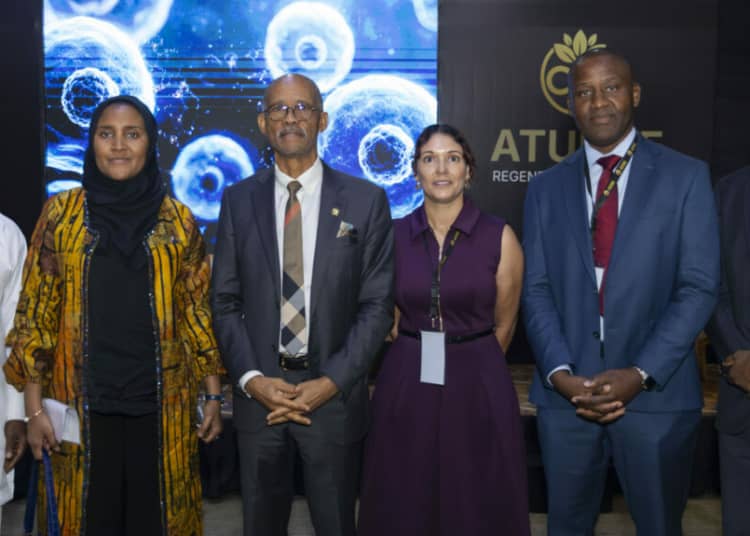
A new United States-Nigeria healthcare partnership has been launched in Lagos with a mandate to expand access to advanced medical treatment in Nigeria and reduce the country’s dependence on overseas healthcare.
The initiative, Atunse Healthcare Limited, is a partnership between KweHealth, LLC of the United States and Tri-State Healthcare System of Nigeria.
The company says it will focus on regenerative medicine, advanced treatment, local clinical capacity and healthcare manufacturing as part of efforts to strengthen Nigeria’s health sector and retain more healthcare spending within the country.
The initiative comes amid continuing concern over medical tourism and the country’s dependence on imported medicines, vaccines, medical technologies and specialist healthcare services.
At the launch in Lagos, the President and Chairman of Atunse Healthcare, Prof. Kamar Adeleke, said the partnership was designed to combine international scientific and manufacturing expertise with Nigerian clinical and institutional capacity.
Adeleke said KweHealth would provide the scientific and manufacturing platform, while Tri-State Healthcare System would contribute clinical delivery and institutional expertise.
He stressed that Atunse Healthcare was Nigerian-domiciled and Nigerian-based, adding that its objective was to help develop an ecosystem capable of delivering sophisticated medical care locally.
According to him, the challenge goes beyond the money Nigerians spend seeking treatment abroad.
He said the dependence on imported healthcare products also exposed Nigeria to vulnerabilities in global supply chains.
Adeleke cited estimates that Nigeria lost about $2.39bn to medical tourism in 2024, but available reporting on Central Bank of Nigeria foreign-exchange data has put 2024 spending on foreign healthcare-related services at approximately $2.39m.
The larger $2.39bn estimate has separately been attributed to health-sector commentators and should therefore be treated as an estimate rather than an official CBN figure.
He said the bigger concern was that Nigerians who could not afford to travel abroad were also affected when advanced treatment was unavailable domestically.
Adeleke further argued that Africa’s dependence on imported medicines and vaccines remained a major weakness that required urgent investment in local production, research and human capital.
Also speaking at the event, the Group Executive Director, Commercial Operations, Oil & Gas, Dangote Industries, Fatima Aliko Dangote, who represented the Group President and Chief Executive Officer of Dangote Group, Aliko Dangote, described healthcare capacity as a strategic national priority.
She said a country capable of preventing, detecting and treating diseases effectively would be better positioned to grow its economy, protect its workforce, retain skilled professionals and attract investment.
Dangote said the COVID-19 pandemic had demonstrated the dangers of excessive dependence on external sources for critical health supplies and expertise.
She urged Nigeria to strengthen its healthcare infrastructure, domestic manufacturing capacity and human resources to reduce vulnerabilities during future health emergencies.
Her position reflects a wider challenge confronting Nigeria’s health system: attracting and retaining skilled professionals while creating the infrastructure, equipment and financing required for advanced care.
The Lagos State Commissioner for Health, Prof. Akin Abayomi, who represented Governor Babajide Sanwo-Olu, said regenerative medicine could become an important frontier for Nigeria’s healthcare sector.
Abayomi said Lagos would need to develop the scientific expertise, institutions and human resources required to participate meaningfully in the emerging field.
He said Nigeria still faced a substantial shortage of healthcare professionals and institutions capable of supporting sophisticated medical interventions.
“We have a huge gap in our health workforce. We must train more people, we have to build the institutions and, where there are gaps, we have to find ways to bring expertise back into the country,” he said.
The commissioner’s comments also highlight the human-capital dimension of Nigeria’s medical-tourism challenge, as the country continues to grapple with the loss of health professionals to overseas opportunities.
The National Agency for Food and Drug Administration and Control also signalled that innovation in regenerative medicine would have to be matched by rigorous regulation.
Representing the NAFDAC Director-General, Prof. Mojisola Adeyeye, the Director of Vaccines, Biologics and Medical Devices Registration Directorate, Mrs Khadijah Ade-Abolade, said the agency had adjusted its regulatory framework to accommodate emerging areas of medicine.
She said NAFDAC was prepared to support innovation but would insist on safety, quality and scientific evidence before new biologics and regenerative medicine products could be introduced into the Nigerian market.
Ade-Abolade said developers would be expected to provide clinical evidence relevant to African populations, comply with manufacturing standards and maintain effective post-market surveillance.
She also said NAFDAC was supporting Federal Government efforts to revive local vaccine manufacturing.
NAFDAC’s existing regulatory guidance makes clear that vaccines and other biological medicinal products must meet registration and quality requirements before manufacture, importation, sale or distribution in Nigeria.
The speakers agreed that reducing medical tourism would require more than opening new hospitals.
They identified medical research, local pharmaceutical and vaccine manufacturing, modern diagnostic facilities, specialist training, healthcare infrastructure, regulatory capacity and sustained investment as essential components of a stronger health system.
That assessment is consistent with recent research identifying high capital costs, weak infrastructure, human-resource gaps and brain drain among the major obstacles to developing local vaccine manufacturing capacity in Nigeria.
For Nigeria, the challenge is therefore not simply to persuade citizens to stop travelling abroad for treatment.
The more fundamental task is to create a healthcare system in which patients can obtain safe, affordable and internationally credible specialist care at home.
If Atunse Healthcare succeeds in combining technology transfer with genuine Nigerian skills development, clinical research and manufacturing capacity, the initiative could become part of that broader transition.
But experts say such partnerships will have to be measured not merely by the number of facilities established, but by the quality of treatment delivered, professionals trained, technologies transferred, products manufactured locally and patients who no longer need to leave Nigeria to access advanced care.
 '
' '
'Do you want to share a story with us? Do you want to advertise with us? Do you need publicity for a product, service, or event? Contact us on WhatsApp +2348183319097 Email: platformtimes@gmail.com
We are committed to impactful investigative journalism for human interest and social justice. Your donation will help us tell more stories. Kindly donate any amount HERE
 '
'