

Daud Olatunji
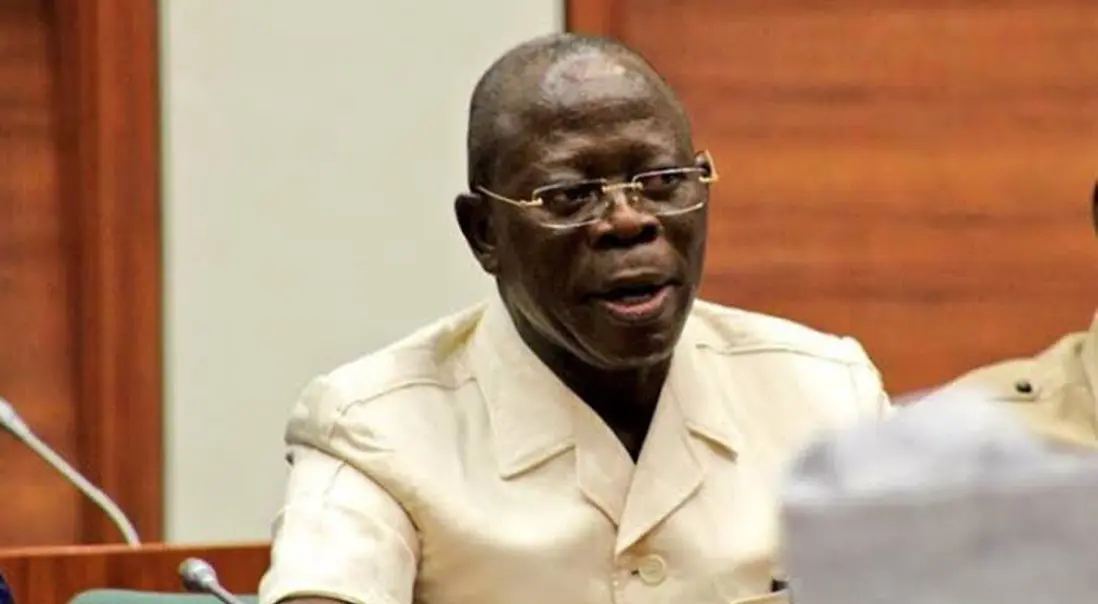
Former President of the Nigeria Labour Congress, Adams Oshiomhole, has recalled how he mobilised residents of Ogun State, including prominent figures, to protest the removal of petrol subsidy during the administration of former President Olusegun Obasanjo.
Oshiomhole, now the Senator representing Edo North, said he led the mobilisation because he believed the Obasanjo administration lacked the capacity and infrastructure to ensure that the benefits of subsidy removal reached ordinary Nigerians.
He made the disclosure on Sunday at the seventh national discourse organised by The Companion, an association of Muslim men in business and the professions, at the University of Lagos.
The discourse, themed, “Nigeria’s Political Landscape and The Ethno-Religious Divides,” was chaired by former Kano State Governor, Ibrahim Shekarau, while the Lagos State Deputy Governor, Obafemi Hamzat, was the special guest of honour.
Oshiomhole, who was NLC president during Obasanjo’s administration between 1999 and 2007, recalled travelling to Abeokuta to mobilise Ogun residents against the proposed policy.
He specifically mentioned Afolabi Salisu, Chairman of the Senate Committee on ICT and Cyber Security, as one of those he mobilised to canvass opposition to the subsidy removal.
According to him, his objection was not necessarily against removing subsidy but against doing so without putting mechanisms in place to ensure that the savings were equitably distributed.
“He has the capacity to take, but he doesn’t have the enabling capacity to distribute it because certain infrastructure you need for such distribution are absent,” Oshiomhole said.
He added that the mobilisation eventually spread beyond Ogun State, with workers and students at the University of Lagos joining the protests.
“To prove this to the people, I got Ogun people, including Afolabi, to go on strike against Obasanjo. When we organised those protests, even the University of Lagos workers and the students joined us,” he said.
Oshiomhole said some Nigerians who criticised his opposition to subsidy removal at the time had now become vocal about the consequences of rising petrol prices.
He, however, said he had moved on from the argument.
“Now, everybody is saying, ‘I can’t pay N100,000 for one litre, how much is my salary?’ I have seen those who used to lecture me about wastage, diversion, better deployment of resources, I have seen them now speaking my language,” he said.
The senator’s comments come amid renewed national debate over the economic consequences of the petrol subsidy removal by the President Bola Tinubu administration and the management of the savings generated from the policy.
Finance Minister and Coordinating Minister of the Economy, Wale Edun, had disclosed that subsidy removal mobilised N15.8tn in resources for the federation between June 2023 and December 2025.
The development has triggered competing arguments among political actors over whether the policy should be retained, reversed or accompanied by stronger mechanisms for accountability and redistribution.
Speaking on the theme of the conference, Oshiomhole also argued that ethnicity should have no place in Nigeria’s democratic politics, insisting that poverty and deprivation affect citizens across ethnic and religious divides.
He said Nigerians should compete for political power based on ideas, competence and values rather than ethnic identity.
“In rejecting feudal rulership and opting for democracy, ethnicity should have no place, because the poor man from the West, North and South all have the same federal character,” he said.
“There is no difference between the hunger in the Yoruba man’s stomach and that of the one in Urhobo or in Auchi.”
The former Edo governor argued that ethnic groups were not homogeneous, noting that every community had people who could be described as oppressors and the oppressed.
“In my view, there is no such thing as ethnic right because within every ethnic group, you have the oppressor and the oppressed. You have the good, the bad and the ugly. And you also have people of diverse religions. It is so in the North and South,” he said.
Oshiomhole maintained that democracy should protect and expand the rights of individuals rather than promote privileges based on ethnic identity.
He accused some ethnic and religious leaders of exploiting identity politics to gain political advantage.
“But ethnic champions and religious elites manipulate ethnic privileges to provide a false basis for electioneering and means to acquire power,” he said.
He called for a political system where Nigerians would be judged by their ideas, values and capacity to deliver rather than their ethnic or geographical origins.
“My summary is this: we own Nigeria. The challenge we have now is how to demystify the ethnic thing, remove that shield, let everybody bear his father’s name. Let’s compete for power not on the basis of where you come but on the basis of the ideas and values you bring. That way, we will build a united country,” Oshiomhole said.
 '
' '
'Do you want to share a story with us? Do you want to advertise with us? Do you need publicity for a product, service, or event? Contact us on WhatsApp +2348183319097 Email: platformtimes@gmail.com
We are committed to impactful investigative journalism for human interest and social justice. Your donation will help us tell more stories. Kindly donate any amount HERE
 '
'